The Kings of Gondor: Part 10 – The Rise of the Stewards

Welcome back, fellow hobbits and denizens of Middle-earth! It’s been quite a journey since I last delved into the lore of the Kings of Gondor. After a lengthy hiatus and precious time spent with family, I’m thrilled to return to this series and pick up where we left off. The tales of Gondor’s regal lineage have been patiently waiting, and I’m eager to continue exploring their rich history and significance. So, get ready to embark on this renewed adventure with me as we dive back into the annals of Gondor and unearth the stories that have been on hold for too long. Here’s to resuming our quest and many more stories to come!

Rise of the Stewards

With the tragic disappearance of King Eärnur and the end of the direct line of Anárion, Gondor faced an uncertain future. This momentous transition saw the governance of the realm passed to the Stewards, who would rule in the absence of a king. Their stewardship, marked by dedication and resilience, preserved the kingdom through some of its darkest times. In this installment, we explore the early period of the Stewards, focusing on their significant contributions and challenges.

Mardil Voronwë: The First Ruling Steward

Mardil Voronwë, known as “the Good Steward,” was the first to assume control following the loss of Eärnur. Appointed as the Steward by King Eärnil II, Mardil served loyally and diligently. Upon Eärnur’s mysterious disappearance during his ill-fated challenge to the Witch-king of Angmar, Mardil took up the mantle of leadership. His tenure set a high standard for those who followed, emphasizing duty, wisdom, and unwavering loyalty to Gondor.

Mardil’s administration was characterized by his efforts to maintain stability and order. He fortified the defenses of Minas Tirith, ensuring the city could withstand any threats from Mordor or other adversaries. His prudent governance and effective military strategies laid the groundwork for the Stewards’ rule, demonstrating their capability to lead Gondor through turbulent times.

The Stewardship Continues: Cirion and the Oath of Eorl

One of the most notable Stewards in the early period was Cirion. His reign was marked by a pivotal alliance with the Éothéod, a significant move that would shape the future of Gondor. Facing the imminent threat of the Balchoth, Cirion sought the aid of Eorl the Young, leader of the Éothéod. This alliance was solidified through the Oath of Eorl, a momentous pact forged during the Battle of the Field of Celebrant.

Eorl’s swift response to Cirion’s call for help resulted in a decisive victory over the Balchoth. In gratitude, Cirion granted the lands of Calenardhon to the Éothéod, who established the kingdom of Rohan. This alliance was not just a military necessity but a lasting bond of mutual respect and support that endured for centuries, playing a crucial role in the defense of Middle-earth during the War of the Ring.

Beren and the Replanting of the White Tree

Beren, another significant Steward, ruled during a time of recovery and hope. His tenure saw the replanting of the White Tree of Gondor, a powerful symbol of resilience and continuity. The White Tree descended from Nimloth of Númenor and Telperion of Valinor, represented the enduring spirit of Gondor and its connection to the ancient and noble heritage of the Dúnedain.

Beren’s diplomatic efforts were equally noteworthy. He worked tirelessly to strengthen alliances with neighboring realms, particularly Rohan, ensuring that Gondor remained well-defended and supported. His reign exemplified the Stewards’ role in not just maintaining the kingdom but also nurturing its growth and unity.

Denethor II: The Last Ruling Steward

The stewardship reached its zenith and nadir under Denethor II, whose rule was marked by brilliance and despair. Denethor was a complex figure, driven by a fierce dedication to Gondor but also haunted by the shadow of Mordor. His use of the Palantír, a seeing-stone that allowed him to communicate and spy at great distances, led to his gradual descent into madness, as Sauron’s deceptions took their toll on his mind.

Denethor’s tenure was defined by the War of the Ring, a period of immense strife and heroism. His sons, Boromir and Faramir, played crucial roles in the defense of Gondor. Boromir’s valiant efforts in the Fellowship of the Ring and Faramir’s steadfast leadership in the defense of Osgiliath highlighted the strength and courage of Denethor’s line. Despite his flaws, Denethor’s commitment to Gondor’s defense was undeniable, and his efforts delayed Sauron’s advances until the return of the true king.

Conclusion

The period of the Stewards was one of perseverance and resilience. They held the kingdom together through wars, invasions, and internal strife. Their governance ensured that Gondor survived until the return of its king, a testament to their unwavering duty and the enduring strength of the realm. As we reflect on the legacy of the Stewards, we honor their role in maintaining the hope and future of Gondor, bridging the past with the promise of a brighter tomorrow.

I trust that you all have been savoring the journey through this series as much as I have enjoyed crafting and weaving it together. Though we approach the final chapters of our tale, there remain many more stories yet to be told. Thus, I entreat you to remain ever vigilant and keep watch upon these pages, for there is much more to unfold. Consider pledging your allegiance to our chronicle, that you might never miss a moment of our shared adventure.

Until next we meet, may your days be bright and your spirits high.

Farewell and well met!

Cheers,

Iogro Merrybelly

The Kings of Gondor: Part Nine – A Bloodline Lost

Welcome back fellow hobbits and people of Middle Earth! It’s been a very long time since I last wrote about the Kings of Gondor, but after a long break and much time away with family I felt it time to return and continue writing.  So, looking forward to continuing this series and many others just like it.

83600606The Unwise King

Earnur was the son of Earnil II. He like his father was a great warrior and became a great leader of armies before he became King.  His greatest victory was against Angmar in the Battle of Fornost, in which he defeated the Witch-king, whom he intended to slay had his steed not panicked in terror of the Witch-king’s darkness.  Earnur became King in TA 2043, and was challenged by the Witch-king of Angmar.  The King of the Ringwraiths, who then resided in Minas Morgul wanted this King of Gondor dead and gone.  Earnur, being quick to anger and wrath, would have accepted his challenge had the wise Steward Mardil Voronwe not held him back, and so the first challenge went unanswered.  Just seven years later a second challenge came, mocking Earnur, and the steward Mardil was not able to stop the King this time.  Ernur accepted the challenge, and after entering the gates of Minas Morgul with a small escort, Earnur was never heard from again.  The unwise King was thought to be dead, so his crown now rests upon his father’s tomb in the Hallows of Minas Tirith.

Prophecy_GlorfindelThe Battle of Fornost

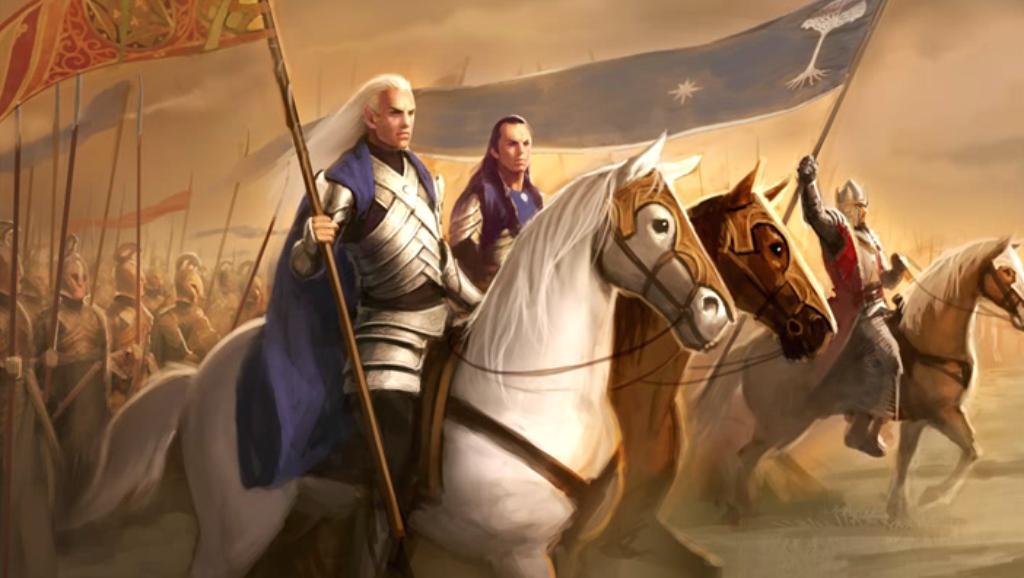
A year prior to the battle, the armies of Angmar conquered Arthedain, the last realm of Arnor. Angmar’s armies had taken Fornost, the capital of the Dunedain, and Arvedui, the last King of Arnor, had drowned in the Ice-Bay of Forochel. A year later, a fleet of ships under King Earnur arrived in the Grey Havens and set off toward what was left of the once-great northern kingdom. With the armies of Gondor came men from Rhovanion, elves from Lindon, and the remainder of the Dunedain (among them Aranarth, the Prince of Arthedain).

The battle itself did not take place in the city of Fornost, but on the plains to the west of the city, near Lake Evendim. The armies of Angmar hurried west to meet the assault, and seeing this, the cavalry of Gondor rode north into the Hills of Evendim to wait in ambush. As the main part of the army of Gondor met the enemy in battle, the Gondor cavalry set out from the hills to strike the rear of the army of Angmar. This served as the turning point in the battle, and allowed the combined armies of the west to gain the advantage. Realizing that his forces were all but completely destroyed, the Witch-king of Angmar fled eastward. As he fled, an army led by Glorfindel came up out of the south and blocked his escape, destroying what was left of his crumbling army; the Witch-king himself was able to escape during the night and fled southward. Though the battle itself had been lost and Angmar utterly destroyed, Sauron was extremely pleased with the Witch-King’s work, for the destruction of the northern kingdoms of the Dunedain was a victory for the Dark Powers which far exceeded the loss of the Witch-King’s realm.

Glorfindel,_Elrond_and_King_Earnur_unite_against_the_Witch-King_of_AngmarA Broken Bloodline

The Line of Anarion was broken with the disappearance of Earnur, and the rule of Gondor passed to the Stewards beginning with Mardil Voronwe, the Steward who had tried to restrain Earnur from going to Minas Morgul to face the Witch-king. The Stewards were to rule “until the King returns” for it wasn’t sure at first whether Earnur had been killed dueling with the Witch-king or not. In addition, Earnur left without naming an heir, and while many nobles in Gondor could lay some sort of claim to the kingship, those claims were generally held in doubt, and no one wanted to risk another civil war like the one that had devastated and weakened Gondor.

The Stewards of Gondor were firstly the chief high councilors to the Kings of Gondor and then the rulers of Gondor, until the return of the rightful king (Aragorn Elessar).

First created by the powerful King Romendacil I, Steward was the traditional title of a chief counselor to the Kings of Gondor.  The Quenya name for the title is Arandur , “Servant of the King”.  The steward was was usually an elderly man not from the Royal House chosen for his wisdom and integrity, and was never permitted to go to war nor to go abroad.  During the time of the Steward Pelendur, from the famous House of Hurin, the title became hereditary, passing the station of counselor from father to son, much like the Kingship.

The House of Hurin was founded by one Hurin of Emyn Arnen, Steward to King Minardil, the twenty-fifth King of Gondor. They were of high Numenorean blood, but not descendants of Elendil in the ruling line.

After the death of King Earnur, who left no heir to the throne of Gondor, the Steward Mardil Voronwe became the first of the Ruling Stewards. Mardil was the first of the Stewards to administer Gondor, and his descendants did so for 25 generations.

The Stewards watched over the throne until it could be reclaimed by a true King of Gondor, an heir of Elendil. When asked by his son Boromir how long a time must pass before a Steward could become a King, if the King did not return, Denethor II replied, “Few years, maybe, in other places of less royalty … In Gondor ten thousand years would not suffice” (The Two Towers).

The Stewards never sat on the throne of the King; instead, they sat on a simple chair of black stone placed below it.

I hope you all are enjoying this series as it has been an absolute blast to write and put together!  We are nearing the end of the series but still have a lot more writing to do, so stay tuned to the site and think about following so you never miss one of my series.

You all stay awesome and I bid you a fine farewell!

Cheers,

Iogro Merrybelly


The Battle of the Gladden Fields

AnduinThe One Ring Lost

The Disaster of the Gladden Fields was a battle at the beginning of the Third Age, in which Isildur and a group of acompanying Dunedain were attached by a large group of Orcs as they were marching home after defeating Sauron. The king and his three eldest sons Elendur, Aratan, and Ciryon were all slain and the Ring of Power was lost in the River Anduin. Only three men survived this battle, Ohtar being one of them, an esquire of the kings which was able to save the shards of Narsil.

With the death of Isildur, it impacted both Gondor and Arnor as it left both kingdoms seperated and isolated.  Arnor wouldn’t be able to completely recover from this loss of it’s nobles and knights until the kingship of Aragorn in the Fourth Age. Most importantly, Isildur’s death prevented him from passing on the One Ring to the Keepers of the Three, which he had passed on to his brother Elendur to be his chief reason for visiting Elrond in Rivendell.

After the War of the Alliance, Isildur remained in Gondor for one year, taking back lost lands.  He sent a large part of Arnor’s armies back to Eriador through the Fords of Isen to Fornost.  After getting the affairs of the southern realm in order, he handed the South Kingdom over to Meneldil and marched to Rivendell. He chose to leave his wife and son at Rivendell, but also came for counsel from lord Elrond.

ae12The Battle Ground

The Dunedain traveled northwards from Lorien, marching along a path that led to Greenwood the Great where Thranduil ruled. They had to change routes due to the flooding of the Anduin, which led Isildur to take the road on the eastern banks of the river. Isildur’s party was flanked as the enemy used the steep cliffs overlooking the river.

The Dunedain sang cheerful songs but as the evening drew close they began to hear the orcs in the nearby forest. The first onslaught struck quickly so Isildur called for his esquire Ohtar to take the shards of Narsil back to Rivendell for safe keeping.  The second attack from the orcs brought down the Numenorians great defenses, and Elendur convinced Isildur to flee and cross the Anduin if he could and find safety back at Rivendell.

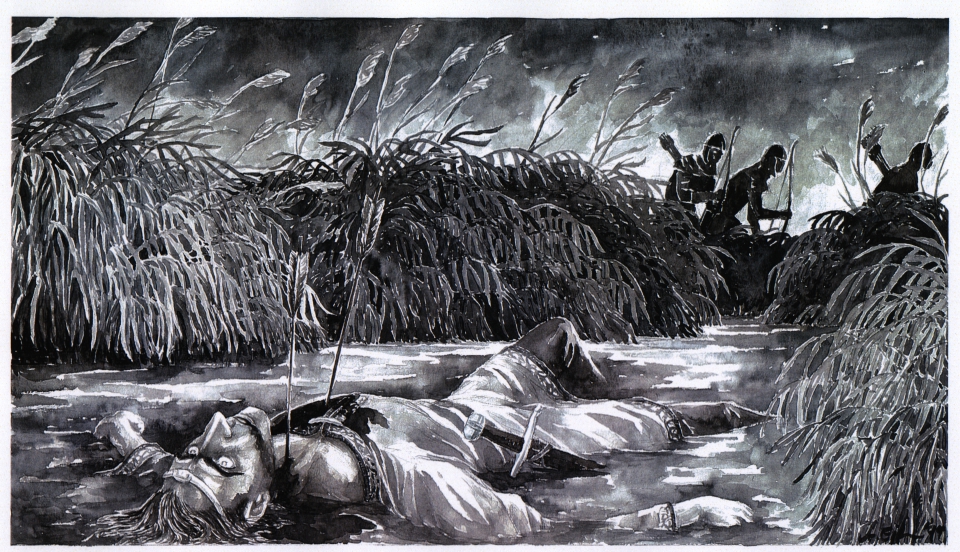
Isildur cloaked himself with the ring, and made a run for the valley parting ways with his armies and tried to cross the river. Unfortunately the rivers waters were flowing to hard and Isildur being exhausted got tangled in the reeds and in doing so the ring slipped from his finger. Nearby Orc’s caught sight of Isildur in the waters and out of fear quickly shot him and fled.

eiszmann42Wake of Destruction 

Only Ohtar, Elendur, Estelmo, and a handful of men survived the battle. Isildur’s body was never recovered, and was presumed captured and mutilated by Sauron’s forces  The orc army that ambushed the Dunedain were scattered among the lands by a relief force but they were to late.  Estelmo after being recovered spoke of how Isildur and Elendur related to each other about the One Ring. Isildur remarked: “I cannot use it. I dread the pain of touching it. And I have not yet found the strength to bend it to my will. It needs one greater than I know myself to be. My pride has fallen. It should go to the Keepers of the Three.”

Probably the biggest fall of the Gladden Fields was the union of Arnor and Gondor were broken by blood, and Isildur never managed to give the ring of power to the three.  Elrond, Galadriel, and Celeborn if given the chance probably would have destroyed the ring of power long before Sauron would have gathered his spirit and refortified Mordor.  But we all know how this story ends as Sauron does finally fall to the hands of many brave souls, and one very important little hobbit named Frodo.