 A Hobbits Home
In former times, Men were seldom seen there, though Dwarves often passed through the Shire as they travelled to the Blue Mountains from their lands in the East. More rarely still, Elves could sometimes be seen in the woods as they journeyed to Mithlond, the Grey Havens beyond the borders of the Shire, where they cross the Sea into the West. Dark things seldom threatened the hills and meadows of the Shire. Largely this has been because hobbits are very good at keeping to their own business and not being noticed by others. But Little Folkwould be aghast and unbelieving if they only knew the lengths to which Gandalf the Grey and the Rangers of the North have gone to ensure the country’s peace. Now, though, even the Shire cannot escape the notice of the Shadow in the East.
The Lore
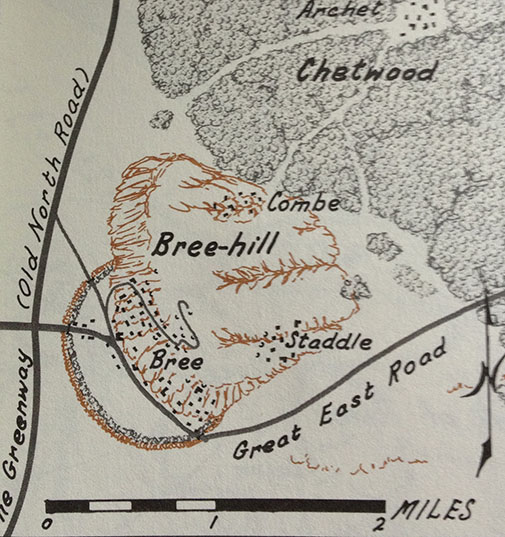
In the year 1601 of the Third Age, the Fallohide brothers Marcho and Blanco lead a group of Hobbits west from Bree and crossed the Bridge of Stonebows (later known as the Brandywine Bridge) and settled in the empty land they found. This became year 1 of the Shire-reckoning. King Argeleb II, the tenth King of Arthedain and a direct ancestor of Aragorn, granted the Hobbits this unused land and thus it became The Shire.
In III 2340 Hobbits expanded the Shire to include also Buckland and Brandy Hall was founded, though Buckland was never considered part of “the four farthings of the Shire”. Little is told about the history of the Shire, except for genealogical details about families, such as the Baggins, Brandybucks, Tooks, and many more. However…
In 22 September III 2890 Bilbo Baggins was born, and a few decades later his adventures would bring focus on the Shire. A fateful morning III 2941 an old bearded man with a blue pointed hat approached Bilbo and soon the Quest of Erebor begun, chiefly taking place in the far East. Eventually Bilbo brought back to Bag End treasures that greatly enriched hobbits all around the Shire, but one of the smaller items, a modest ring would also prove extremely hazardous, though not at once. In III 3001 Bilbo leaves the Shire and settles down in Rivendell, after giving the One Ring to Frodo.
 In III 3017 Gollum (the former owner of the One Ring) was released from Mordor, probably shortly after he had revealed “Baggins” and “Shire” for Sauron. The Shire was still innocently unaware that the Dark Lord soon would begin the War of the Ring and their farthings were at stake. In early April III 3018 Gandalf tells Frodo about the One Ring and its powers and hazards, urging him to leave the Shire promptly, though Frodo hesitated, he was slow and it took him more than five months to set out. In September 14 Frodo, Sam and Pippin set out from Bag End towards Crickhollow in Buckland (where Merry would join them on the quest).
The Shire was a fertile and well-tilled part of Arnor, but deserted during the waning days of the Kingdom when it was known as the splinter-realm of Arthedain; where the Shire was, it had been the hunting grounds of the King of Arnor. The Hobbits(who lived in Dunland and parts of depopulated Cardolan and Rhudaur) got official permission from King Argeleb II at Norbury (Fornost) to settle the lands. This was finally done in Third Age 1601 (Year 1 in Shire Reckoning) by Hobbits from Bree, led by the brothers Marcho and Blanco.
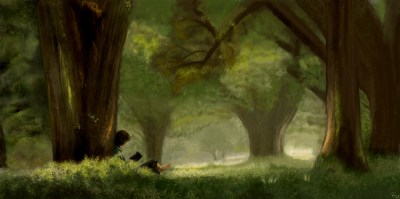 The Shire was the homeland of the Hobbits. It was located in the northwest of Middle-earth, in the region of Eriador and within the Kingdom of Arnor, that is, while the kingdom existed. By the Third Age it was one of the few heavily-populated areas left in Eriador. Its name in Westron was Sûza”Shire” or Sûzat “The Shire”. Contrary to popular misconception, The Shire was not the birthplace of Frodo Baggins. The Shire was settled by Hobbits in the year TA 1601 (Year 1 in Shire Reckoning). The Hobbits (who originally lived in the vale of Anduin) had migrated west over the Misty Mountains in the decades before, and before entering The Shire they had lived in Dunland and parts of the depopulated Arnorian splinter-realms Cardolan and Rhudaur. It has been speculated that the Hobbits had originally moved west to escape the evils of Mirkwood, and the trouble caused by the Easterlings. The Shire was a part of Arthedain, and as such a part of Arnor. The Hobbits were granted official permission from King Argeleb II at Norbury (Fornost) to settle the Shire, which was not populated at the time, and seen as the King’s hunting grounds. The Hobbits considered themselves to be subjects of the King, and sent some support troops to the great battles Arnor fought against The Witch-king of Angmar. Tales claim that some Hobbit bowmen were involved at the Battle of Fornost, although no tales of it exsist in Men records. After the fall of Arnor, the Shire remained a small but independent entity.
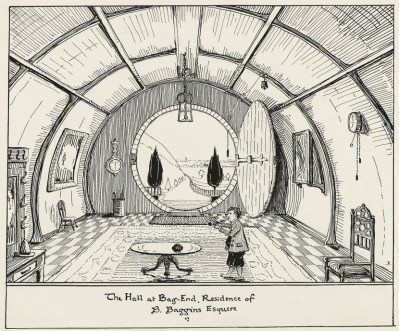 The Shire During the Third Age
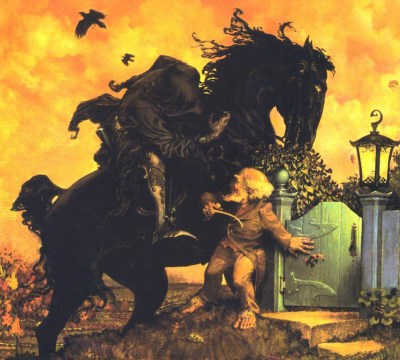
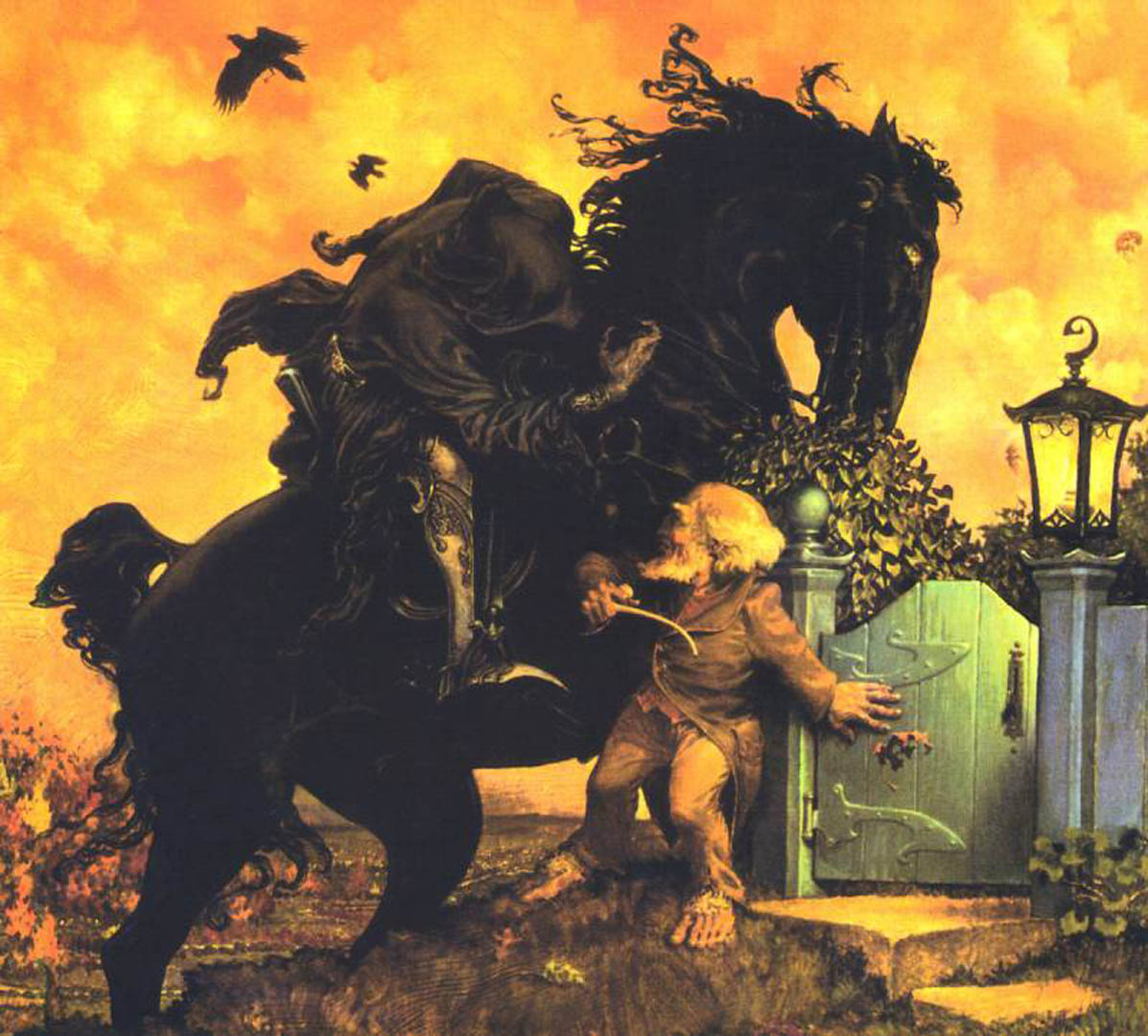
This peaceful situation changed after Bilbo Baggins’ acquisition of the One Ring in the year SR 1343 of the Shire Reckoning. Shortly after the first events that led to the War of the Ring (autumn of the year 1419 in Shire Reckoning), the Shire was first visited by the Nine Ringwraiths who went as far as Hobbiton, and then captured by Saruman. It was liberated with the help of Frodo, Sam, Merry and Pippin after the end of the Quest of the Ring. After Aragorn’s return as the King of Arnor and Gondor, the Shire became a protected enclave inside the Reunited Kingdom. He is known to have issued an order that forbade the entrance of full-sized Men into the Shire.
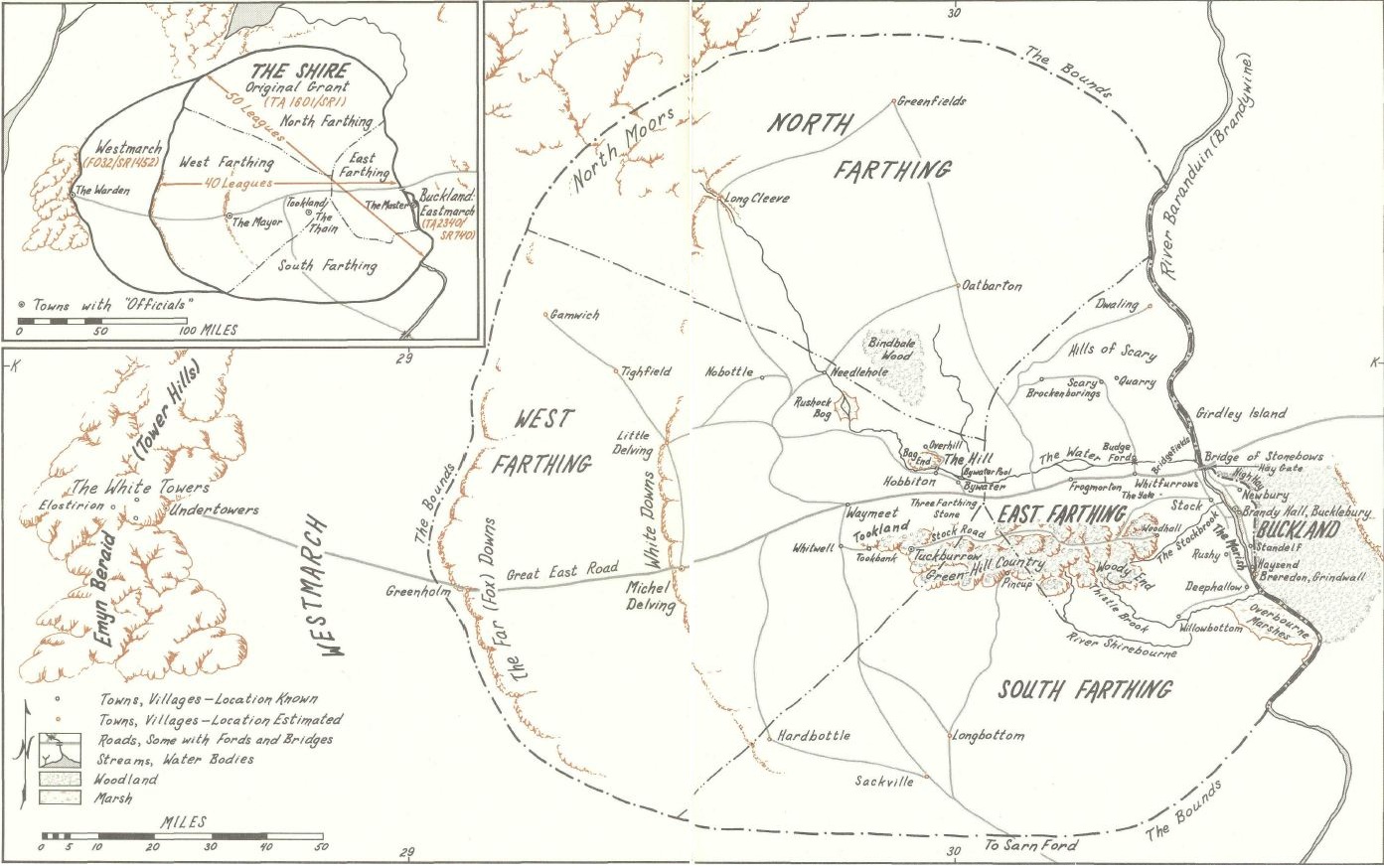
The Brandywine River (Baranduin) bound the Shire from the east. (Hobbits also lived in Buckland, which lay east of the river and west of the Hedge protecting the Shire from invasion from the Old Forest; however, Buckland was not formally recognised as part of The Shire until after the War of the Ring, when it was granted officially to The Shire by Aragorn II Elessar.) From the north and the west The Shire had no topographical borders, but rather was bounded by the ancient south and east roads, and by vague geographical features such as theTower Hills. The Shire was quite densely populated in parts with many villages and a few towns, but it still was open enough to allow for wide forested areas and marshes. The total amount of land calculated in square miles was 21,400 probably not including the Westmarch.
 The Shire was originally divided in four Farthings (Northfarthing, Southfarthing, Eastfarthing, and Westfarthing), but Buckland and later the Westmarch were added to it. Within the Farthings there were some smaller, unofficial divisions such as family lands; nearly all the Tooks lived in or near Tuckborough, for instance. In many cases a Hobbit’s last name indicates where their family came from: Samwise Gamgee’s last name derived from Gamwich, where the family originated. Outside the Farthings, Buckland itself was named for the Oldbucks (later Brandybucks). The Shire’s small size, relative lack of importance in terms of geographical position, natural resources, or even concerning hobbits themselves made it too modest an objective for conquest from the more dominant races of the East and South. More importantly, the Shire was guarded and protected by the Dúnedain Rangers, who patrolled the borders and kept out intruders, though Tolkien notes that many of the current hobbits of the Shire have grown so accustomed to this that they have forgotten their protectors altogether.
However the limited government of the Shire did hold its own voluntary police force known as Shirriffs that helped to keep the Shire safe, usually from trespassing beasts rather than from enemy forces. The only foreigners to enter the Shire were the Dwarves travelling on the Great Road that ran through the Shire to and from their mines in the Blue Mountains (Ered Luin), and the occasional elves on their way to the Grey Havens. Despite this, two battles were fought in the Shire, the Battle of Greenfields, and the Battle of Bywater. The Shire was also attacked by White Wolves in TA 2911 during the Fell Winter, prompting the use of the Horn-call of Buckland.
The Shire derived its laws from the authority of the King at Fornost. After Fornost fell and the last king died, the Hobbits appointed a Thain to continue the authority of the missing king. The title of Thain eventually passed to the head of the Took clan in Tuckborough. The Thain commanded an armed force during emergencies, but otherwise had only a symbolic role. The Mayor of Michel Delving, elected once every seven years, became the most important official in the Shire. Most hobbits regarded Michel Delving as the principal town of the Shire, particularly with regard to its government. The Mayor was also the Postmaster and the First Shirriff for the whole Shire, so some called him the Mayor of the Shire.
 The Shire was a small but beautiful and fruitful land, beloved by its inhabitants. The Hobbits had an extensive agricultural system in the Shire, but did not proceed with industrialization. Various supplies could be found in the Shire, including cereals, fruit, wood and pipe-weed (a favourite treat of Hobbits). Its relatively peaceful existence during the perilous period preceding the defeat of Sauron can be attributed to the vigilance ofGandalf and Rangers of the North led by Aragorn who used daring tactics to keep evil at bay. However when these set out to a distant war, the Shire became essentially defenceless, which led to its capture. But the damage which Saruman caused by forced industrialization was undone by the Hobbits’ efforts. The Shire was restored with soil from Lórien, given to Sam by Galadriel. The year SR 1420 was called The Great Year of Plenty and was considered by the inhabitants of the Shire to be the most productive and prosperous year in their history. The industrialization of the Shire was based on Tolkien’s witnessing of the extension of the Industrial Revolution to rural Warwickshire during his youth, and especially the deleterious consequences thereof. The rebellion of the hobbits and the restoration of the pre-industrial Shire may be interpreted as a prescription of voluntary simplicity as a remedy to the problems of modern society.
 The Great Port
 The Stronghold was Broken



 A Hobbits Journey