A Fantasy Writers Process

tumblr_static_tumblr_static_4eo5pzujbwcg8gws0gcc8oc0s_focused_v3.jpgIt’s hard to start writing a niche genre like fantasy when you’ve got the passion for it, but no idea where to start! Maybe you have an idea, but you’re afraid to take the first step because you’re afraid of failing. While the writing process is frustrating and yes, your story may not work out, but if you do your research and work hard, you will find yourself creating an unbelievable story with a world you can mold to your liking.  It’s going to take a lot of patience, will-power to push through tough areas, and learning a few tips along the way from fellow writers.

This is my “Where Do I Start List” on the most important parts of the writing process that I use all the time.  None of these steps are chiseled in stone by any means but these are all tips / tricks I’ve learned over the years….and taken the good advice of better writers who helped me along my journey.

1. Write down EVERY SINGLE IDEA you have!  When writing a novel it doesn’t matter how silly an idea may sound, you thought of it for a reason so write it down.  These ideas can always stem into another and cause creativity and imagination to be boosted.  Plus this is a great way to keep track of the “Idea Process” which is how you personally pop out ideas.

When writing ideas down it could be as simple as (random word here) or it could be a bit more complex and you take it a step further.  Try something like this below and see if it helps with creating new ideas.

  • “Maybe (insert random name here) came across a clue (insert random stuff here) and discovered a great secret.”
  • “Should (name) be a knight or a king, or just some (random person in the story?)”
  • Keep track of how you use ideas and organize them.  See my post on mind mapping a novel to get some ideas of what to use and how to use this method.

2. Look at the setting of a story first before anything.  If you are a fantasy writer like me, then I’m sure you’ve spent a good bit of time doing this already.  Remember this is your story and you can make it however you like, but it’s always a good thought to look at other writers and see what imaginative thing they’ve come up with.  Does your world rely on magic, or maybe it’s inspired by a real place and you’ve put a twist on it.  Depending on what you choose, your characters must reflect the cultures and upbringing in this world. My novel is set in a fictional world but still close to home with traces of European cultures with kings, queens, monsters, tall tales, and hero’s alike.

3. Character development is an absolute must!!!! Make sure you take your time and plot out each character…give them some love as I’ve seen to many times where a story could have been great but the characters were very underdeveloped and it ruined the story. Pay close attention to those minor characters in the book because they can become key to a great story.  Take a look at a post I did on writing minor characters.

4. Character Names have to tie into the cultures you use in the story.  Think about that for a second as this can go a lot of different ways.  Do you have a made up language like Tolkien, or maybe you’ve pulled from Greek mythology, or just classic names from different cultures.  Most of my book I’ve created comes from a European background with a lot of made up in between.

5. Make a timeline because this helps keep everything consistent throughout the story, especially if you use days/weeks/months in your story. This will also allow you to go into accurate detail about places, seasons, weather, people etc.  My book i’m currently working on, Brothers Three, ranges over the course of a 10 year period for the main story.  This story begins with the birth of three brothers who were separated at birth to disguise who they really were, but picks up when the boys are 10.  The story begins on a spring morning, so I made sure to describe the temperature and what the “Spring” season was like which also affected the terrains and landscapes of course. Always make sure to keep in mind the time of year and how long time has passed in your story so that it’s consistent. A timeline also helps with events leading up to your main story. Every major event in the story, whether it actually occurs during the present or not, should be recorded on the timeline. If something major happened to a character in the past, it should be recorded. If something major happens before a main character is born, record their birth-date on the timeline.  I don’t want to give any spoilers away for my book so I didn’t want to share my timeline but one day in future posts I hope to share that process.

6. Make an outline of your entire plot. Some people argue against this process as there are authors who just write great work as they go along, but in my opinion making an outline worked great for me.  Your timeline you created can help a great deal with creating the outline as you should be keeping track of all major plot points and how they roll across chapters, major / minor characters, minor plots, climaxes, etc.

7. Editing, Editing, Editing!  Once you’ve typed out your manuscript, edit it yourself into multiple drafts….Why? Because you don’t want to lose the thing for one, and you are going to butcher this thing when editing it.  I would take a few chapters at a time, print them out, and use a colored pen (I prefer red or blue) but any color you choose will work to cross out, change words, or fix punctuation. It definitely helped me to have a thesaurus and grammar book for quick reference as well.
These are the main points I like to use when writing and getting things ready to edit. Everyone is different and each has their own methods they will develop and enjoy to use. These are mine and I hope they might work for you on the writing journey.  Good luck to all of you with your own writing adventures!

Blogging Is A Journey

blog-typeBlogging is a great outlet for writers who want to grow and connect with an audience or just to have an outlet for something you enjoy…”Writing”!  This provides us a way to go in depth over a social media post, aka micro-blogging outlet like Twitter.  I’ve enjoyed blogging for years and it’s given me a place to hangout with others in my little corner of cyber-space.  If you’ve spent anytime at all blogging or writing, you know it can be tough and at times bring some stress with it.

Over the years I’ve learned by being burnt by fire and gleaming knowledge from others who were better writers than I was.  So here is my list of some tips I use that I hope will help you in your blogging journey.

 
1. You never know when a good blogging idea is going to pop up, so put those blog ideas down on paper, or keep a digital list of sorts.  I personally go old school and use a notebook for my blogging ideas along with sticky notes as I use different colors for different topics.  It may sound like madness but it works for me and helps keep me organized for my writing schedules.

2. If you have time and can do it, schedule posts throughout the week.  With my schedule a week or two out is all I can do but most of the time it’s 4-5 days out.  Keep a backlog of posts if you are trying to hit a specific count of posts per week or month that you can quickly choose from as well.

3. Find you some blogging friends that will allow you to do guest blogging, and or co-blogging as that’s a great way to market your content and grow each others sites.

4. Browse through images you want to use for your blog posts and keep a stock in a folder for future posts.  This will help with the last minute search for an image, though lately I’ve been making my own depending on the topic.  See what works best for you and your schedule.

5. Make yourself a list of items to check before you hit that publish button.

6. Break up your posts into multiple parts if they are running long. This will help keep the readers attention and also coming back for those additional parts.

7. Use those comment sections as it can be a gold mine.  Watch for questions and good topics for conversations and even potential notes for future posts.

8. Life happens and if you are like me well then blogging is a hobby, so don’t stress if you don’t make those post counts you wanted.  Best thing to shoot for is consistency but when you can’t don’t sweat it.  I try to post twice a week but that doesn’t always happen.

9. Don’t fret about reusing previous posts or topics either.  You don’t want to repost the same exact post you’ve already used, but when you are in a crunch rework an old one and use that thing.

10. Give yourself some grace. This is a journey full of learning and it’s going to be filled with mistakes, and curve balls so when you find that crazy typo or sentence that doesn’t make sense, don’t worry.  Learn from those mistakes and make this blogging journey fun and something you want to become better at.

These are my bread and butter items I use whether I’m writing a small blog post, or working on my novel series.  I would love to hear from you all on any thoughts or comments you have.  Would you all add anything to this list?

Writing Fantasy – Do’s & Dont’s

writing-a-bookFantasy is a fun genre of fiction that uses magic or other supernatural elements as a main plot element, theme, or setting. Many works within the genre take place in imaginary worlds where magic and magical creatures are common. Fantasy is generally set apart and crosses paths with science fiction and horror as they all three have sub-genres in the fiction world.
Fantasy is one of those genre’s made up of many creative things and frequently includes elements from the Middle Ages.  Most fantasy is adventure based, with a conflict between good and evil which is usually the common theme of plot.  When you here fantasy you probably think of things like wizards, elves, magic, etc…Fantasy is often based on myths, legends, and folklore, that could stem across multiple cultures.

If you’ve thrown around the idea of writing fantasy then here are a few things to do.  

  • Read a lot of fiction in the fantasy, science fiction, and horror genre’s. Soak up as much as you can about the way the books flow, plot layouts, structure, etc.
  • Do the real world research on any folklore, culture, and traditions those era’s had you want to pull into the book.
  • Ask questions, find writing mentors, learn new ways to bring an idea to the page.
  • If you are setting your story in medieval times or using elements from those times, research medieval life in the real world.
  • Plan your fantasy worlds before you start, figure out all the details you want the readers to know about.  This will help you during the writing process as it will become more natural and eliminate any doubt you might have on the topics.
  • Set limits for your world and hero / heroine of the world, as this creates obstacles within the story for readers to be evolved with and helps get to know the world.
  • Bring your fantasy to life with lots of detail.  Give the readers a chance to meet everyone in the book, and make them feel at home like they are actually in the world you are describing.

Here are a few things not to do when writing fantasy. 

  • Don’t disclose everything you know about the fantasy world you’ve made.  The planning you do up front is for you to make sure the story is told correctly, but that doesn’t mean that every detail you write needs to make it to the book.  All the prep you do up front will give the readers something real to look forward to and enjoy. Give the readers some play room with things that you know about the world but they don’t yet.  Let them come up with there own ideas and conclusions about a specific personality of a person, or maybe a place in the book.
  • Don’t break the rules of the world that you have planned.  This in a way will give the readers a false sense of reading and make them feel cheated like what your telling isn’t worth the time for them to read it anymore.
  • Don’t copy people, places, things from other fantasy authors.  Use your imagination to create this magical universe you want the readers to be a part of.
  • Don’t lose track of the story and where you are at with it. Map the book out, the ideas, and all the fun details you get throughout the days while prepping to write.  It’s fun to create worlds with magical tales to tell but don’t get so caught up with the tiny details that you forget to create the main plot of the story.
  • Don’t forget to save MULTIPLE copies of this story and the details, along with any planning materials you have along the way.  You don’t want to lose that work and not have a backup to revert to.

Mind Mapping a Novel

Writers-Block

Are you struggling to start your book?  I struggled with this idea for a long time before I dove into the deep end of the writing pool, and then when I dove in it was a bit overwhelming and at times felt I was drowning.

Many people don’t write books because they simply don’t know how to start.  They possess an idea for a book, but they don’t know what to do with it. They can’t imagine how they get from initial idea to finished manuscript which isn’t a small feat at all so don’t think I’m playing this down.

It wasn’t until I began using the “Brain Dump” method to get my ideas that were just floating around that space in my head, to the paper so I could have a visual.  Some call this mind mapping, but for me this is just an old fashioned Brain Dump.  Whatever you like to call it doesn’t really matter, just the methodology and way it’s used. Brain dumping will take you from a few grand book ideas, to a detailed book outline you can work from to make a manuscript.  This ultimately becomes the go to place for when you need a guide to take you from start to finish of this novel you’ve dived into.

It’s funny how our brains work as we have an analytical and creative side, so mapping those ideas out for a book when thinking about that can be tough.  Basically mind mapping allows you to bring the two sides of your brain together in one location so that all the thoughts and information are easily visual and accessible. Once you’ve learned how to wrangle those thoughts it’s time to take a look at the actual brain dump.  This is the point where the thought has to become a reality.  So….how do you make the brain dump happen?

Well multiple ways, but my favorites are using a large white board to map out my ideas and plot pieces of story together.  My journal is always a go to, though lately it’s littered with sticky notes from ideas I need to go back and form into the story section I need it in.  Another favorite is the sticky note and poster board which is always fun for me as you get to move the sticky notes around and write on the poster board as well.  Maybe this is a super writing nerd kinda thing, but this is very relaxing and enjoyable for me and that’s why i’m writing this post.  I’m hoping this sparks some ideas for you as well and lights a fire so you can get to moving on that great book idea you have.

Think of the brain like this and hopefully it will help you picture what needs to happen.

Brain Dump Process

  • Creative Right Brain is where the ideas flow from and all the magic happens.  The fun stuff clicks on this side of the brain.
  • Analytical Left Brain is where the organization of all that creative material you just dumped to the paper happens.  This is where the structure of the book comes from and where your – table of contents, and outline of the book will look like.

If you’ve lined everything out and keep a good record of the book and use this process then you can produce some very detailed information and great chapter outlines for your book.

Now let’s look back at the Sticky Notes and how they will help you map this book out. This is the easiest way to make a mind map of your book.

My Favorite Brain Dump Process:

  • Grab yourself a large poster board or poster boards, or even a large white board will work. Get yourself a big stack of sticky notes….multi colored is what I like to use as I color coordinate topics to specific colors.
  • Take a single sticky note in the middle of the poster board and write your topic on it, or a book title, just depending on what you are working on.
  • Write all the related topics you can think of on sticky notes and place them anywhere on the poster board.  Sounds like chaos I know, but don’t worry about where you place them , or  about organizing them, unless you are absolutely sure the topics relate to one another.
  • Fill the board with as many topics as you can possibly think of as this is the “Brain Dump” phase and when you think you’re done, look again as you will more than likely come up with more topics after taking a break, or a step back.
  • At this point I like to take a picture of the board for reference purposes in case I have to take a break or get pulled away for something.  They are called sticky notes, not permanently held in spot notes.
  • Ok now comes the organization of the topics.  The analytical side of the brain is ready to be worked right? Look for related topics. Pick up the notes and move them around. Take a close look at what you have grouped together as they just might become the chapters of your book. More than likely, this will be the groups with the most information lumped together.  Just remember this is your book and your board so move things around how you feel fits best, and don’t be afraid to break apart groups into multiple chapters if one is too large. Just make sure you use a different colored sticky note to mark that chapter and don’t forget to name the chapter.
  • Use each of the sticky notes you have grouped together under a chapter as a sub-topic that you want to write about in that chapter.  This is where the fun begins as writing guides and book maps are a must at this point.  Sub-plots of a story can make things confusing if you don’t.


Ok now get ready to write as it’s going to take a lot to get that story from your head to paper so what are you waiting for?  Sit down, start slow, think it out and enjoy the process of making that next best book anyone has ever read!

NBI 2016 Coming To A Close

1464077259935

As we come to a close on the Newbie Blogger Initiative “Lite” for this year I first and foremost want to give a big shout out to all our new bloggers who joined with us this year!!!!  This was a crazy month but I’ve seen some great stuff being posted from everyone so I tip my hat to you all and give you props for stepping out of the box and writing with us and say welcome to the gang.

List of our 2016 Recruits –

Go give them some love and likes as they publish some fantastic stuff!!!!

Vagrant Zero at Just East of West
Zyngor at Pleasant Gamer
EGrey at The Wild Core Chronicle
Kluwes at I’m Not Squishy
Shadowz at Shadowz Gaming Blog
A2Zeo at A to Zeo
Mingnon at Cookie Cutter Monks
Sparko Marco at SparkoMarcoGaming
Chordian at Chordian.net
Elio at Static Refresh

 
I also want to say thank you to all the supporters who have helped each year to keep this thing going. The troops rallied together this year and we did start a bit late, but this year has been a lot of fun and I’ve really enjoyed being a part of it.  NBI has a strong community of gamers, writers, and content creators who enjoy connecting and that is what makes this group fun and cheeky to be a part of.  As we come to a close for the NBI event, I leave you with this last tid bit for the months to come while you type away creating those blogging masterpieces.

Blogging with a schedule is tough but if you like to keep up the pace and continue to grow, you’ve probably developed a system for staying on track. Staying consistent is the key to a blogging schedule and what I use works for me so I hope it helps spark some ideas for you.

Before You Get the Wheels Turning 
Think consistency, consistency, consistency…. because blogging in a way is like exercise but for the brain and the hardest part is….STARTING the engine. Once you’ve kicked some momentum into gear…usually after a few cups of coffee, it’s probably not hard to get going. Just like exercise though it’s one of those things that at first you usually have to force yourself to do, but it becomes more natural over time.  Remember Consistency is key.

Do You Have a Planner? 
I’m an old fashioned kinda guy and go analog for writing things down when I plan. Whether it be in my Moleskine, or a sticky note that later goes in my Moleskin that is where most of my planning happens.  This becomes a reference point for me if I’m writing something that I can’t quite get to that day, or maybe it’s a larger piece I’m writing and want to keep track of where I’m at.  To me having something I can check off in a Moleskin is a great sense of achievement… you know… I just made a check mark by a task right.

Make That Schedule Happen
I’m a planner so I tend to know how many posts each week that I’ll be able to get out.  I on average blog twice to three times a week and usually publish about 6-8 posts a week.  Now, that varies depending on what I have going on but I’ve committed to blogging twice a week for sure.  This may be completely different for you…it may be once a month, once a day, or whatever you fancy.  Being a planner means I like to choose one day a week and plan out some posts in advance so that I have a constant feed to work on, which helps me from falling behind on my schedule. I only recommend scheduling for a week at a time because you probably won’t know the specifics of that week until the week before. By making your specific schedule for the following week on whatever day you choose, it gives you some flexibility in posting. If you end up with some free time and want to post more than what you schedule, well that’s just a bonus for the readers.


Remember this is just what works for me so you have to find what works best for you. Sometimes though it’s easier to use another idea instead of recreating the wheel.

I hope you’ve enjoyed all the content that has come out of our writers this year during the Newbie Blogger Initiative.  Go connect with them, and we will see you out in the digital community somewhere.

Sincerely,

Iogro Merrybelly

Newbie Blogger Initiative 2016 – Writing With Focus

1464077259935


Starting a blog is easy for the most part as the tools you can get now days makes the startup pretty seamless.  What isn’t so easy is staying focused while writing as it takes time, and time is the killer for most writers.  Either we don’t have enough of it, or we lose focus over a period of time and get frustrated with what we were trying to accomplish.  I’ve been down these paths quite a lot before but over the years it’s helped me learn how to stay focused, or at least narrow it down so I can enjoy writing.

One of the questions I hear a lot from new bloggers is am I doing this blog thing correctly?

That question is very broad but when you break all those pieces down into why you started your blog and even why you started writing…..that question becomes pretty easy to answer.

Doing this blog thing comes down to personal preference overall but be willing to focus your material and niche so you can reach an audience.

These are just a few things I’ve stumbled over and even sometimes fallen on my face while writing and blogging.  I’m no professional by any means, but I enjoy what I get to do with my little corner of the internet and I want to make it the best I can.

One of the ways to improve your blog is step back and examine all of the aspects of what your blog brings for readers.  Do you have a vision for the blog, or at least an idea of the direction you want to go?

The more you narrow your focus, the more you broaden your audience.  This is where vision and an idea of where and what the blog will look like helps.

Before you begin writing, consider your subject (what you want to write about), then figure out the the theme (your angle and area of focus), then put it into action and figure out what you want to accomplish.

What subject or subjects are you writing about, and what are you passionate about?  If you can bring those two ideas together then you’ve made a huge step as that’s something most writers struggle with for years.

Take a look at the theme of your site and writing style as well.  Think of it as a subset of your main topics and figure out what that looks like for you.  Ask yourself: What will my writing “VOICE” be? Will it be tackling the humorous side of things, or maybe you take a more practical approach to writing.

Lastly, take a look at what you want your blog to accomplish overall.  This is the main goal of this little exercise so take some time and look at what impressions you want to leave the readers with.  Ultimately the question is why am I blogging and how does it bring enjoyment to my life?

For me writing is a passion but connecting with people is a bigger passion and that is where my enjoyment and focus comes from.

One of my writing mentors gave me this little nugget years ago and quickly became a favorite quote and one I stuck to when I was struggling with writing.

“Start writing, no matter what. The water does not flow until the faucet is turned on.”         – Louis L’Amour 


Newbie Blogger Initiative 2016 – Cartography of a Fantasy World

1464077259935


See, you can post about anything for

I wanted to do something different this morning and take a look at map making!!!  Didn’t you ever draw a secret treasure map when you were a kid?  Map making is fun but it can be a huge challenge and pain point for writers who want to depict their world to the audience.

Technically I’m wrong in calling it “Map Making” which I pulled this from the definition off of Wikipedia.

“Cartography (from Greek χάρτης khartēs, “map”; and γράφειν graphein, “write”) is the study and practice of making maps. Combining science, aesthetics, and technique, cartography builds on the premise that reality can be modeled in ways that communicate spatial information effectively”

Personally I’ve always enjoyed making maps for any of the stories I’ve written but that doesn’t mean I didn’t have frustrations that came along while making them.  Creating a map for a fictional world is one of the most satisfying things you can do, as it gives you a greater idea and visual reference to what your world really looks like.  All those ideas floating around in your head about this magical world is only a pen and paper away. Creating a map on paper is one of the best ways for a writer to connect to their world as it allows you to see the geography of the land, and best thing is it’s yours so customize how you see fit.

I’m not a published writer “Yet” but that is something I am diligently working on as I have a fantasy novel series that’s in the making. This epic story is currently four years in the works and map making has been a huge piece of depicting this piece of fantasy.  The worst part about writing when you have a map for reference is when you go back and realize you’ve missed a great detail of location specifics in the story.  It’s one of those oops moments you get when writing and the questions begin to pop about why didn’t I look at this closer, or why did I write location A when it really should have been location B the war took place.

Frequent reference to your map can be one of the greatest tools in the bag for you as a writer.  Stumped on where your hero was supposed to end up, check the map and maybe it will turn a flickering light bulb into a bright spotlight of an idea.  The uses for a map from a writers perspective are to help bring the story to life, and give the geography of what you have in your head a visual presence for you and the reader.

Mapping a world isn’t a set style and there really isn’t anything you can do that is wrong or would break some hidden rule of map making.  Take a look at the visual style of the following map.  Probably one of the most famous fantasy worlds ever created to date.

middleearth.jpg

I don’t think their will ever be another world quite like what Tolkien created with Middle Earth, but that’s not to say we can’t get some inspiration off of the beautiful world he created.

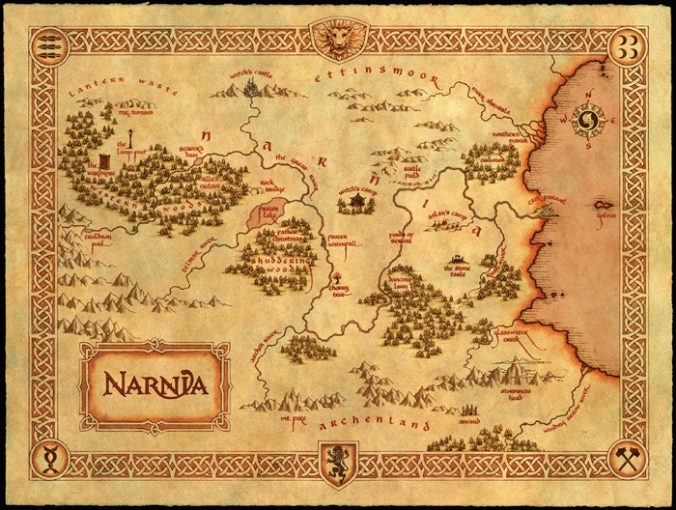
Another famous author and amazing story with a vast beautiful map is Narnia.  Both C.S Lewis and Tolkien had grand creative minds and each with their own flair for map making.

Map-of-Narnia-cs-lewis-1434807-700-528

Now a quick look at a rough draft for one of my maps I created.  It’s nowhere finished and doesn’t have the flare or prestige either of the maps above do.  The world I’m creating is for the novel series I spoke about earlier.

This is the first time I’ve ever let anyone look at one of the early rough drafts of one of my maps.  This one is still in the works and it’s ever changing at times with new places and grows as I continue to write this novel.

Welcome to Ardonia – The main world of my novel series Brothers Three

Map (2)


How do I get started map making…..?

  • Have fun and CREATE
    • First and foremost have fun with it and allow it to be something that sparks creativity for you and your story.  Don’t let it become a burden or you will be overwhelmed and quit pretty quickly through frustration.  It’s easy to try and be a perfectionist when creating a map for anything so don’t be afraid to have multiple versions, drafts, copies, and let the map be something that could continually grow and change just as a real world does.
  • Take Risks
    • Don’t be afraid to develop something that doesn’t work the first time around.  Remember things have a natural process for development and as you write and grow the story, your map may continue to grow with it.  Don’t get stuck in one style of box….have a bunch of them and hop in and out whenever you want.
  • Create the Foundation
    • Every world has a center of attention.  What is your’s?  What are the major cities, towns, and locations on your map?  You have to start somewhere so why not start with a basic list of cities and towns.
  • Land Development & Growth
    • Anything you create will always be a work in progress of sorts.  As I mentioned above the land mass you create will have a natural development process and a free flow but you have to allow for that space and development to happen.  Have some places in your world that aren’t mapped out per say….maybe it’s a discovery point later on in the story and a new map get’s released. Just sayin.
  • Features of the World
    • This is a very complex piece of map making, as you not only have to think about the geography of the land, but the type of surroundings, climate, cultures, race of inhabitants etc.  Do you have a town with a unique culture that stands out from the rest, or maybe a deserted location locked away with dark secrets.  The possibilities are limitless of how you carve the land and features of this world.


Have fun creating your world and enjoy the development of how the characters of the story interact with their surroundings. Go checkout some of your favorite fantasy / sci-fi novels and begin to explore their worlds as it will help you get a perspective of what to do for your map.


Writing & Building a Fantasy World

8da509b65cfd623939820230f39dc6d9As with most things in writing, there are a lot of ways to build a world well, and a lot more ways to do it poorly.  First, let me start with the fact that I am still working on my first novel series, and the world building early on became overwhelming.  This is no one’s fault except mine as I rushed into a very large project that at the time I wasn’t quite ready to tackle yet.  Many years of writing short fantasy / sci-fi stories, and personal blogging gave me the feeling I was ready to take on a novel of epic proportions.  Ultimately, I’ve loved every minute of this writing journey I’ve ventured into as it’s helped me grow as a writer, and building worlds was a huge step into the creative for me.  These few paragraphs are  just some of the tips and tricks I’ve learned a long the way to make world building easier, and more enjoyable.

When looking at the world you want to build think of it along these two lines: first, you need to establish what you know about the world.  Start looking at everything the world needs to have….Does the world have technology based on some time period we currently have or seen?  Does this world fit into a specific time period that we already know?  Maybe it’s set in the colonial age, or maybe some time period we’ve never even seen before. If you’re setting your world into a specific time period, you can answer a lot of questions for yourself as we have the history to study on it. The more different you make your world than any culture in earth’s history, the more challenging it is both for you as a writer and for your readers to imagine.

sb10067155f-001

Secondly, you’re going to have to think about how the world works which is where the writing gets fun!  This portion of the story creation is where you let the imagination run wild most of the times!  This is where you get to ask the big questions: Does this world have magic in it? What are the economic systems in this world? What kind of ruler or rulers will you have in this world? See, the fantastic thing about writing fantasy is that you can make up almost anything you want – as long as it makes sense and can be explained to some degree. If your world feels too weird, it will be hard for your readers to buy into what you’ve created. So in some ways, the weirder you make things, the more you have to make sure that readers see that your characters experience these weird things as normal everyday living. Think of the most normal objections readers would have to the weird things in your world, and don’t be afraid to confront them head on within the story.

So looking back at our first line of thinking, you really need to make a big decision of how this world actually works and functions.  Brain power is all this takes, along with gallons of coffee, and caffeine!  Really though, this just takes some time and deep thought, but coffee just goes well with that process!  It may take some serious study, as you look into how societies operated. Or it may just take time thinking. Whatever it is, you want to have the broad outlines of how people interact in your world figured out and settled. Secondly, you can look at layering other cultures into the story and process of how the world functions.   Does the kingdom next door have no nobility? Or not believe in magic, or believe in whatever you want really. This can get very mind-boggling though but if you are willing then go for it. Basically, there’s a lot of hard work here, and none of it will show up on the page. At least, none of it will show up as extra words that you write.

Third, do things out of the box and differently.  Don’t just copy some great authors ideas down and try to copy what they’ve created.  They became great writers and created those worlds because they did just that, thought differently and outside of the box. This will make your world more interesting. Doing things differently from what you’ve always seen is a good habit to trait and continue to cultivate that as a writer.

writing-fantasy-1920x1200Fourth, You’ve decided how your world works, you’ve decided your characters’ places within this world, and now you have to write, write, write. I tend to give very broad outlines of my world and the inner workings; then as the characters move through the world, I bring out those specifics.  My plot within the story moves very fast and at times the world building takes a back seat, but all in all the creation of the world takes place and ultimately becomes immersive.

Fifth, the greatest thing about world building is it’s your imagination and it’s not limited to a keyboard, or whatever walls you dwell in while writing.  Whatever you find fascinating and want to pursue for your book, go after it with vigor and don’t let anyone tell you otherwise.  Whatever you find fascinating, can make your book stand out from every other book that has ever been written – as long as you make it fascinating to the readers.  Most of the times this is an easy task as you know what you like, and what draws you to enjoyment while reading.  If you find something your passionate about it is extremely easy to communicate that as it’s just that a PASSION!  Just remember take care to communicate with the readers.  If you can do that within the flow of the plot and overall book, they will more than likely enjoy and love what you’ve written.

Don’t let building a world of fantasy be something to constrain your imagination, instead let it be the freedom you enjoy while writing what you love!

scr.ee tags:

#fantasyworlds

Writing In a Winter Snow Storm

writing-a-book


Hello again everyone!

It has been around a month since my last legit post and that has been strategic, and completely on purpose.  It’s that time of year where our families schedule becomes insane, but like I said it’s on purpose.  This time of year for us is busy with family events and time for us to relax, escape with each other and do those fun family things together.

This has not only been a busy few months but an extremely busy year in total.  As a husband and father to seven year old triplets life has a way of pulling your attention to the important things.  We as a family have always been prioritized, but as everyone we can stray away from those “Important Things” and have to wrangle our small attention spans back in to focus.

I’ve had to slow down the frequency of blogging lately mainly because I can’t create more than 24 hours in a day…though I wish I could sometimes.  This summer was a killer in hours for me due to a very large project at work I was managing in which I was having to work both days & nights a lot of the summer.  With that being said, the project was overall a pretty good success and allowed me to manage a team of people who could make it a success in future years.  Now that the summer has passed and winter is upon us…which happens to be my favorite time of year BTW.

That brings me to my next statement and why I named this blog post what I did.  Winter is my favorite due to a lot of reasons, but one very important and dear to my heart is writing and creativity for me started one very cold winter when I was just a young boy in which I got to read “The Hobbit” for the very first time.

This sparked a passion for writing, creativity, reading and knowing one day I would write my own book, or books.  That has been many years ago and even though my background in school was majoring in creative writing and arts, I ended up being a project manager of all things.  Now that doesn’t mean I’ve lost the passion to write, but what it does mean is I have to prioritize my time so that I can continue my passion of writing.  That prioritization comes in many forms and sometimes it means taking a break from writing which I think any writer out there could say the same thing.

Writing to me is always like writing in a snow storm and the reason I say that is,  “A snow storm is beautiful chaos filled with creativity and awe inspiring moments of it’s ability to fascinate the mind and be completely unique every time it happens.”  This is why I love winter and why I will always continue to love writing no matter the form it comes in.

To all those creative minds and soon to be, thinking about, am doing writers out there I prod you to find what inspires you to do what you love.

One of my  favorite quotes and something I always try to remember, “Writing is easy. All you have to do is cross out the wrong words” – Mark Twain

Keep writing and having fun while you do it ya’ll!

Cheers!

scr.ee tags:

#winter


Creative Writing – What, How, Why of a Fantasy Novel

Writing a fantasy novel is great fun – you can literally let your imagination run wild.  It’s a little different when writing a novel set in the real world as unlike books set in reality where you can use real life as examples, you’ll have to invent everything in your new fantasy world.  Do you enjoy writing, are you working on a fantasy novel, or have you had the notion to start one?  I hope the next few minutes while reading this helps you no matter what stage you might be in for writing a novel.

One of the best things you could do to kickstart things is read as many classics as you can find!  No matter the type of book you begin writing this will give you a good idea about what works and what doesn’t.  Remember though that reading other peoples works is something to help with idea spawning and relax your mind.  You must take note not to simply copy the ideas you’ve read from any of the good old classics or other pieces of work you find.  If you find yourself dealing with elves, half-lings and orcs whilst being a reluctant hero on a quest to destroy a powerful item, it’s probably best to scrap it and start again. It is true that all stories are a combination of those the reader has encountered over the years. But, you should always try to find an original angle and it certainly should not be obvious what the source material was. Reading the classics will also allow you to discover how well-crafted characters interact with each other as the story progresses.

Tip 1. Use established myths and legends as the basis for your fantasy world. Think about what your fantasy world might be like.  Do your studying and find out what your world and culture is most like….Is it Celtic, Roman, a medieval world or a blend of multiple cultures with your own twist on it? Once you’ve chosen, go and read about the myths and legends that relate to those cultures. The mythological creatures and characters and their stories will give you a great basis for your new world.

Tip 2. Get to know your imaginary world – you need to be able to describe it in detail if you are going to convince your readers, for the duration of the book at least, that it exists. Be thorough and detail everything you can possibly imagine about the world you are creating.

  • Physical – what does your fantasy world look like? Think about and make a note of:
    • the colour of the sky
    • what other planets can be seen from the surface
    • whether the air is breathable
    • what the plants look like
    • what creatures live there
    • whether there are seas
    • what the landscape looks like
    • futuristic world or something older
  • Residents – decide who lives in your newly formed fantasy world. You should spend time thinking about how they look, what they eat, how they move, whether they need sleep, how they speak to one another etc…
  • Society – what kind of society exists? Do they need money to buy things? Is there a complex system of politics they follow? Do they have a police force, a king or president? Is there a religion?
  • Special powers/magic – Do the residents have any special powers or use magic? If so, what are they and why do they exist? Does everyone have use of them or only certain people?

Tip 3. Make your characters believable. This is one of the most essential parts of the book if you want to hook and keep readers interested in the story. A great way to achieve this is to apply logic to every character in every fantasy world you create. This means creating a set of rules that apply to the world and the character. The rules can be based on either real life or they can be simply invented by you.  Remember if you are creating the rules of the world, don’t let a BOX hold you back from being creative.  Sometimes creating our own ways is just the push we need to make that next step in our creative writing.

Tip 4. Make sure you keep careful notes of all the details you invent for your new fantasy world. This will help you maintain continuity throughout the novel. There are many ways of doing this, some writers like to have a set of cards with the details on, others set up spreadsheets; so play around with different systems to find one that suits you the best.  I personally use a book mapping chart I created in excel that helps me track all major parts of the book I need.  I hope these few steps help you get started, or give an idea of what steps to take next in writing your new fantasy novel!

Remember, have fun!! That is the first and foremost thing I can say when writing… Have Fun and lots of it!