The Veylric Divide

Part II – When the Twilight Broke Itself
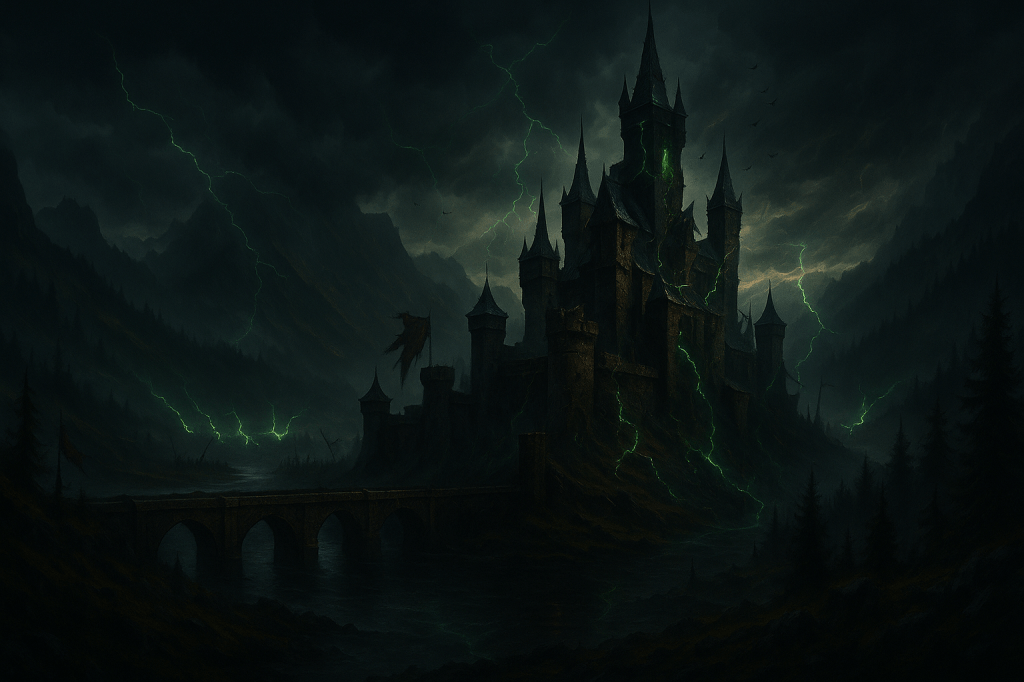
Great kingdoms rarely fall from the outside.
It is within—where whispers are sharper than swords—that ruin is born.


The Court of Shadows

At the height of its splendor, Noctharion was a realm of perfect balance.
Its citadels of obsidian rose like pillars between dawn and night, its banners of crimson and midnight mirrored both blood and storm.
The people of dusk held fast to their oath: to guard the borders between light and dark.

But within the heart of the Seventh Throne, a quieter battle began.

In the Great Hall of Eclipsera, torches burned blue within crystal sconces. Their glow fell across faces lined by suspicion rather than faith. Here sat the high lords and ladies of House Draemyr, once united by blood and purpose, now divided by philosophy.
What began as a debate of destiny became a fracture of the soul.

“We were meant to hold the line,” said one.
“We were meant to command it,” replied another.

The twilight that once shielded the realm had begun to turn upon itself.


Seeds of Pride

It was Lord Veyric Draemyr who first dared to voice what others only whispered.
He stood before the obsidian throne, its surface catching the torchlight like liquid night.

“Why should the dusk kneel before the dawn?” he asked.
“Do we not bear the weight while Gallandor basks in its own light?”

Many agreed in silence. Others, loyal to the old vows, shifted uneasily.
Among them was Prince Althar, his nephew, who saw in his uncle’s words not strength—but hunger.

That hunger spread faster than plague.


The Four Factions of the Divide

As the court split, so too did the kingdom’s spirit. Four banners were raised within the same walls:

1. The Iron Loyalists — those who clung to the oath of balance and defended Gallandor’s alliance, led by General Kaelor the Younger.
Their fortresses held the northern passes, still bearing the old sigil of the dusk-crown encircled by light.

2. The Shadowborn — Veyric’s followers, who claimed dusk was destiny, not duty.
They believed Noctharion should rule, not guard. Their emblem became the broken circle, a crown eclipsing the sun.

3. The Veiled Ones — scholars and seers who delved into forbidden magic.
They sought communion with powers beyond the Veil, believing knowledge itself could crown kings.
Among them, Lady Thalyss Draemyr whispered to mirrors and fire, learning tongues that had not been heard since the First Age.

4. The Betrayers — mercenaries and nobles who sold allegiance to whichever side promised them more.
It was they who opened the first gates in the walls and bartered secrets to unseen voices that spoke in dreams.

Each faction believed they alone carried the future of dusk.
Together, they forged the beginning of its end.


The Whisper of Ash

The dreams began soon after.
Lords woke with soot upon their palms. Priests heard hymns in reverse.
Children wept in sleep, saying a voice called from “beyond the mirror.”

That was the first sign of the Ash-Whisper—a disembodied promise echoing through obsidian halls.

“Why stand as the wall… when you might be the throne?”

It spoke differently to each heart.
To the proud, it promised dominion.
To the fearful, security.
To the grieving, resurrection.

And so began the quiet servitude of a people who believed they were free.


The Feast of Knives

On the eve of the Feast of Duskwatch, House Draemyr gathered to celebrate the old oaths of unity.
But unity was already ash.
Poison turned wine to black fire; daggers flashed in the candlelight.
By dawn, twenty-three nobles lay dead across the marble floors.
The banners of dusk were taken down and burned in the courtyards below.

That night, Lord Veyric Draemyr declared himself the True King of Twilight,
and the realm shuddered as the first civil war began.


The Siege of Veylric Hold

The Iron Loyalists gathered at Veylric Hold, the last fortress still sworn to Gallandor.
Its walls of basalt stood six hundred feet high, carved into the cliffs of the Dusk Sea.
But the Shadowborn came with fire.
Not the kind made by men—but by something older.

Veilfire.

The sky turned green. Shadows bled from the stone.
When the hold finally fell, the rivers ran black for seven days.
From that ruin, the Shadowborn built their new capital, Nareth Kûl, upon bones and cinders.
It would one day become the Black Spire.


The Legacy of Division

When the war at last ended, Noctharion no longer existed.
It was a realm of graves and ghosts.
The Draemyr name—once a banner of strength—became a curse.

From its ashes rose the prophecy that would one day echo through the Ash & Veil Chronicles:

“When the wall breaks itself, the ash will not need to knock.”


Behind the Writing

The Veylric Divide is the tragedy of pride made manifest.
Where Part I showed Noctharion’s majesty, this chapter reveals the poison in its veins.
I wanted the court politics to feel operatic—honor giving way to ego, loyalty to ideology, until even the stars seem to turn against them.

The Ash-Whisper introduces the Dread King’s earliest reach, a subtle infection rather than conquest.
From this moment on, every act of ambition across Eldoria traces its shadow back to this night of knives and green fire.


Until Next Time…

Next comes Part III — The Morghast Curse,
when the fractured soul of the Dread King returns through those who once believed they had destroyed him. The night has only begun to burn.
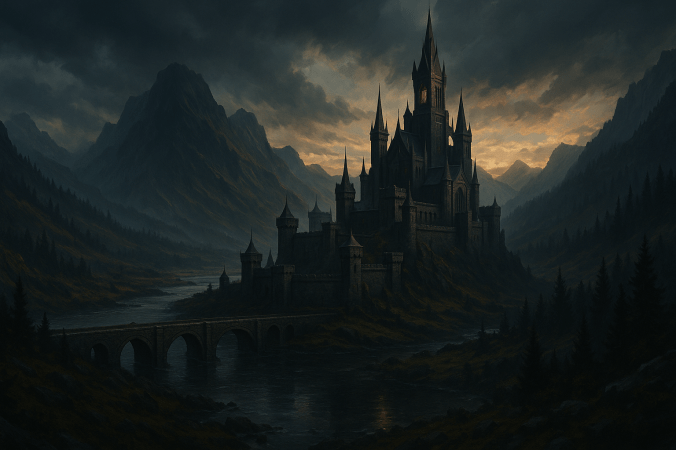
Noctharion, the Seventh Throne: Guardians of the Dusk

Part I — The Lost Kingdom of the Seventh House

Before Barakthûn was cursed, before the shadow consumed the land, there was Noctharion — the Seventh Throne.
It was not yet the Fallen Kingdom.
It was the Twilight Realm.

Where Gallandor gleamed with marble and sunlight, Noctharion stood in basalt and obsidian. Its skies were often storm-shrouded, its rivers deep and dark, its mountains black as iron. And yet, in this brooding beauty, there was majesty.

Noctharion was meant to be balance.
Where Gallandor raised banners of gold and white, Noctharion flew crimson and midnight.
Where Gallandor built temples to the Light, Noctharion raised citadels of endurance — fortresses meant to hold the line when others faltered.

They were not cruel, but they were proud.
Not shining, but steadfast.
Not joyous, but resolute.

It was dusk made kingdom.


The Twilight Realm

The Seventh Kingdom was carved from black stone cliffs, its fortresses rising like thorns against the horizon. Obsidian spires crowned its citadels, and basalt roads cut across the valleys like veins of shadow.

Its people believed themselves guardians of the dusk — the shield between the brilliance of Gallandor and the wild darkness beyond. They found beauty not in brightness, but in the strength to endure.

Among the Seven Thrones, they were the Iron Fist — the kingdom others trusted to hold the borders when the world trembled.


House Draemyr – The Twilight Bloodline

The rulers of Noctharion sat upon the Seventh Throne, proud and unyielding. The Draemyr line was famed for its fortress-lords, warrior-queens, and generals who shaped dusk into a weapon.

Ancestral Legacy

Valryon Draemyr – Founder of the line, called the Twilight Lord. Built the first obsidian citadels, declaring dusk as the shield between light and dark.

King Athelion DraemyrThe Stone Sentinel. Known for fortifying the borders of Eldoria with unbreakable bastions and commanding legions that never broke rank.

Queen Seranyth DraemyrThe Iron Rose. A warrior-queen who rode at the head of her armies and is said to have slain a giant alone at the Battle of Duskwatch.

Lord Malrec DraemyrThe Iron Voice. Famous for his uncompromising discipline and oratory; his decrees were said to echo across the mountains long after he was gone.

King Kaelor I DraemyrThe Shadowed Crown. Questioned why Noctharion should kneel beneath Gallandor’s light, planting the first seeds of ambition that would one day bloom into ruin.


The Later Line

Lord Veyric Draemyr – The most ambitious of his line. His reign marked the first whispers of division within the House, as branches of the family split between loyalty to Gallandor and hunger for power. His name would one day give rise to the Veylric Divide.

Lady Thalyss Draemyr – A courtly mastermind whose cunning words bent lords as surely as blades. Whispers claimed she courted shadows long before the kingdom itself fell to them.

Prince Althar Draemyr – The last heir before the fall into Morghast. A brilliant commander and tactician, but too proud to see the corruption seeping into his own bloodline.


Legacy of the Seventh Throne

The Draemyr dynasty embodied dusk — not light, not darkness, but the strength of the in-between. Yet within that strength grew a fatal flaw:
the belief that they should not guard the crown, but be the crown.

That flaw fractured their House, leaving it vulnerable to whispers of power and, eventually, to the corruption that would make Noctharion the seedbed of Barakthûn.


Themes of Noctharion

Majesty of Shadow – Beauty found in endurance, dusk, and storm.
Pride of Guardianship – The conviction that they alone were strong enough to defend Eldoria.
The First Cracks – Seeds of ambition, jealousy, and hunger for dominion that set them apart from Gallandor’s unity.


Behind the Writing

Noctharion was always meant to stand apart.
If Gallandor was the crown, Noctharion was the clenched fist.

Writing it as a kingdom of dusk and brooding beauty gave me the contrast I wanted against Gallandor’s marble light and Silvermoon’s starlit grace.

I wanted readers to feel the tragedy of it — that this kingdom wasn’t born wicked. It was noble, strong, even necessary. But nobility turned to ambition, and ambition turned to ruin.
To me, that makes the fall into Barakthûn all the more heartbreaking.


Until Next Time…

Noctharion is only the beginning of the Seventh Kingdom’s tale.

Next, we’ll explore The Veylric Divide — how ambition split House Draemyr, how whispers of power fractured their unity, and how the Twilight Realm began its slow descent into shadow.

If dusk can be corrupted… what hope then for the crown of day?

Stormhold: The Ocean Throne

Every kingdom of Eldoria bears a crown, but Stormhold wears the sea itself. Known as the Ocean Throne, it is a realm carved from cliff and wave, where lightning scorches the sky and storms pound the shore. Here, a people have been forged by the tempest — warriors and sailors who believe that only the sea decides who lives and who dies.

Stormhold is both fortress and fleet. Both storm and sanctuary. Both shield and spear. If Gallandor is the heart of Eldoria, Stormhold is its shield.

Its people are hard, proud, and unyielding. Their creed is simple: “The Sea Chooses.”


The Realm of Storms

Stormhold rises where the eastern cliffs of Arathia meet the wrath of the ocean. Its capital, Stormwatch (called Cael’Tharn by locals), is a fortress-city carved into cliffs of black basalt. Harbors open into storm-lashed caverns, where enchanted fleets ride the endless swells. Above them rise storm-spires, jagged towers that glow faintly when lightning dances across their walls.

The coast itself is treacherous — jagged shoals, whirlpools, and tide-caves litter its shores. To outsiders, Stormhold’s seas are death. To Stormholders, they are home.

Atop a high headland rises Cael’Tharn Citadel, lighthouse-fortress of House Draeven, where the great storm-lanterns burn and Tempest Readers train to bend lightning into wards and weapons.

Stormhold is not a kingdom of walls alone — it is a kingdom of storms. Its geography is both shield and trial, isolating its people from inland politics yet binding them to the sea that sustains and defines them.


House Caelthar — The Royal Bloodline

The true rulers of Stormhold are House Caelthar, tracing their line back to Kaelthar the Wave-Breaker, the first to master the ocean and raise Stormwatch above the cliffs. They bear the title “Masters of the Ocean Throne.”

  • King Harad Caelthar — Warrior-king, both sailor and monarch. Known for leading fleets in person, steering ships through typhoons, and wielding a stormforged blade said to channel thunder itself.
  • Queen Elenya Caelthar — Former admiral of the Gray Fleet, famed strategist, and called “the Helm of the Kingdom.” Her counsel is as trusted as Harad’s sword.
  • Princess Searanore Caelthar — Raised as heir of Stormhold, taught navigation, weather-lore, and command. To all, she is the Daughter of the Sea. Yet her true heritage carries a secret that binds her to prophecy and to the Brothers Three.

Crest: A silver trident struck by lightning over midnight waves.
Motto: “The Sea Chooses.”


House Draeven — The Stormriders

Though House Caelthar rules, House Draeven are Stormhold’s other throne. Sworn vassals, they are the legendary Stormriders — sea-wardens, storm-mages, and custodians of the Gray Fleet.

  • Lord Maelric Draeven — Master of the Gray Fleet.
  • Lady Ysira Draeven — Keeper of the Thunderlore, a tradition of weather-mages who “read the skies” and call lightning in battle.
  • Stormrider Cadets — Young sea-knights who prove their worth by sailing into tempests as a rite of passage. Only survival earns them their name.

House Draeven holds Cael’Tharn itself, their lighthouse-citadel serving as naval citadel, weather-mage academy, and cultural emblem of Stormhold’s stormlore. Revered by many, feared by more, they are whispered to be half-blooded with elemental sea-spirits.

The Caelthars and Draevens feud as often as they ally — one family ruling by steel and crown, the other by storms and omens. Yet together, their bond makes Stormhold unconquerable.


Culture of Stormhold

Stormhold is a people of storms. Their lives are measured by tides, their fates by thunder.

  • Seafaring Dominion — The Gray Fleets are Eldoria’s largest navy, warded with weather-charms that allow them to sail through tempests where others would sink. No fleet in Arathia rivals their seamanship.
  • Weather-Magic — Stormhold battlemages wield thunder, lightning, and wave. Tempest Readers treat storms as living beings — listening, learning, bending. Their magic is revered as the kingdom’s divine shield.
  • Isolationist Tradition — Stormhold keeps aloof from mainland politics, its storms serving as natural walls. To outsiders, Stormholders seem harsh, proud, and unyielding. To themselves, they are chosen of the sea.
  • Trial by Storm — Stormhold’s youth earn adulthood not by age but by braving the sea. To sail into a tempest and return alive is to be counted among Stormhold’s true.

Stormhold is less a kingdom of stone than a covenant of storm and sea.


The Secret of Searanore

Though she bears the name Caelthar, Searanore’s true bloodline is hidden. She is the twin sister of Iogro Merrybelly — daughter of Princess Elara of Silvermoon and Prince Darian of Durhaven. To shield her from The Dread Kings assassins, she was fostered into House Caelthar at birth and raised as their heir.

Raised with Stormrider discipline and sea-lore, she became both navigator and weather-reader, embodying the storm itself. Yet her heritage unites three great lines:

  • Elven wisdom (Silvermoon)
  • Human strength (Durhaven)
  • Oceanic dominion (Stormhold)

Her destiny fulfills a hidden verse of prophecy:

“When storm and shadow meet the flame,
The twin-tide’s truth shall bear her name.”

She is both breaker of storms and bridge of kingdoms — but her secret, if revealed, could shatter the trust of House Caelthar and unravel Stormhold itself.


Strengths & Weaknesses

Strengths

  • Naval supremacy unrivaled in Eldoria.
  • Storm-wielding battlemages.
  • Cliffside fortresses near-impregnable.
  • Prophecy embodied in Searanore.

Weaknesses

  • Reliant on seas and storms for defense.
  • Harsh winters and poor harvests, dependent on trade.
  • Rivalries between House Caelthar and House Draeven.
  • Fragility of Searanore’s secret heritage.

Stormhold’s Place in the War

Stormhold is the fulcrum of Eldoria’s seas. Without its fleets, no kingdom can master the oceans. Without its storms, Arathia’s coasts are bare. Yet Stormhold stands on a knife’s edge: one revelation, one betrayal, and its waves may drown allies as swiftly as enemies.

If Gallandor is Eldoria’s heart, Stormhold is its shield — forged of salt, steel, and storm.


Behind the Writing

Stormhold is one of my favorite realms to design because it marries raw natural power with dynastic secrecy. The sea here is not just backdrop — it is character, judge, and executioner.

With Searanore’s hidden bloodline, Stormhold becomes more than a naval kingdom — it becomes prophecy’s keystone. That tension — between isolation and alliance, truth and deception, storm and shore — is what makes Stormhold one of the most dangerous, and most necessary, kingdoms in Eldoria.

When the sea chooses, who dares defy the tide?


Until Next Time…

Stormhold is only one voice in the chorus of Eldoria’s kingdoms. Next, we descend into the stone halls of Ironclad, where dwarves forge runes of power and hammer prophecy into steel. From there, we will venture to Durhaven, and finally to Barakthûn, the shadow of a kingdom lost.

But Stormhold stands now as the Ocean Throne. A realm of storms and sailors. A kingdom where the sea itself chooses who shall rise — and who shall drown.

If the storms turn against Eldoria, who then can weather the tide?

Greenwood: The Sylvan Dominion

If Gallandor is the mountain and Silvermoon is the sky, then Greenwood is the earth itself. The third of Eldoria’s great kingdoms, Greenwood is not a land built of stone or crowned with towers. It is a realm grown — a living dominion of colossal trees, river-spirits, and druids bound to the heartbeat of the world.

To enter Greenwood is to pass beneath boughs that have stood since the Age of Ashes, where roots coil like serpents, where wolves of ember flame watch from the shadows, and where the very forest may rise in judgment. It is not merely a kingdom — it is a covenant with the land.


The Verdant Wilds

The Greenwood stretches across the heart of the Verdant Wilds, an endless forest where sunlight filters through golden canopies and rivers carve silver veins across the earth. But beneath its beauty lies power.

  • The Whispering Woods – Sentient groves said to carry voices of the dead. Travelers often hear names spoken on the wind.
  • The Golden Forest – Heart of Greenwood, its trees shine as if aflame at sunset, but their glow never fades.
  • Cursed Glades – Battlefields of the First Sundering, where shadows seeped into the soil. No flower grows there, and those who linger too long hear whispers urging them to despair.

The Greenwood is not a passive land. It remembers. It judges. And it does not forgive.


Thal’Emoras: The Living City

Hidden deep within the Golden Forest lies Thal’Emoras, Greenwood’s capital — a city not built, but sung into being.

Its halls are woven into the trunks of colossal golden-wood trees, spiraling upward in layers of vine-bridges and terraces lit by sap-lanterns. Roots form stairways, branches bend into arches, and flame-druids tend torches that burn with green fire, symbols of life and balance.

Notable Landmarks

  • The Rootspire – A monolith entwined with roots, believed to be where the first druids bound their lives to the land. Lady Myrialis guards it with unyielding zeal.
  • The Glade of Ancients – A circle of trees so vast their branches weave together like a temple roof. Here, oaths are sworn before the spirits.
  • Temple of the Verdant Eye – A sanctuary grown from a single tree, its heartwood glowing with emerald flame. Within, seers glimpse visions in fire and leaf.
  • The Golden Canopy – The highest level of Thal’Emoras, where the Queen’s council meets beneath branches that shimmer like captured sunlight, even in the blackest night.

Thal’Emoras is not merely a city — it is the forest dreaming in stone and song.


House Thalorien – Wardens of the Forest

The rulers of Greenwood are not kings in the manner of Gallandor or Silvermoon. They are wardens, chosen by both blood and the will of the land itself.

  • Warden-Queen Aerwyn Thalorien – Regal, fierce, and bonded to the Verdant Eye, she carries the Green Sight, hearing whispers of both past and future in the rustling of leaves. Her word is law, not because of crowns, but because the forest itself bows to her.
  • Prince Faelor Thalorien – Her only son, gifted with spirit-sight but brash and proud. He distrusts men, seeing them as destroyers of balance, and often rivals Iogro Merrybelly with open disdain.
  • Lady Myrialis – Aerwyn’s sister, Keeper of the Rootspire. A figure of dread and respect, more priestess than noble, who communes with spirits few dare approach.

House Thalorien traces its line back to Eldros the Verdant, the first druid to bind his soul to the Whispering Woods. They are less a dynasty than a covenant — the embodiment of Greenwood’s vow to protect balance at all costs.


The Culture of Greenwood

The Greenwood elves are distinct from their kin of Silvermoon:

  • Silvermoon → starlight, high magic, crystalline towers, scholars of fate.
  • Greenwood → roots, druids, torchlight, spirits, guardianship of balance.

Greenwood Traditions

  • Tree-Song Magic – Elves sing to shape living wood, raising bridges, halls, and even weapons from the forest itself.
  • Spirit-Binding – Some druids form lifelong pacts with river or beast, drawing strength from their bond.
  • The Ember Flame – Green fire that symbolizes balance; it is never allowed to extinguish within Thal’Emoras.
  • Shadowblending – Warriors slip into the forest’s essence, becoming one with shadow and green — perfect scouts and ambushers.

Their lives are not about dominion, but harmony. To Greenwood elves, to cut without blessing or to take without offering is blasphemy.


Greenwood in the Age of Ashes

During the First Sundering, Greenwood stood as the last barrier against Malakaroth’s eastern advance.

When the Dread King’s armies marched, Aerwyn’s ancestors called the forest to war:

  • Oaks tore their roots from the earth, crushing siege engines.
  • Wolves cloaked in emerald flame hunted cultists through the night.
  • Rivers rose in living torrents, drowning entire battalions.

The land itself fought beside Greenwood. But such power came with scars. There are glades that still bleed shadow, and rivers that whisper with voices of drowned soldiers. Greenwood carries those wounds like a crown — a reminder that balance must always be guarded, or it will shatter.


Prophecy in Greenwood

The druids believe the scars of the Brothers Three are not random. They say the Whispering Woods spoke of them long before their birth — three wounds upon the land, born as sons, who would either restore balance or break it forever.

Some claim the markings on their flesh mirror carvings found in the Rootspire itself. Others whisper that one of the Brothers is destined to fall, his death the price of balance.

Whatever the truth, Greenwood watches them with both hope and fear.


Songs of Greenwood

“Beneath the golden boughs we sing,
Of fire’s gift and shadow’s sting.
The forest wakes, the spirits cry,
Balance holds, or all will die.”


Behind the Writing

Greenwood has always been, for me, the “soul” of Eldoria. Where Gallandor is weight and vigilance, and Silvermoon is mysticism and prophecy, Greenwood is life itself. It’s the reminder that the world is not just kingdoms and crowns, but roots and rivers and spirits older than men or elves.

I wanted Greenwood to feel as dangerous as it feels beautiful. A kingdom you would long to see, yet fear to offend. A place where nature does not serve you — it tests you.

It also reflects my love for being outdoors, for forests that feel alive. Greenwood isn’t just a fantasy forest — it’s what forests feel like when you’re standing in them, listening to the wind and realizing you are very small.


Until Next Time…

Greenwood is the third of the Seven Kingdoms, and one of the most primal. In the weeks to come, we’ll sail the storm-lashed cliffs of Stormwatch, delve into the fiery forges of Ironclad, and walk the frozen halls of Durhaven.

But for now, we leave Greenwood — a realm of druids and spirits, where the forest itself remembers the Age of Ashes, and where balance is both gift and burden.

Silvermoon: The Starlight Realm

If Gallandor is the heart of Eldoria, then Silvermoon is its memory. Hidden high among the mist-shrouded peaks of the Celestian Vale, this elven kingdom has stood since the Age of Ashes, a sanctuary of starlight, wisdom, and secrets.

To step into Silvermoon is to step into a dream — where moonlight glimmers upon white stone terraces, where ancient runes hum with power, and where the air itself feels charged with a quiet, ageless magic.


The Celestian Vale

Silvermoon is carved into the high mountain valleys, shrouded by mists and crowned by starlight. Forested slopes climb toward crystalline peaks, waterfalls plunge into moonlit pools, and the night sky seems closer here than anywhere else in Eldoria.

The elves of Silvermoon say their land is not merely of the world, but between it — a place where stars whisper and where time flows differently beneath the moon. Travelers who enter the Vale often lose track of hours, sometimes even days, as if Silvermoon itself bends the threads of fate.


The City of Lunareth

At the heart of Silvermoon lies Lunareth, the capital city of the elves. Built upon a tiered plateau that gleams like silver under the stars, Lunareth is both fortress and sanctuary.

Notable Landmarks

  • The Observatory of Liraeth – A great tower crowned with lenses of crystal, where seers chart the heavens and read the will of the stars.
  • The Starwell Pools – Sacred springs said to reflect not only the sky, but visions of what may come. Pilgrims whisper prayers here by torchlight.
  • The Arcane Circle – A vast ring of standing stones, glowing faintly with runes of silver. Here, the elven magisters gather to weave starlight-magic.
  • The Moonspire Palace – Seat of House Valcaryn, its spires carved to echo the constellations. Its throne room opens directly to the night sky, for the rulers of Silvermoon claim their crown not from blood alone, but from the stars above.

House Valcaryn – Lords of Starlight

Silvermoon is ruled by House Valcaryn, an ancient line as unyielding as the mountains and as mysterious as the night.

Current Rulers

  • King Arandor Valcaryn – Proud, wise, and distrustful of men, he has guarded Silvermoon for centuries. His word is law, though even he claims to bow to the stars’ decree.
  • Princess Elara Valcaryn – Beloved daughter of Arandor, she defied her father’s will when she gave her heart to Prince Darian of Durhaven. From this forbidden union came Iogro Merrybelly and Searanore, half-elven children whose destinies entwine with the Brothers Three.

Bloodline Through Elara

  • Iogro Merrybelly – Half-elf, half-human son of Elara and Darian. Known for his humor and wisdom, though mocked by some as “Merrybelly.” He is destined to be a protector of the Brothers Three.
  • Searanore Valcaryn – Hidden twin sister of Iogro. Raised apart to protect her from political danger. Fierce warrior, cold and distant in youth, but destined to become one of the most important figures in uniting Eldoria.

Traits of House Valcaryn

  • Masters of starlight magic — weaving fate, prophecy, and light into spellcraft.
  • Lorekeepers who sing prophecy into song rather than writing it in text.
  • Fiercely protective of bloodlines, believing their royal line is chosen by the stars themselves.
  • Deep mistrust of men, which makes Elara’s choice a scar on their house’s pride.

The Culture of Silvermoon

Life in Silvermoon is guided by starlight. Its people are scholars, seers, and artisans who weave magic as naturally as others weave cloth.

  • Starlight Magic – Unique to Silvermoon, this discipline draws from constellations, moonlight, and the unseen threads of fate.
  • Lorekeepers – Elves record not only history, but prophecy. Their scrolls are written as songs, their archives more like libraries of music than words.
  • Rites of Night – Festivals of light are held when the moons align or stars flare. Lanterns float into the sky, carrying prayers for guidance.
  • Isolation – Though beautiful, Silvermoon is not always welcoming. Its people are cautious of outsiders, especially humans, believing most are too fleeting to be trusted with eternal secrets.

Silvermoon in Prophecy

The seers of Silvermoon believe the Brothers Three are not merely heirs of Gallandor, but threads woven by the stars themselves. Some say the three scars they bear are reflected in a constellation above Lunareth, seen only once a generation.

The union of Elara Valcaryn and Darian Varric — though forbidden — is also whispered in prophecy. Their children, Iogro and Searanore, represent something new: a bridge between men and elves, between mortality and eternity.

To the elves of Silvermoon, this is both hope and heresy. For prophecy is clear: the stars bless the world with saviors, but they also curse it with trials.


Songs of Silvermoon

Bards sing often of Silvermoon, their verses drifting like echoes of starlight:

“Silvermoon glimmers, veiled in mist,
Where fate is written, where stars insist.
In Lunareth’s halls, the night is a crown,
But stars may rise — and stars fall down.”


Behind the Writing

Silvermoon was one of the first kingdoms I imagined when building Eldoria. I wanted a realm that felt ethereal, almost otherworldly, yet rooted in deep traditions. It became the perfect counterbalance to Gallandor — where Gallandor is stone and burden, Silvermoon is starlight and secrecy.

It also became one of the most personal kingdoms for me to write, because Silvermoon ties directly into family and choice. Elara’s defiance, Iogro’s half-blood heritage, and Searanore’s hidden destiny all spring from this place. Their struggles mirror themes I’ve always loved in fantasy: identity, belonging, and the cost of defying tradition.


Until Next Time…

Silvermoon is the second of the Seven Kingdoms, and one of the most mysterious. In the weeks to come, we’ll descend into Greenwood, where druids and forest elves weave life into living cities of torchlight and oak. We’ll also chart the seas of Stormwatch, delve into the forges of Ironclad, and tread the frostbitten halls of Durhaven.

But for now, we leave the starlit halls of Silvermoon — a realm of beauty and burden, memory and prophecy, where the stars themselves weave the fate of Eldoria.

Silvermoon — where starlight crowns the night, and prophecy shines eternal.

Gallandor: The High Kingdom of Eldoria

Every world has its crown — the place where history, destiny, and power converge. In Eldoria, that place is Gallandor. Known as the First Kingdom, Gallandor was born out of victory in the First Sundering, and for a thousand years it has stood as the guardian of prophecy, the jewel of Arathia, and the seat of the High King and Queen.

It is more than a kingdom. It is the beating heart of Eldoria.


The Land of Arathia

Gallandor lies in Arathia, the fertile heartland of Eldoria. Its rolling plains are rich with crops, its rivers glimmer like silver threads, and its roads carry travelers from all corners of the realm. Yet at the center of this abundance rises something far greater — Ashrathal, called Emberhold in bardic songs.

This mountain was not born of nature alone. It rose from the scar of the First Sundering, a peak forged in ash and fire when Malakaroth, the Dread King, was defeated. To the lords of Gallandor, it is Ashrathal, the Throne of Ash. To the common folk, it is Emberhold, the Keeper of Embers. Both names are true. Both carry weight.

Upon its slopes and around its base, Gallandor was built — a kingdom of stone and memory. But beneath the mountain lies a darker truth.

The mountain itself is a tomb.

At its core rests the chained body of Malakaroth. Gallandor is both protector of the world and reminder of its greatest wound. To live in Gallandor is to live in the shadow of vigilance, knowing that peace is not guaranteed but guarded every day.


The City of Arathia

At the mountain’s foot sprawls Arathia City, Gallandor’s capital and the jewel of Eldoria. Its white-stone walls gleam in the sun, its spires rise toward the heavens, and its streets hum with knights, scholars, merchants, and pilgrims.

Notable Landmarks

  • Caer Thalion – Royal citadel of House Galanor, where the High King and Queen sit the throne. Its banners fly high above the city.
  • The Great Library of Eldoria – Vault of prophecy and history, where the Whispering Stones are kept under guard of the Keepers.
  • The Hall of the Dragon Riders – Monument to Gallandor’s proud order of dragon riders, now faded but never forgotten.
  • The Spindelum Vault – Hidden deep beneath the city, where the Spindelum of Time was once locked away.
  • The Whispering Stair – Tower where seers climb to glimpse visions. Its steps echo with voices not of this world.

Arathia City is not only the seat of kings. It is the memory of the First Sundering, the guardian of prophecy, and the heartbeat of Eldoria itself.


House Galanor: Blood of Kings

At the center of Gallandor’s story stands House Galanor, the ruling family whose line stretches back to the Age of Ashes.

  • King Alric Galanor – A wise and battle-hardened High King, patron of the Keepers and defender of prophecy.
  • Queen Elenara Galanor – Regal and compassionate; scarred forever when Morgathra, sister of the Dread King, attacked her during pregnancy.
  • The Brothers Three – Torin, Kael, and Eadric. Triplets born in a single breath of fate, scarred in the womb by Morgathra’s curse. Each bears a fragment of shadow, and each is bound to destiny.
  • Galen Galanor – Brother to Alric, a retired general and secret leader of the Keepers, sworn to guard the Spindelum of Time.

House Galanor is not just a royal bloodline. They are guardians of the world’s hope. The fate of Eldoria itself is tied to their scars.


The Burden of the Crown

Gallandor’s rulers carry more than crowns — they carry the weight of a tomb. Every monarch of House Galanor swears the same oath:

“As long as Gallandor stands, the tomb remains sealed.”

It is their glory, but also their curse. To be High King or Queen is to watch over the wound of the world, never free of the shadow it conceals.


The Culture of Gallandor

Gallandor’s people are proud and resilient, shaped by both plenty and vigilance.

  • Farmers tend the fertile fields of Arathia, their harvests feeding much of Eldoria.
  • Knights uphold ancient codes of chivalry, carrying lances and banners that trace their lineage to the First Sundering.
  • Scholars of the Great Library dedicate their lives to understanding prophecy and recording the lore of the past.
  • Common folk live with quiet pride, knowing their kingdom is the shield of Eldoria.

Gallandor is also haunted by memory. Every festival, every song, every monument whispers of the war that shaped the world. Its people live with hope, but also with scars.


Legacy of the Dragon Riders

Gallandor was once home to the legendary dragon riders, warriors who forged bonds with dragons and carried fire into battle against Malakaroth’s legions. Their order has all but vanished, but their spirit remains.

The Hall of the Riders is lined with statues. Songs still tell of Riven and the others who rode flame across the skies. Some believe their bond is not gone — that when the world needs them most, dragons and riders will rise again.


Gallandor in the Brothers Three

For the Brothers Three, Gallandor is not only their birthplace. It is their burden.

Born in Caer Thalion, beneath the banners of House Galanor and above the tomb of Malakaroth, their scars tie them to Gallandor’s destiny. Their journey stretches far across Eldoria, but all paths lead back to Ashrathal — to Emberhold — the mountain that holds both ash and ember, ruin and hope.

If Gallandor falls, all Eldoria falls with it.

“The crown of Gallandor guards the tomb,
If the crown should fall, the world is doomed.”


Behind the Writing

Gallandor has always been one of my favorite creations. From the beginning, I knew I wanted a kingdom that felt both majestic and haunted — a place of light and glory, but one forever built upon scars.

Tolkien’s Gondor inspired me, but Gallandor became something heavier. Not just a city of stone, but a city built on a tomb. Not just a line of kings, but a bloodline bound to prophecy. For me, Gallandor embodies the tension of fantasy itself: light built over shadow, hope born of ruin.

Crafting Gallandor has been my escape — a place to explore, to build, to return to when life demanded too much. It’s been years of sketches, notes, maps, and songs. And now, opening its gates here is a joy, letting you step into the world that has lived in my head for so long.


Until Next Time…

Gallandor is the First Kingdom, but it is only the beginning. Soon, we’ll step into Silvermoon — the hidden realm of elves — and Greenwood — the torchlit dominion of druids and forest spirits. We’ll descend into Ironclad’s glowing forges, sail with Stormwatch’s storm-driven fleets, march across Durhaven’s frozen plains, and walk the haunted halls of Barakthûn.

But it begins here, in Gallandor.
The First Kingdom. The guardian of the tomb. The heart of Eldoria.

If the crown of Gallandor falters, so too does the world.

The Age of Ashes: Remembering the First Sundering

Before the Brothers Three, before the Spindelum of Time, there was the war that nearly broke the world. The old songs call it the First Sundering. The people remember it as the Age of Ashes.


The War of All

It began over a thousand years ago, when Malakaroth, the Dread King, rose from the shadows. His power was unlike anything the world had faced before — a hunger not for land or gold, but for the very soul of creation. His armies moved like a tide across Eldoria, burning, corrupting, consuming.

This was no simple clash of kingdoms. It was a war of the world itself. Every people, every race — elves in their silver towers, dwarves in their deep halls, men in their fledgling kingdoms, halflings in their quiet valleys — were drawn into the struggle. Even creatures now lost to memory are said to have taken part, their names surviving only in half-sung songs.

It was the one time in all of Eldoria’s history when unity became a necessity. The banners of Silvermoon, Greenwood, Ironclad, Stormwatch, and countless lesser realms flew side by side. Differences were set aside, though not without struggle — the proud dwarves distrusted the elves, men fought among themselves even as they fought the shadow, and many wondered if peace among allies was possible at all.

But the greater darkness left them no choice. The War of All had begun.


The Shadow’s Legions

Malakaroth’s strength was not only in his will but in the armies he summoned. Songs speak of the Blackened Hosts — men twisted by shadow, their eyes hollow, their voices no longer their own. There were beasts as well, some born of fire, others carved from stone, still others crawling up from pits of endless night.

Legends tell of the Revenants, generals of dread who could not be slain by steel, for death itself seemed to serve them. Others whisper of forests corrupted into armies of thorn and root, moving at Malakaroth’s command.

The war was not only fought on battlefields but in the very fabric of the world. Storms raged unnaturally. Seas rose higher than before. Mountains cracked, and entire valleys were swallowed by shadow.


The First Sundering

The war stretched across generations, its cost too great to measure. Some say entire kingdoms were erased from history — not conquered, but sundered, their names carried only in fragments of song.

The final battle came at the foot of the greatest mountain in Eldoria. There, the armies of light and shadow clashed for the last time. The ground shook. The skies burned. The rivers ran red.

Malakaroth was at last defeated — but not destroyed. For evil such as his does not die easily. He was bound in chains of flame and entombed deep within the heart of the mountain.

And so Gallandor, the First Kingdom, was founded above that tomb. It rose not merely as a seat of kings, but as a guardian, a living fortress built to watch forever over the prison of the Dread King.


The Age of Ashes

The victory did not come without ruin. Eldoria was left scarred, its beauty marred by the long shadow of war.

  • Forests, once lush, were burned into wastelands.
  • Dwarven halls cracked and caved beneath the earth.
  • Valleys became swamps, poisoned by shadow’s residue.
  • Ruins littered the land — silent reminders of what was lost.

The people called it the Age of Ashes, for even in victory, the world seemed broken, covered in the soot of its suffering.

Though thousands of years have passed since Malakaroth last walked the earth, the dread of his reign lingers. Whispers cling to the ruins. Old wounds ache in the land itself. And there are places in Eldoria where his shadow still festers, waiting.


The Scars That Remain

The First Sundering was not just a battle — it was a breaking.

  • The elves of Silvermoon still sing laments of those who never returned.
  • Greenwood bears trees twisted black, remnants of corruption.
  • The dwarves of Ironclad carry deep grudges, for they lost more halls than any people, and many never forgave their allies for failing to hold the lines.
  • Stormwatch’s cliffs are said to have risen higher during that age, carved by waves whipped by Malakaroth’s storms.

Even the smaller folk — halflings, nomads, wanderers — carry tales of ancestors driven from lands they never reclaimed. The Sundering touched all, and none escaped unchanged.

This is why Eldoria feels heavy with memory. Every ruin whispers of the Age of Ashes. Every kingdom carries scars, both visible and hidden.


A Living Legacy

For the Brothers Three, born in Gallandor, this history is no distant myth. It is their inheritance.

They live above the mountain that sealed the Dread King. They breathe the air of a kingdom founded not on peace but on vigilance. They are the sons of prophecy, their birth echoing with scars that tie them to that ancient darkness.

The Spindelum of Time itself may be bound to the Sundering. Some say it was forged in those days, others that it was uncovered in the aftermath. Whatever its origin, it has become a thread woven through Eldoria’s fate.


Why I Build Histories

As a writer, the Age of Ashes has been one of my favorite parts of shaping Eldoria. I’ve always been drawn to the way Tolkien built his worlds — how The Silmarillion gave weight to The Lord of the Rings, how ancient wars and forgotten heroes shaped every page of the stories that came after.

I wanted Eldoria to carry that same depth. Not just a surface story, but bones beneath the soil. The First Sundering may not be the tale readers follow page by page in The Brothers Three, but it shapes every corner of their world.

Writing history into fantasy is more than lore for me. It’s restoration. It’s a way of giving my story roots that go deeper than the characters themselves. It’s also been one of the most life-giving parts of my creative journey — an escape, yes, but also a place where my imagination finds purpose and breath.


Until Next Time…

The Age of Ashes has ended. The First Sundering is long past. But the scars it left still shape Eldoria — and perhaps the battles yet to come.

If the world was once broken, who is to say it cannot be broken again?

And a question, for you:
Do you love when fantasy dives into ancient wars and legends, or do you prefer to discover the story only in the present?

Years in the Making: A First Look at The Brothers Three Series and the Journey of Storytelling

Welcome back to A Hobbit’s Journey.

It’s been a little while since I last wrote here, but this season feels like the right time to begin again. For the past few months, I’ve felt the pull to return to this space — to share stories, reflections, and the worlds I’ve been quietly building in the background. Today begins a new chapter of writing, one I’m excited to walk with you.

If you’ve read my blog before, you know I love to explore Tolkien, myth, and the beauty of fantasy. That passion hasn’t changed. But alongside those reflections, I’ll also be sharing something very close to me: my own novel series, The Brothers Three.

Over the weeks ahead, I’ll be writing about the fantasy world I’ve been building for over eight years — the lore, the kingdoms, the songs, the villains, and the brothers at its heart. I’ll also share the process behind the words: how stories are mapped, how characters are shaped, and how world-building grows from sparks of inspiration into living, breathing realms.

This is the next step of A Hobbit’s Journey — not just reading and reflecting on fantasy, but creating it, together.


The Brothers Three Novel Series

It begins in Gallandor, the First Kingdom of Eldoria, built into the mightiest mountain in the land. For centuries, it has stood as the seat of the High King and Queen — a place of power, politics, and history. But beneath its grandeur lies a deeper truth. The mountain itself holds the sealed tomb of the Dread King, who was defeated in what the old songs call the First Sundering, a war so vast it drew every race and kingdom into its fire. The era itself is remembered as the Age of Ashes, when the world burned and nearly broke under his shadow. His body was entombed in the mountain’s depths, and Gallandor rose above it — both protector and reminder of the darkness that once sought to unmake the world.

It is here that three brothers were born together, in the same moment, under the same breath of fate. Triplets. A rarity even in our world, but in Eldoria, it is almost unheard of. Their birth sent whispers through the kingdom — whispers that destiny had not chosen one heir, but three.

Yet they were not born unmarked. Before their first cries echoed through the halls, Morgathra — the Dread King’s sister — had laid her curse upon them. Each bore a scar, etched before birth, a reminder that darkness had not forgotten.

And so their lives began not as princes in peace, but as sons of prophecy, tethered to a storm that has yet to break.


A World Called Eldoria

Their story stretches far beyond Gallandor’s mountain citadel. It unfolds across seven kingdoms, each with its own crown and song.

  • Silvermoon, hidden high in mist-shrouded mountains, where the High King’s palace glimmers faintly in the moonlight.
  • Ironclad, carved into the mountainside, its forges glowing red against the night sky.
  • Greenwood, a city grown into the colossal trees of the ancient forest, alive with torchlight and elven grace.
  • Stormwatch, clinging to jagged cliffs above a raging sea, its towers lit by lightning and battered by endless waves.
  • And others still, each carrying scars from the age of shadow, each holding secrets that will one day test the Brothers Three.

Eldoria is not merely a setting. It is a land heavy with memory. Every stone remembers the wars that came before. Every ruin whispers of glories and griefs long past. And in its silence, something stirs again.


The Spindelum of Time

At the heart of their first tale lies a relic — the Spindelum of Time.

Neither jewel nor crown, it is older than the kingdoms themselves. Some say it was forged by the Keepers. Others claim it fell from the stars. All agree on one thing: it does not serve lightly.

The Spindelum does not bend to men’s will. It tests them. To glimpse it is to see past, present, and future threaded together in fragile strands. To wield it is to risk shattering them all.

The Brothers did not seek it. But it has called to them all the same.


Songs Already Sung

And here is where the story blurs with myth. Across Eldoria, bards sing fragments of it already — not as prophecy, not as history, but as echoes.

They sing of The Forge Beneath the Veil, where fire was first kindled in darkness.
They mourn with The Whispering Wastes, where silence holds the voices of the lost.
They tell of oaths, of stars, of flames that would not kneel.

And if you’d like to hear those songs brought to life, you can. Over the last several months, I’ve been sharing them through a project called The Ambient Bard — a YouTube channel where the tales of Eldoria are sung out in bardic style, weaving lore and music together. It’s been a joy to take pieces of this world and give them voice, letting the songs of Eldoria echo outside the page.


Why I Write

Writing, for me, has always been more than words on a page. It’s an escape — a way of stepping outside the weight of the world for a while and breathing in another one. Some people find relief in music, others in long walks or painting; for me, it has always been stories.

When life has been heavy, the page has been a place to lay it down. When the world has felt too loud, the act of creating another has been quiet enough to hear myself again. Over the years, that practice of world-building, character-making, and plotting stories hasn’t just been about books — it’s been about restoration.

And that’s part of why I’m sharing it here. Not just to say “here’s my novel,” but to open the process, the joy, and the love of fantasy that’s carried me since I was a child. If you’ve ever felt that pull into a book that made you forget the clock, or if you’ve ever longed for a story that gave you space to breathe — you already know why I write.


Why This Story Matters

The Brothers Three isn’t just a book I’m writing. It’s the culmination of a lifetime of loving fantasy, of fifteen years of blogging, of eight years of world-building, character-making, and story-weaving.

It’s about brotherhood. About scars that become strength. About the fragile hope that even in a world overshadowed by darkness, light can still break through.

And maybe that’s why I want to share it here. Not because it’s finished — it isn’t. Not because it’s perfect — it won’t be. But because stories aren’t meant to be hidden. They grow brighter when they’re shared.


Looking Ahead

So what can you expect here in the weeks ahead?

  • Lore & World Building — more glimpses of Eldoria’s kingdoms, heroes, and villains.
  • Writing Reflections — behind-the-scenes looks at process, inspiration, and creativity.
  • Fantasy Explorations — my ongoing love of Tolkien and other works that shaped this journey.
  • The Brothers Three — teasers, tales, and moments as the saga continues to take shape.

This blog will be a blend of both my world and the craft of writing itself. A place where the songs, the lore, and the process meet.


Until Next Time…

This is only the beginning. In the weeks to come, I’ll be sharing more glimpses of Eldoria — its kingdoms, its heroes, its ruins, it’s shadows, and my writing process of how I look at creating a fantasy world and more.

For now, I’ll leave you with this:

The Brothers, Born as one, scarred as three, bound by the turning of time.

And a question, for you:
What draws you most to fantasy stories — the characters who carry the burden, the lore that breathes beneath the world, or the landscapes that make you long to wander?

Blaugust 2024: The End of a Journey and the Start of Something More

Blaugust 2024 has officially come to an end, and what a month it’s been! We’ve navigated the chaos of life, deadlines, and creativity, and whether you’ve written one post or 31, you’ve made it through with flying colors. Congratulations!

Blogging, as we know, can be a rollercoaster of joy and stress. It’s about finding that balance—managing blogging and life responsibilities in a way that doesn’t drain us, but rather refuels us. It’s a delicate art, and Blaugust has once again reminded us of the importance of enjoying the process rather than getting lost in the pressure of perfection.

Takeaways from Blaugust 2024

As we wrap up this month, here are some key takeaways that can carry us forward in our writing journey, even when we’re not immersed in an event like Blaugust:

1. Time Management is Key—But So Is Flexibility

Writing deadlines are important, but life will often intervene. This month reminded me how critical it is to have a plan, but also to allow room for the unexpected. If you can’t stick to a rigid schedule, that’s okay. Create soft goals and keep track of your ideas. Journaling during downtime, like on vacations, is a great way to keep your creative spark alive, even if you aren’t publishing.

2. Batch Writing is a Game Changer

One of the strategies that helped me during Blaugust was batch writing. Setting aside dedicated blocks of time to write multiple posts helped me stay ahead of deadlines, and alleviated pressure on busier days. Whether it’s weekends or early mornings, carving out time for uninterrupted writing is a game changer.

3. Find Inspiration in Everyday Life

We sometimes forget that life itself is content. The experiences we have with family, friends, or even while traveling can turn into inspiration for future blog posts. I journaled while on vacation and will likely turn those notes into full-fledged posts at some point. Real life is full of blog-worthy moments—tap into that!

4. Writing Should be a Joy, Not a Task

At times, writing feels more like a chore than a creative release. When that happens, step back and reassess your approach. For me, writing is a way to decompress, not something that adds more stress. Finding the right mindset is essential to enjoying the process.

5. Community is Everything

The best part of Blaugust is the community. New bloggers joined us this year, adding fresh perspectives, and it’s been wonderful to see everyone’s creativity unfold. Beyond this event, stay connected with your fellow bloggers—engage on Discord, comment on each other’s posts, and reach out when you need support. We’re all in this together, even outside of Blaugust.

Final Thoughts and Takeaways for the Future

So where do we go from here? As Blaugust comes to an end, it’s important to think about how to maintain the momentum we’ve built this month. Here are a few thoughts for continuing the journey:

  • Set New Goals: Whether it’s writing weekly, bi-weekly, or just when inspiration strikes, setting goals will help keep you on track.
  • Keep Learning: There’s always room to grow as a writer. Continue reading, engaging with other bloggers, and exploring new techniques to improve your craft.
  • Remember Your “Why”: When things get tough, remember why you started blogging in the first place. Keep that reason close, and let it guide you when motivation wanes.

Lastly, I’d like to offer a huge congratulations to everyone who participated in Blaugust 2024! Whether you wrote one post or thirty, you did something incredible. Writing isn’t easy, and you should be proud of the creativity and dedication you’ve put into this month.

As we move into the fall, I encourage everyone to keep writing, stay connected to this wonderful community, and embrace the joy that blogging can bring. You never know what amazing things may come from it—perhaps even a future collaboration!

And of course, a special thanks to Belghast for organizing this event and creating such a supportive environment for us all to thrive in.

Enjoy your September, friends. Keep writing, keep creating, and let’s continue this journey together!

Blogging, Life, and Family Adventures

Balancing blogging and life can be a juggling act—especially when you’re a dad of 16-year-old triplets, married for 23 years, and juggling work, home life, and the occasional much-needed family vacation abroad. I recently missed 10 days of posting while traveling, but that time away reminded me why I write in the first place: for joy, creativity, and expression, not for checking off boxes on a to-do list.

My wife has known since day one that marrying a writer meant she’d be subject to spontaneous brainstorming sessions, listening to me ramble about plot twists, characters, and random ideas. She’s been a patient partner in all this, even when my enthusiasm strikes during a dinner she just wanted to enjoy in peace! Some of our funniest moments have come from her raised eyebrows and eye rolls when I dive into full writer mode—talking through plot ideas she probably wasn’t in the mood for.

Finding Balance: Flexibility and Fun

Despite the chaos, I try to maintain a writing rhythm that works with, not against, life. Writing, for me, is a creative outlet that relieves stress, but it’s essential to keep it flexible. During the vacation, I kept a journal of our adventures—a way to stay connected to writing even when blog posts weren’t happening. The journal serves as a personal keepsake and potential material for future posts, turning family memories into inspiration.

Bringing the Family Into My Writing World

Writing isn’t a solo act for me; I involve my family whenever I can. My kids often join me for creative writing sessions where we craft stories from word prompts. Even when writer’s block strikes, we make the most of it by sharing ideas or just enjoying time together. Those moments, whether productive or not, are a reminder that writing should always remain a passion, not a source of stress.

Make Writing a Joy, Not a Chore

The truth is, there will be times when deadlines slip or creativity takes a backseat to life’s responsibilities, and that’s okay. Writing shouldn’t feel like a burden—it should be a joy. So, when blogging starts to feel like just another item on my to-do list, I take a step back and remember why I started in the first place. Bringing in my family and keeping the process fun helps keep that joy alive.

Final Thoughts

Balancing blogging with life is never easy, but it’s about embracing the unpredictability and making it work for you. Involving family in the process, giving yourself grace for missed posts, and remembering why you write in the first place can help you keep that balance. Life may be chaotic, but it’s in that chaos that some of the best inspiration emerges—whether it’s late-night journaling, a shared writing session with the kids, or a laugh with my wife about yet another one of my writing rants.

Ultimately, blogging and life can coexist when you let them feed into each other, rather than compete for your time.