The Veylric Divide

Part II – When the Twilight Broke Itself
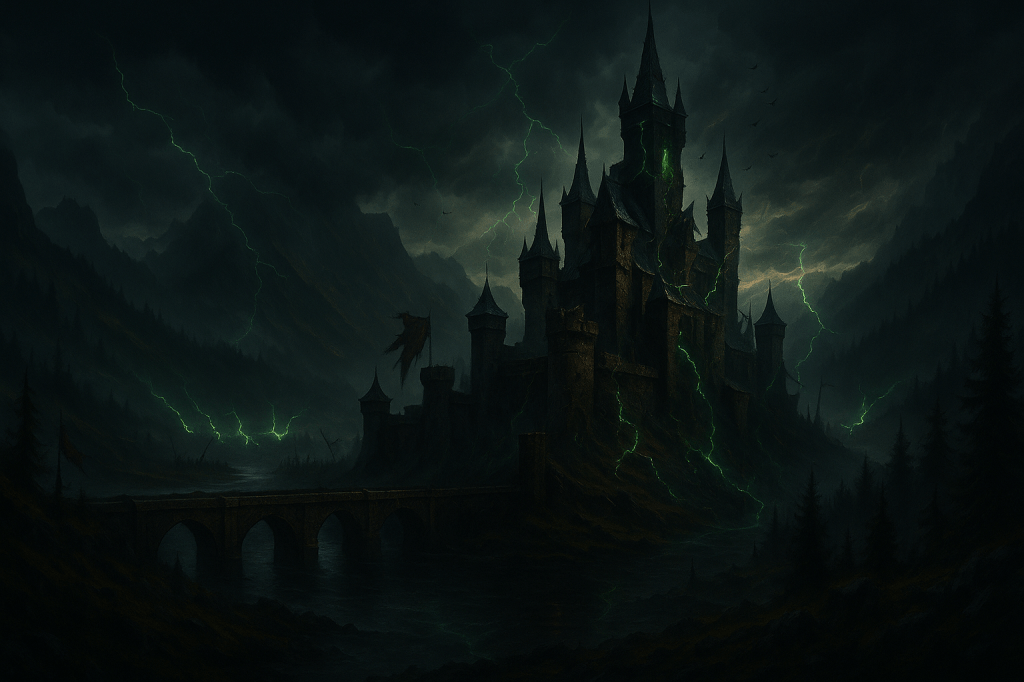
Great kingdoms rarely fall from the outside.
It is within—where whispers are sharper than swords—that ruin is born.


The Court of Shadows

At the height of its splendor, Noctharion was a realm of perfect balance.
Its citadels of obsidian rose like pillars between dawn and night, its banners of crimson and midnight mirrored both blood and storm.
The people of dusk held fast to their oath: to guard the borders between light and dark.

But within the heart of the Seventh Throne, a quieter battle began.

In the Great Hall of Eclipsera, torches burned blue within crystal sconces. Their glow fell across faces lined by suspicion rather than faith. Here sat the high lords and ladies of House Draemyr, once united by blood and purpose, now divided by philosophy.
What began as a debate of destiny became a fracture of the soul.

“We were meant to hold the line,” said one.
“We were meant to command it,” replied another.

The twilight that once shielded the realm had begun to turn upon itself.


Seeds of Pride

It was Lord Veyric Draemyr who first dared to voice what others only whispered.
He stood before the obsidian throne, its surface catching the torchlight like liquid night.

“Why should the dusk kneel before the dawn?” he asked.
“Do we not bear the weight while Gallandor basks in its own light?”

Many agreed in silence. Others, loyal to the old vows, shifted uneasily.
Among them was Prince Althar, his nephew, who saw in his uncle’s words not strength—but hunger.

That hunger spread faster than plague.


The Four Factions of the Divide

As the court split, so too did the kingdom’s spirit. Four banners were raised within the same walls:

1. The Iron Loyalists — those who clung to the oath of balance and defended Gallandor’s alliance, led by General Kaelor the Younger.
Their fortresses held the northern passes, still bearing the old sigil of the dusk-crown encircled by light.

2. The Shadowborn — Veyric’s followers, who claimed dusk was destiny, not duty.
They believed Noctharion should rule, not guard. Their emblem became the broken circle, a crown eclipsing the sun.

3. The Veiled Ones — scholars and seers who delved into forbidden magic.
They sought communion with powers beyond the Veil, believing knowledge itself could crown kings.
Among them, Lady Thalyss Draemyr whispered to mirrors and fire, learning tongues that had not been heard since the First Age.

4. The Betrayers — mercenaries and nobles who sold allegiance to whichever side promised them more.
It was they who opened the first gates in the walls and bartered secrets to unseen voices that spoke in dreams.

Each faction believed they alone carried the future of dusk.
Together, they forged the beginning of its end.


The Whisper of Ash

The dreams began soon after.
Lords woke with soot upon their palms. Priests heard hymns in reverse.
Children wept in sleep, saying a voice called from “beyond the mirror.”

That was the first sign of the Ash-Whisper—a disembodied promise echoing through obsidian halls.

“Why stand as the wall… when you might be the throne?”

It spoke differently to each heart.
To the proud, it promised dominion.
To the fearful, security.
To the grieving, resurrection.

And so began the quiet servitude of a people who believed they were free.


The Feast of Knives

On the eve of the Feast of Duskwatch, House Draemyr gathered to celebrate the old oaths of unity.
But unity was already ash.
Poison turned wine to black fire; daggers flashed in the candlelight.
By dawn, twenty-three nobles lay dead across the marble floors.
The banners of dusk were taken down and burned in the courtyards below.

That night, Lord Veyric Draemyr declared himself the True King of Twilight,
and the realm shuddered as the first civil war began.


The Siege of Veylric Hold

The Iron Loyalists gathered at Veylric Hold, the last fortress still sworn to Gallandor.
Its walls of basalt stood six hundred feet high, carved into the cliffs of the Dusk Sea.
But the Shadowborn came with fire.
Not the kind made by men—but by something older.

Veilfire.

The sky turned green. Shadows bled from the stone.
When the hold finally fell, the rivers ran black for seven days.
From that ruin, the Shadowborn built their new capital, Nareth Kûl, upon bones and cinders.
It would one day become the Black Spire.


The Legacy of Division

When the war at last ended, Noctharion no longer existed.
It was a realm of graves and ghosts.
The Draemyr name—once a banner of strength—became a curse.

From its ashes rose the prophecy that would one day echo through the Ash & Veil Chronicles:

“When the wall breaks itself, the ash will not need to knock.”


Behind the Writing

The Veylric Divide is the tragedy of pride made manifest.
Where Part I showed Noctharion’s majesty, this chapter reveals the poison in its veins.
I wanted the court politics to feel operatic—honor giving way to ego, loyalty to ideology, until even the stars seem to turn against them.

The Ash-Whisper introduces the Dread King’s earliest reach, a subtle infection rather than conquest.
From this moment on, every act of ambition across Eldoria traces its shadow back to this night of knives and green fire.


Until Next Time…

Next comes Part III — The Morghast Curse,
when the fractured soul of the Dread King returns through those who once believed they had destroyed him. The night has only begun to burn.

Durhaven: The Stone Bastion of Men

Every realm of Eldoria has its strength. Gallandor holds the crown, Stormhold rules the seas, and Silvermoon gazes at the stars. But Durhaven? Durhaven is the fortress of humanity itself — the kingdom that stands like a shield between the heartlands of Arathia and the encroaching dark.

Known as the Stone Bastion, Durhaven was born from resilience. Its people carved citadels into stone hills and valleys, its kings hammered law into discipline, and its armies have stood like iron walls against the storms of history.


The Capital of Durhold

At the heart of Durhaven lies Durhold, a mighty fortress-city of gray stone. Rising above the River Dur, its towers and battlements seem less built than grown from the very bones of the earth.

Durhold is not only a citadel but a thriving hub:

  • The Great Hall – seat of House Durain and the political heart of the kingdom.
  • The Market Quarter – bustling with farmers, smiths, and merchants who keep Durhaven alive through trade.
  • The Catacombs of Durhaven – vast, ancient tunnels beneath the city, once used to shelter the people during sieges. They now serve as ancestral tombs, reliquaries of relics, and chambers where whispers linger long after words are spoken.
  • The Chamber of Echoes – hidden deep in the catacombs, a sanctum where kings and queens meet in secret and oaths are bound by stone and silence.

Durhold is a city of strength and secrecy — open to the sun above, yet rooted in shadowed halls below.


House Durain – Guardians of Men

House Durain has ruled Durhaven since its founding, their line bound to stone as firmly as their fortresses.

  • King Alden Durain – A stern and pragmatic ruler, famed for his military genius and his mastery of fortifications. He is protector and strategist, forever wary of shadow and betrayal.
  • Queen Mara Durain – A woman of keen intellect and sharper diplomacy. Where Alden rules the battlefield, she rules the council, ensuring Durhaven’s stability through trade and reform.
  • Prince Darian Durain – Charismatic, courageous, and beloved by his people. But his love for Princess Elara of Silvermoon defied every boundary of blood and custom. Their forbidden union birthed Iogro and Searanore — half-human, half-elven twins, whose very existence ties Durhaven to prophecy itself.

House Durain embodies discipline and sacrifice. They see themselves as the shield of mankind, tasked with enduring what other kingdoms cannot.


Culture of Durhaven

The people of Durhaven are hardy and proud. They are farmers in fertile valleys, soldiers in stone keeps, and masons who build walls that endure for centuries.

  • Military Tradition – Durhaven commands one of the strongest human armies, with disciplined legions, armored cavalry, and master tacticians. Their engineers craft the finest siege engines in Eldoria.
  • Agriculture – The River Dur feeds sprawling farmlands, making Durhaven one of the breadbaskets of Arathia. Their food sustains allies and armies alike.
  • Architecture – Sturdy, austere, and enduring. Castles and villages alike are built with an eye toward survival, not ornament.
  • Values – Honor, loyalty, resilience, and discipline. They prize order above passion, duty above whim.

Yet this strength is also their weakness. Their suspicion of outsiders — especially of Elves and magic — has often set them at odds with Silvermoon and Greenwood.


Role in Prophecy

Durhaven’s place in the saga is as unshakable as its stone. It is the military bulwark of humanity, the kingdom that refuses to fall no matter the storm.

But through Prince Darian’s love for Elara of Silvermoon, Durhaven became bound to a destiny far larger than stone and steel. Their children, Iogro and Searanore, embody the unity of human and elf, north and south, discipline and dream.

The Chamber of Echoes and the catacombs beneath Durhold hold secrets yet to be revealed — relics, oaths, and truths that may decide whether prophecy is fulfilled or broken.


Durhaven’s Place in Eldoria

If Gallandor is the crown, and Stormhold the shield, Durhaven is the wall.

It is the stone that stands against shadow. The hammer that builds, the fortress that holds, and the oath that does not break.

But walls can crack. And when prophecy knocks at its gates — in the form of Iogro, Searanore, and the Brothers Three — Durhaven must decide whether to cling to its traditions or embrace the unity that may yet save the world.


Behind the Writing

Durhaven has always been my way of exploring the discipline and weight of humanity in fantasy storytelling. Where Gallandor is steeped in prophecy and Silvermoon in arcane wisdom, Durhaven is about endurance — the grit of men and women who hold the line, who may not always understand magic but who understand sacrifice.

When I first began shaping Durhaven, I wanted it to feel like a kingdom that could have existed in our own history — a place of legions, stone, and honor — but layered with fantasy depth. Its catacombs, its secret chambers, and its forbidden love story with Silvermoon gave it a personal connection to the saga that surprised even me as I wrote it.

Durhaven, for me, is not just about armies or walls. It’s about what humanity clings to when shadow presses in. It’s about oaths, family, and what happens when even stone must bend.


Until Next Time…

Durhaven is but one stone in the great wall of Eldoria’s kingdoms. Next, we will journey into Ironclad, the Stone Kingdom of the dwarves, where molten forges burn and runes are hammered into steel. After that, we will descend into the shadowed ruins of Barakthûn.

But here in Durhaven, the wall still holds. The legions still march. The oaths still bind.

If Durhaven falls, what wall will stand in its place?

Stormhold: The Ocean Throne

Every kingdom of Eldoria bears a crown, but Stormhold wears the sea itself. Known as the Ocean Throne, it is a realm carved from cliff and wave, where lightning scorches the sky and storms pound the shore. Here, a people have been forged by the tempest — warriors and sailors who believe that only the sea decides who lives and who dies.

Stormhold is both fortress and fleet. Both storm and sanctuary. Both shield and spear. If Gallandor is the heart of Eldoria, Stormhold is its shield.

Its people are hard, proud, and unyielding. Their creed is simple: “The Sea Chooses.”


The Realm of Storms

Stormhold rises where the eastern cliffs of Arathia meet the wrath of the ocean. Its capital, Stormwatch (called Cael’Tharn by locals), is a fortress-city carved into cliffs of black basalt. Harbors open into storm-lashed caverns, where enchanted fleets ride the endless swells. Above them rise storm-spires, jagged towers that glow faintly when lightning dances across their walls.

The coast itself is treacherous — jagged shoals, whirlpools, and tide-caves litter its shores. To outsiders, Stormhold’s seas are death. To Stormholders, they are home.

Atop a high headland rises Cael’Tharn Citadel, lighthouse-fortress of House Draeven, where the great storm-lanterns burn and Tempest Readers train to bend lightning into wards and weapons.

Stormhold is not a kingdom of walls alone — it is a kingdom of storms. Its geography is both shield and trial, isolating its people from inland politics yet binding them to the sea that sustains and defines them.


House Caelthar — The Royal Bloodline

The true rulers of Stormhold are House Caelthar, tracing their line back to Kaelthar the Wave-Breaker, the first to master the ocean and raise Stormwatch above the cliffs. They bear the title “Masters of the Ocean Throne.”

  • King Harad Caelthar — Warrior-king, both sailor and monarch. Known for leading fleets in person, steering ships through typhoons, and wielding a stormforged blade said to channel thunder itself.
  • Queen Elenya Caelthar — Former admiral of the Gray Fleet, famed strategist, and called “the Helm of the Kingdom.” Her counsel is as trusted as Harad’s sword.
  • Princess Searanore Caelthar — Raised as heir of Stormhold, taught navigation, weather-lore, and command. To all, she is the Daughter of the Sea. Yet her true heritage carries a secret that binds her to prophecy and to the Brothers Three.

Crest: A silver trident struck by lightning over midnight waves.
Motto: “The Sea Chooses.”


House Draeven — The Stormriders

Though House Caelthar rules, House Draeven are Stormhold’s other throne. Sworn vassals, they are the legendary Stormriders — sea-wardens, storm-mages, and custodians of the Gray Fleet.

  • Lord Maelric Draeven — Master of the Gray Fleet.
  • Lady Ysira Draeven — Keeper of the Thunderlore, a tradition of weather-mages who “read the skies” and call lightning in battle.
  • Stormrider Cadets — Young sea-knights who prove their worth by sailing into tempests as a rite of passage. Only survival earns them their name.

House Draeven holds Cael’Tharn itself, their lighthouse-citadel serving as naval citadel, weather-mage academy, and cultural emblem of Stormhold’s stormlore. Revered by many, feared by more, they are whispered to be half-blooded with elemental sea-spirits.

The Caelthars and Draevens feud as often as they ally — one family ruling by steel and crown, the other by storms and omens. Yet together, their bond makes Stormhold unconquerable.


Culture of Stormhold

Stormhold is a people of storms. Their lives are measured by tides, their fates by thunder.

  • Seafaring Dominion — The Gray Fleets are Eldoria’s largest navy, warded with weather-charms that allow them to sail through tempests where others would sink. No fleet in Arathia rivals their seamanship.
  • Weather-Magic — Stormhold battlemages wield thunder, lightning, and wave. Tempest Readers treat storms as living beings — listening, learning, bending. Their magic is revered as the kingdom’s divine shield.
  • Isolationist Tradition — Stormhold keeps aloof from mainland politics, its storms serving as natural walls. To outsiders, Stormholders seem harsh, proud, and unyielding. To themselves, they are chosen of the sea.
  • Trial by Storm — Stormhold’s youth earn adulthood not by age but by braving the sea. To sail into a tempest and return alive is to be counted among Stormhold’s true.

Stormhold is less a kingdom of stone than a covenant of storm and sea.


The Secret of Searanore

Though she bears the name Caelthar, Searanore’s true bloodline is hidden. She is the twin sister of Iogro Merrybelly — daughter of Princess Elara of Silvermoon and Prince Darian of Durhaven. To shield her from The Dread Kings assassins, she was fostered into House Caelthar at birth and raised as their heir.

Raised with Stormrider discipline and sea-lore, she became both navigator and weather-reader, embodying the storm itself. Yet her heritage unites three great lines:

  • Elven wisdom (Silvermoon)
  • Human strength (Durhaven)
  • Oceanic dominion (Stormhold)

Her destiny fulfills a hidden verse of prophecy:

“When storm and shadow meet the flame,
The twin-tide’s truth shall bear her name.”

She is both breaker of storms and bridge of kingdoms — but her secret, if revealed, could shatter the trust of House Caelthar and unravel Stormhold itself.


Strengths & Weaknesses

Strengths

  • Naval supremacy unrivaled in Eldoria.
  • Storm-wielding battlemages.
  • Cliffside fortresses near-impregnable.
  • Prophecy embodied in Searanore.

Weaknesses

  • Reliant on seas and storms for defense.
  • Harsh winters and poor harvests, dependent on trade.
  • Rivalries between House Caelthar and House Draeven.
  • Fragility of Searanore’s secret heritage.

Stormhold’s Place in the War

Stormhold is the fulcrum of Eldoria’s seas. Without its fleets, no kingdom can master the oceans. Without its storms, Arathia’s coasts are bare. Yet Stormhold stands on a knife’s edge: one revelation, one betrayal, and its waves may drown allies as swiftly as enemies.

If Gallandor is Eldoria’s heart, Stormhold is its shield — forged of salt, steel, and storm.


Behind the Writing

Stormhold is one of my favorite realms to design because it marries raw natural power with dynastic secrecy. The sea here is not just backdrop — it is character, judge, and executioner.

With Searanore’s hidden bloodline, Stormhold becomes more than a naval kingdom — it becomes prophecy’s keystone. That tension — between isolation and alliance, truth and deception, storm and shore — is what makes Stormhold one of the most dangerous, and most necessary, kingdoms in Eldoria.

When the sea chooses, who dares defy the tide?


Until Next Time…

Stormhold is only one voice in the chorus of Eldoria’s kingdoms. Next, we descend into the stone halls of Ironclad, where dwarves forge runes of power and hammer prophecy into steel. From there, we will venture to Durhaven, and finally to Barakthûn, the shadow of a kingdom lost.

But Stormhold stands now as the Ocean Throne. A realm of storms and sailors. A kingdom where the sea itself chooses who shall rise — and who shall drown.

If the storms turn against Eldoria, who then can weather the tide?