Great kingdoms rarely fall from the outside. It is within—where whispers are sharper than swords—that ruin is born.
The Court of Shadows
At the height of its splendor, Noctharion was a realm of perfect balance. Its citadels of obsidian rose like pillars between dawn and night, its banners of crimson and midnight mirrored both blood and storm. The people of dusk held fast to their oath: to guard the borders between light and dark.
But within the heart of the Seventh Throne, a quieter battle began.
In the Great Hall of Eclipsera, torches burned blue within crystal sconces. Their glow fell across faces lined by suspicion rather than faith. Here sat the high lords and ladies of House Draemyr, once united by blood and purpose, now divided by philosophy. What began as a debate of destiny became a fracture of the soul.
“We were meant to hold the line,” said one. “We were meant to command it,” replied another.
The twilight that once shielded the realm had begun to turn upon itself.
Seeds of Pride
It was Lord Veyric Draemyr who first dared to voice what others only whispered. He stood before the obsidian throne, its surface catching the torchlight like liquid night.
“Why should the dusk kneel before the dawn?” he asked. “Do we not bear the weight while Gallandor basks in its own light?”
Many agreed in silence. Others, loyal to the old vows, shifted uneasily. Among them was Prince Althar, his nephew, who saw in his uncle’s words not strength—but hunger.
That hunger spread faster than plague.
The Four Factions of the Divide
As the court split, so too did the kingdom’s spirit. Four banners were raised within the same walls:
1. The Iron Loyalists — those who clung to the oath of balance and defended Gallandor’s alliance, led by General Kaelor the Younger. Their fortresses held the northern passes, still bearing the old sigil of the dusk-crown encircled by light.
2. The Shadowborn — Veyric’s followers, who claimed dusk was destiny, not duty. They believed Noctharion should rule, not guard. Their emblem became the broken circle, a crown eclipsing the sun.
3. The Veiled Ones — scholars and seers who delved into forbidden magic. They sought communion with powers beyond the Veil, believing knowledge itself could crown kings. Among them, Lady Thalyss Draemyr whispered to mirrors and fire, learning tongues that had not been heard since the First Age.
4. The Betrayers — mercenaries and nobles who sold allegiance to whichever side promised them more. It was they who opened the first gates in the walls and bartered secrets to unseen voices that spoke in dreams.
Each faction believed they alone carried the future of dusk. Together, they forged the beginning of its end.
The Whisper of Ash
The dreams began soon after. Lords woke with soot upon their palms. Priests heard hymns in reverse. Children wept in sleep, saying a voice called from “beyond the mirror.”
That was the first sign of the Ash-Whisper—a disembodied promise echoing through obsidian halls.
“Why stand as the wall… when you might be the throne?”
It spoke differently to each heart. To the proud, it promised dominion. To the fearful, security. To the grieving, resurrection.
And so began the quiet servitude of a people who believed they were free.
The Feast of Knives
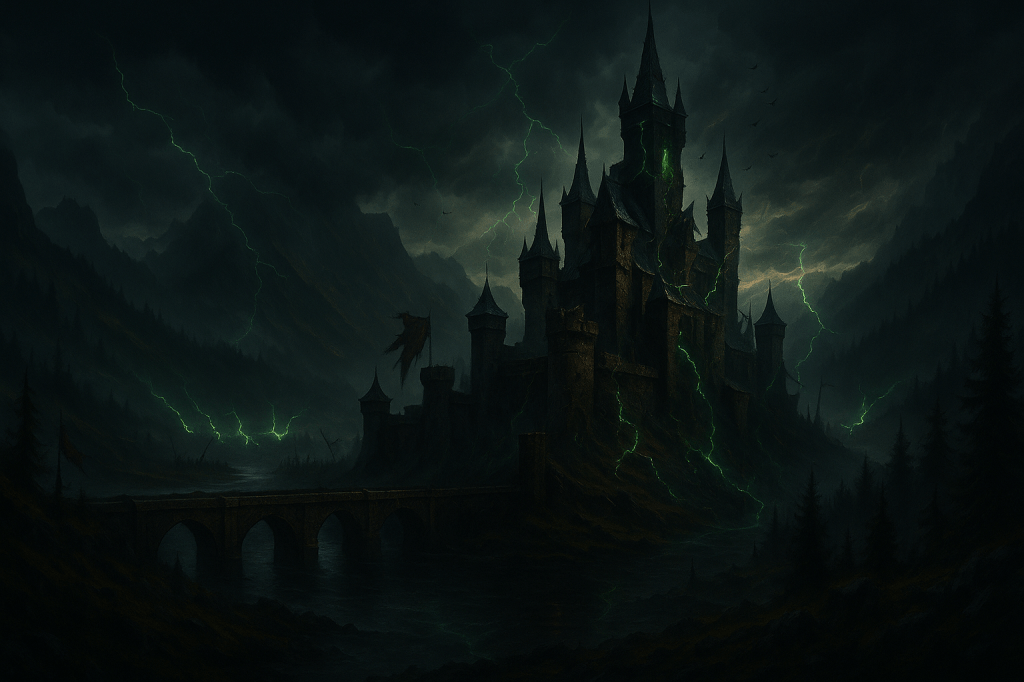
On the eve of the Feast of Duskwatch, House Draemyr gathered to celebrate the old oaths of unity. But unity was already ash. Poison turned wine to black fire; daggers flashed in the candlelight. By dawn, twenty-three nobles lay dead across the marble floors. The banners of dusk were taken down and burned in the courtyards below.
That night, Lord Veyric Draemyr declared himself the True King of Twilight, and the realm shuddered as the first civil war began.
The Siege of Veylric Hold
The Iron Loyalists gathered at Veylric Hold, the last fortress still sworn to Gallandor. Its walls of basalt stood six hundred feet high, carved into the cliffs of the Dusk Sea. But the Shadowborn came with fire. Not the kind made by men—but by something older.
Veilfire.
The sky turned green. Shadows bled from the stone. When the hold finally fell, the rivers ran black for seven days. From that ruin, the Shadowborn built their new capital, Nareth Kûl, upon bones and cinders. It would one day become the Black Spire.
The Legacy of Division
When the war at last ended, Noctharion no longer existed. It was a realm of graves and ghosts. The Draemyr name—once a banner of strength—became a curse.
From its ashes rose the prophecy that would one day echo through the Ash & Veil Chronicles:
“When the wall breaks itself, the ash will not need to knock.”
Behind the Writing
The Veylric Divide is the tragedy of pride made manifest. Where Part I showed Noctharion’s majesty, this chapter reveals the poison in its veins. I wanted the court politics to feel operatic—honor giving way to ego, loyalty to ideology, until even the stars seem to turn against them.
The Ash-Whisper introduces the Dread King’s earliest reach, a subtle infection rather than conquest. From this moment on, every act of ambition across Eldoria traces its shadow back to this night of knives and green fire.
Until Next Time…
Next comes Part III — The Morghast Curse, when the fractured soul of the Dread King returns through those who once believed they had destroyed him. The night has only begun to burn.
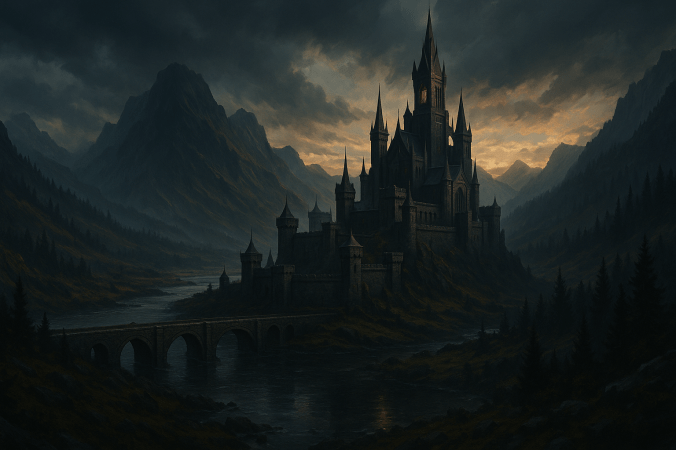
Before Barakthûn was cursed, before the shadow consumed the land, there was Noctharion — the Seventh Throne. It was not yet the Fallen Kingdom. It was the Twilight Realm.
Where Gallandor gleamed with marble and sunlight, Noctharion stood in basalt and obsidian. Its skies were often storm-shrouded, its rivers deep and dark, its mountains black as iron. And yet, in this brooding beauty, there was majesty.
Noctharion was meant to be balance. Where Gallandor raised banners of gold and white, Noctharion flew crimson and midnight. Where Gallandor built temples to the Light, Noctharion raised citadels of endurance — fortresses meant to hold the line when others faltered.
They were not cruel, but they were proud. Not shining, but steadfast. Not joyous, but resolute.
It was dusk made kingdom.
The Twilight Realm
The Seventh Kingdom was carved from black stone cliffs, its fortresses rising like thorns against the horizon. Obsidian spires crowned its citadels, and basalt roads cut across the valleys like veins of shadow.
Its people believed themselves guardians of the dusk — the shield between the brilliance of Gallandor and the wild darkness beyond. They found beauty not in brightness, but in the strength to endure.
Among the Seven Thrones, they were the Iron Fist — the kingdom others trusted to hold the borders when the world trembled.
House Draemyr – The Twilight Bloodline
The rulers of Noctharion sat upon the Seventh Throne, proud and unyielding. The Draemyr line was famed for its fortress-lords, warrior-queens, and generals who shaped dusk into a weapon.
Ancestral Legacy
Valryon Draemyr – Founder of the line, called the Twilight Lord. Built the first obsidian citadels, declaring dusk as the shield between light and dark.
King Athelion Draemyr – The Stone Sentinel. Known for fortifying the borders of Eldoria with unbreakable bastions and commanding legions that never broke rank.
Queen Seranyth Draemyr – The Iron Rose. A warrior-queen who rode at the head of her armies and is said to have slain a giant alone at the Battle of Duskwatch.
Lord Malrec Draemyr – The Iron Voice. Famous for his uncompromising discipline and oratory; his decrees were said to echo across the mountains long after he was gone.
King Kaelor I Draemyr – The Shadowed Crown. Questioned why Noctharion should kneel beneath Gallandor’s light, planting the first seeds of ambition that would one day bloom into ruin.
The Later Line
Lord Veyric Draemyr – The most ambitious of his line. His reign marked the first whispers of division within the House, as branches of the family split between loyalty to Gallandor and hunger for power. His name would one day give rise to the Veylric Divide.
Lady Thalyss Draemyr – A courtly mastermind whose cunning words bent lords as surely as blades. Whispers claimed she courted shadows long before the kingdom itself fell to them.
Prince Althar Draemyr – The last heir before the fall into Morghast. A brilliant commander and tactician, but too proud to see the corruption seeping into his own bloodline.
Legacy of the Seventh Throne
The Draemyr dynasty embodied dusk — not light, not darkness, but the strength of the in-between. Yet within that strength grew a fatal flaw: the belief that they should not guard the crown, but be the crown.
That flaw fractured their House, leaving it vulnerable to whispers of power and, eventually, to the corruption that would make Noctharion the seedbed of Barakthûn.
Themes of Noctharion
Majesty of Shadow – Beauty found in endurance, dusk, and storm. Pride of Guardianship – The conviction that they alone were strong enough to defend Eldoria. The First Cracks – Seeds of ambition, jealousy, and hunger for dominion that set them apart from Gallandor’s unity.
Behind the Writing
Noctharion was always meant to stand apart. If Gallandor was the crown, Noctharion was the clenched fist.
Writing it as a kingdom of dusk and brooding beauty gave me the contrast I wanted against Gallandor’s marble light and Silvermoon’s starlit grace.
I wanted readers to feel the tragedy of it — that this kingdom wasn’t born wicked. It was noble, strong, even necessary. But nobility turned to ambition, and ambition turned to ruin. To me, that makes the fall into Barakthûn all the more heartbreaking.
Until Next Time…
Noctharion is only the beginning of the Seventh Kingdom’s tale.
Next, we’ll explore The Veylric Divide — how ambition split House Draemyr, how whispers of power fractured their unity, and how the Twilight Realm began its slow descent into shadow.
If dusk can be corrupted… what hope then for the crown of day?
Every mountain in Eldoria has a voice, but only one roars with the sound of hammer and flame. Ironclad, the Forgestone Kingdom, is a realm where stone and fire meet, where bloodlines are tempered like steel, and where dwarves walk taller, prouder, and fiercer than any legend told in the halls of men.
Forged in the First Age, when Durak Forgestone united the mountain clans after the First Sundering, Ironclad has stood as the beating heart of dwarven resilience, the anvil upon which the fate of kingdoms is often struck.
The Realm of Ironclad
Ironclad lies in the Firepeak Mountains, its capital Stoneforge Keep carved into the roots of living rock. Great rune-lit halls stretch for miles, their walls veined with molten ore, their pillars engraved with the histories of clans long past.
The Great Anvil Hall, throne room, and forge combined, burn eternally with forge-fires, where kings sit not above their people but among their craft. When judgment is passed, it is done beneath hammer and flame.
The land above is harsh and winter-bound, forcing most of Ironclad’s people into the undercities. Caverns, bridges, and labyrinthine mines stretch beneath the mountains, where rivers of crystal and fire illuminate cities carved from shadow and stone.
House Brannok – The Forgestone Bloodline
Ironclad’s ruling house traces back to Durak Forgestone (Durak Brannok I), the founder-king who forged the Runeblade Ankar’dûm and bound the mountain clans into a single kingdom. His line became the Brannoks, known as the Forgestone Bloodline.
Ancestral Legacy
Durak Forgestone (Durak I) – Founder, first wielder of Ankar’dûm, united the clans.
King Brannok II “The Iron-Banner” – Rallied armies, established the Iron Banner of unity.
Princess Kaela Brannok – Founded the Emberguard, elite shieldmaidens who fight as queens’ protectors.
Queen Mara Brannok “The Flame-Tongue” – First queen to rule alone; her speeches stirred armies like wildfire.
Queen Veyra Brannok “The Steel Rose” – Legendary beauty and warrior, remembered in songs of both love and battle.
The Current Line
King Torvald Brannok – Broad-shouldered warrior-king, smith of renown, but heavy with the weight of tradition.
Queen Sigrid Brannok – Once commander of the Emberguard, famed for her beauty and battlefield ferocity.
Crown Prince Halrik Brannok – Strong heir, yet torn between duty and wanderlust.
Princess Kaelith Brannok – Striking, politically shrewd, whispered to be courted by Greenwood nobility.
Prince Dorn Brannok – Youngest, mischievous, and a genius of runecraft, underestimated by many.
The Brannoks embody Ironclad’s creed: to be both hammer and flame, builders and destroyers, bound to legacy and prophecy alike.
The Dwarves of Ironclad – Distinct and Reimagined
Ironclad dwarves are not the squat miners of old tales. They are taller, closer to human stature, but broader and denser in build, their frames carved by the forge.
Physique – Men stand between 5’2” and 5’10”, heavily muscled, with chiseled features. Women are striking, powerful, and renowned for their beauty as much as their strength.
Beards & Hair – Men keep shorter, braided beards; some are clean-shaven. Women wear elaborate braids to signify rank, lineage, or warrior vows.
Skin & Eyes – Tones of bronze, copper, obsidian, or pale silver-gray. Eyes glimmer like jewels or molten gold.
Culture – Family is sacred. Every child’s birth is recorded in stone tablets marked with destiny. Love is fierce, enduring, and sung in feasts that last weeks.
Warriors & Forge
Ironclad dwarves are unmatched in smithcraft and war:
Weapons – Rune-carved hammers, axes, and greatswords. Women favor twin axes or spear-shield formations.
Tactics – Shock infantry backed by rune-powered war machines. Their siege engines once brought down Malakaroth’s fortress walls.
Emberguard – Elite shieldmaidens, commanded by queens, as deadly as any male phalanx.
To fight as Ironclad is to see war not as bloodshed, but as sacred duty.
Role in History & Prophecy
Ironclad has long stood as a bulwark in the wars of Eldoria:
The First War – Their siegecraft helped end Malakaroth’s reign, bringing down the Dread King’s fortresses.
Alliances – Bound to Gallandor by marriage, their trade and smithing enriched the High Kingdom’s armies.
Prophecy – A verse hidden in the rune-archives declares:
“From fire and stone shall rise beauty and blood, When the shadow returns, Ironclad shall stand — Neither man nor elf, but forged in both.”
This prophecy speaks not only of their mixed stature and heritage, but of a destiny that ties Ironclad directly to the final war.
Strengths & Weaknesses
Strengths:
Supreme smithing and rune-magic craft.
Fearless warriors and shock infantry.
Emberguard’s unmatched shieldmaiden ranks.
Strong alliances with Gallandor and Greenwood.
Weaknesses:
Pride and ambition often cause clan feuds.
Vulnerable to betrayal from within.
Haunted by the prophecy — some fear it will undo them.
Behind the Writing
Ironclad began for me as a way to reimagine dwarves beyond their stereotypes. I wanted a people who weren’t bound to being “short, drunken miners,” but a race of warriors and smiths who carried themselves with the nobility of men and the fire of their mountain forges.
Designing Ironclad became a blend of myth and reinvention: taller dwarves, fierce shieldmaidens, a society where passion, tradition, and artistry burn as brightly as war. Their culture became not just one of survival, but of legacy — every name carved into stone, every weapon a story, every queen and king part of an unbroken chain.
Until Next Time…
Ironclad is the hammer of Eldoria, the forge where prophecy itself is tempered. But not all kingdoms remain whole.
Next, we descend into Barakthûn, the Fallen Kingdom, now a shadowed realm where crowns burn with green fire and the lands have been twisted by Malakaroth’s curses.
If Ironclad is the anvil of hope, Barakthûn is the echo of ruin.
What happens when fire that was meant to forge is turned to ash?
Every realm of Eldoria has its strength. Gallandor holds the crown, Stormhold rules the seas, and Silvermoon gazes at the stars. But Durhaven? Durhaven is the fortress of humanity itself — the kingdom that stands like a shield between the heartlands of Arathia and the encroaching dark.
Known as the Stone Bastion, Durhaven was born from resilience. Its people carved citadels into stone hills and valleys, its kings hammered law into discipline, and its armies have stood like iron walls against the storms of history.
The Capital of Durhold
At the heart of Durhaven lies Durhold, a mighty fortress-city of gray stone. Rising above the River Dur, its towers and battlements seem less built than grown from the very bones of the earth.
Durhold is not only a citadel but a thriving hub:
The Great Hall – seat of House Durain and the political heart of the kingdom.
The Market Quarter – bustling with farmers, smiths, and merchants who keep Durhaven alive through trade.
The Catacombs of Durhaven – vast, ancient tunnels beneath the city, once used to shelter the people during sieges. They now serve as ancestral tombs, reliquaries of relics, and chambers where whispers linger long after words are spoken.
The Chamber of Echoes – hidden deep in the catacombs, a sanctum where kings and queens meet in secret and oaths are bound by stone and silence.
Durhold is a city of strength and secrecy — open to the sun above, yet rooted in shadowed halls below.
House Durain – Guardians of Men
House Durain has ruled Durhaven since its founding, their line bound to stone as firmly as their fortresses.
King Alden Durain – A stern and pragmatic ruler, famed for his military genius and his mastery of fortifications. He is protector and strategist, forever wary of shadow and betrayal.
Queen Mara Durain – A woman of keen intellect and sharper diplomacy. Where Alden rules the battlefield, she rules the council, ensuring Durhaven’s stability through trade and reform.
Prince Darian Durain – Charismatic, courageous, and beloved by his people. But his love for Princess Elara of Silvermoon defied every boundary of blood and custom. Their forbidden union birthed Iogro and Searanore — half-human, half-elven twins, whose very existence ties Durhaven to prophecy itself.
House Durain embodies discipline and sacrifice. They see themselves as the shield of mankind, tasked with enduring what other kingdoms cannot.
Culture of Durhaven
The people of Durhaven are hardy and proud. They are farmers in fertile valleys, soldiers in stone keeps, and masons who build walls that endure for centuries.
Military Tradition – Durhaven commands one of the strongest human armies, with disciplined legions, armored cavalry, and master tacticians. Their engineers craft the finest siege engines in Eldoria.
Agriculture – The River Dur feeds sprawling farmlands, making Durhaven one of the breadbaskets of Arathia. Their food sustains allies and armies alike.
Architecture – Sturdy, austere, and enduring. Castles and villages alike are built with an eye toward survival, not ornament.
Values – Honor, loyalty, resilience, and discipline. They prize order above passion, duty above whim.
Yet this strength is also their weakness. Their suspicion of outsiders — especially of Elves and magic — has often set them at odds with Silvermoon and Greenwood.
Role in Prophecy
Durhaven’s place in the saga is as unshakable as its stone. It is the military bulwark of humanity, the kingdom that refuses to fall no matter the storm.
But through Prince Darian’s love for Elara of Silvermoon, Durhaven became bound to a destiny far larger than stone and steel. Their children, Iogro and Searanore, embody the unity of human and elf, north and south, discipline and dream.
The Chamber of Echoes and the catacombs beneath Durhold hold secrets yet to be revealed — relics, oaths, and truths that may decide whether prophecy is fulfilled or broken.
Durhaven’s Place in Eldoria
If Gallandor is the crown, and Stormhold the shield, Durhaven is the wall.
It is the stone that stands against shadow. The hammer that builds, the fortress that holds, and the oath that does not break.
But walls can crack. And when prophecy knocks at its gates — in the form of Iogro, Searanore, and the Brothers Three — Durhaven must decide whether to cling to its traditions or embrace the unity that may yet save the world.
Behind the Writing
Durhaven has always been my way of exploring the discipline and weight of humanity in fantasy storytelling. Where Gallandor is steeped in prophecy and Silvermoon in arcane wisdom, Durhaven is about endurance — the grit of men and women who hold the line, who may not always understand magic but who understand sacrifice.
When I first began shaping Durhaven, I wanted it to feel like a kingdom that could have existed in our own history — a place of legions, stone, and honor — but layered with fantasy depth. Its catacombs, its secret chambers, and its forbidden love story with Silvermoon gave it a personal connection to the saga that surprised even me as I wrote it.
Durhaven, for me, is not just about armies or walls. It’s about what humanity clings to when shadow presses in. It’s about oaths, family, and what happens when even stone must bend.
Until Next Time…
Durhaven is but one stone in the great wall of Eldoria’s kingdoms. Next, we will journey into Ironclad, the Stone Kingdom of the dwarves, where molten forges burn and runes are hammered into steel. After that, we will descend into the shadowed ruins of Barakthûn.
But here in Durhaven, the wall still holds. The legions still march. The oaths still bind.
If Durhaven falls, what wall will stand in its place?
Every kingdom of Eldoria bears a crown, but Stormhold wears the sea itself. Known as the Ocean Throne, it is a realm carved from cliff and wave, where lightning scorches the sky and storms pound the shore. Here, a people have been forged by the tempest — warriors and sailors who believe that only the sea decides who lives and who dies.
Stormhold is both fortress and fleet. Both storm and sanctuary. Both shield and spear. If Gallandor is the heart of Eldoria, Stormhold is its shield.
Its people are hard, proud, and unyielding. Their creed is simple: “The Sea Chooses.”
The Realm of Storms
Stormhold rises where the eastern cliffs of Arathia meet the wrath of the ocean. Its capital, Stormwatch (called Cael’Tharn by locals), is a fortress-city carved into cliffs of black basalt. Harbors open into storm-lashed caverns, where enchanted fleets ride the endless swells. Above them rise storm-spires, jagged towers that glow faintly when lightning dances across their walls.
The coast itself is treacherous — jagged shoals, whirlpools, and tide-caves litter its shores. To outsiders, Stormhold’s seas are death. To Stormholders, they are home.
Atop a high headland rises Cael’Tharn Citadel, lighthouse-fortress of House Draeven, where the great storm-lanterns burn and Tempest Readers train to bend lightning into wards and weapons.
Stormhold is not a kingdom of walls alone — it is a kingdom of storms. Its geography is both shield and trial, isolating its people from inland politics yet binding them to the sea that sustains and defines them.
House Caelthar — The Royal Bloodline
The true rulers of Stormhold are House Caelthar, tracing their line back to Kaelthar the Wave-Breaker, the first to master the ocean and raise Stormwatch above the cliffs. They bear the title “Masters of the Ocean Throne.”
King Harad Caelthar — Warrior-king, both sailor and monarch. Known for leading fleets in person, steering ships through typhoons, and wielding a stormforged blade said to channel thunder itself.
Queen Elenya Caelthar — Former admiral of the Gray Fleet, famed strategist, and called “the Helm of the Kingdom.” Her counsel is as trusted as Harad’s sword.
Princess Searanore Caelthar — Raised as heir of Stormhold, taught navigation, weather-lore, and command. To all, she is the Daughter of the Sea. Yet her true heritage carries a secret that binds her to prophecy and to the Brothers Three.
Crest: A silver trident struck by lightning over midnight waves. Motto:“The Sea Chooses.”
House Draeven — The Stormriders
Though House Caelthar rules, House Draeven are Stormhold’s other throne. Sworn vassals, they are the legendary Stormriders — sea-wardens, storm-mages, and custodians of the Gray Fleet.
Lord Maelric Draeven — Master of the Gray Fleet.
Lady Ysira Draeven — Keeper of the Thunderlore, a tradition of weather-mages who “read the skies” and call lightning in battle.
Stormrider Cadets — Young sea-knights who prove their worth by sailing into tempests as a rite of passage. Only survival earns them their name.
House Draeven holds Cael’Tharn itself, their lighthouse-citadel serving as naval citadel, weather-mage academy, and cultural emblem of Stormhold’s stormlore. Revered by many, feared by more, they are whispered to be half-blooded with elemental sea-spirits.
The Caelthars and Draevens feud as often as they ally — one family ruling by steel and crown, the other by storms and omens. Yet together, their bond makes Stormhold unconquerable.
Culture of Stormhold
Stormhold is a people of storms. Their lives are measured by tides, their fates by thunder.
Seafaring Dominion — The Gray Fleets are Eldoria’s largest navy, warded with weather-charms that allow them to sail through tempests where others would sink. No fleet in Arathia rivals their seamanship.
Weather-Magic — Stormhold battlemages wield thunder, lightning, and wave. Tempest Readers treat storms as living beings — listening, learning, bending. Their magic is revered as the kingdom’s divine shield.
Isolationist Tradition — Stormhold keeps aloof from mainland politics, its storms serving as natural walls. To outsiders, Stormholders seem harsh, proud, and unyielding. To themselves, they are chosen of the sea.
Trial by Storm — Stormhold’s youth earn adulthood not by age but by braving the sea. To sail into a tempest and return alive is to be counted among Stormhold’s true.
Stormhold is less a kingdom of stone than a covenant of storm and sea.
The Secret of Searanore
Though she bears the name Caelthar, Searanore’s true bloodline is hidden. She is the twin sister of Iogro Merrybelly — daughter of Princess Elara of Silvermoon and Prince Darian of Durhaven. To shield her from The Dread Kings assassins, she was fostered into House Caelthar at birth and raised as their heir.
Raised with Stormrider discipline and sea-lore, she became both navigator and weather-reader, embodying the storm itself. Yet her heritage unites three great lines:
Elven wisdom (Silvermoon)
Human strength (Durhaven)
Oceanic dominion (Stormhold)
Her destiny fulfills a hidden verse of prophecy:
“When storm and shadow meet the flame, The twin-tide’s truth shall bear her name.”
She is both breaker of storms and bridge of kingdoms — but her secret, if revealed, could shatter the trust of House Caelthar and unravel Stormhold itself.
Strengths & Weaknesses
Strengths
Naval supremacy unrivaled in Eldoria.
Storm-wielding battlemages.
Cliffside fortresses near-impregnable.
Prophecy embodied in Searanore.
Weaknesses
Reliant on seas and storms for defense.
Harsh winters and poor harvests, dependent on trade.
Rivalries between House Caelthar and House Draeven.
Fragility of Searanore’s secret heritage.
Stormhold’s Place in the War
Stormhold is the fulcrum of Eldoria’s seas. Without its fleets, no kingdom can master the oceans. Without its storms, Arathia’s coasts are bare. Yet Stormhold stands on a knife’s edge: one revelation, one betrayal, and its waves may drown allies as swiftly as enemies.
If Gallandor is Eldoria’s heart, Stormhold is its shield — forged of salt, steel, and storm.
Behind the Writing
Stormhold is one of my favorite realms to design because it marries raw natural power with dynastic secrecy. The sea here is not just backdrop — it is character, judge, and executioner.
With Searanore’s hidden bloodline, Stormhold becomes more than a naval kingdom — it becomes prophecy’s keystone. That tension — between isolation and alliance, truth and deception, storm and shore — is what makes Stormhold one of the most dangerous, and most necessary, kingdoms in Eldoria.
When the sea chooses, who dares defy the tide?
Until Next Time…
Stormhold is only one voice in the chorus of Eldoria’s kingdoms. Next, we descend into the stone halls of Ironclad, where dwarves forge runes of power and hammer prophecy into steel. From there, we will venture to Durhaven, and finally to Barakthûn, the shadow of a kingdom lost.
But Stormhold stands now as the Ocean Throne. A realm of storms and sailors. A kingdom where the sea itself chooses who shall rise — and who shall drown.
If the storms turn against Eldoria, who then can weather the tide?
If Gallandor is the mountain and Silvermoon is the sky, then Greenwood is the earth itself. The third of Eldoria’s great kingdoms, Greenwood is not a land built of stone or crowned with towers. It is a realm grown — a living dominion of colossal trees, river-spirits, and druids bound to the heartbeat of the world.
To enter Greenwood is to pass beneath boughs that have stood since the Age of Ashes, where roots coil like serpents, where wolves of ember flame watch from the shadows, and where the very forest may rise in judgment. It is not merely a kingdom — it is a covenant with the land.
The Verdant Wilds
The Greenwood stretches across the heart of the Verdant Wilds, an endless forest where sunlight filters through golden canopies and rivers carve silver veins across the earth. But beneath its beauty lies power.
The Whispering Woods – Sentient groves said to carry voices of the dead. Travelers often hear names spoken on the wind.
The Golden Forest – Heart of Greenwood, its trees shine as if aflame at sunset, but their glow never fades.
Cursed Glades – Battlefields of the First Sundering, where shadows seeped into the soil. No flower grows there, and those who linger too long hear whispers urging them to despair.
The Greenwood is not a passive land. It remembers. It judges. And it does not forgive.
Thal’Emoras: The Living City
Hidden deep within the Golden Forest lies Thal’Emoras, Greenwood’s capital — a city not built, but sung into being.
Its halls are woven into the trunks of colossal golden-wood trees, spiraling upward in layers of vine-bridges and terraces lit by sap-lanterns. Roots form stairways, branches bend into arches, and flame-druids tend torches that burn with green fire, symbols of life and balance.
Notable Landmarks
The Rootspire – A monolith entwined with roots, believed to be where the first druids bound their lives to the land. Lady Myrialis guards it with unyielding zeal.
The Glade of Ancients – A circle of trees so vast their branches weave together like a temple roof. Here, oaths are sworn before the spirits.
Temple of the Verdant Eye – A sanctuary grown from a single tree, its heartwood glowing with emerald flame. Within, seers glimpse visions in fire and leaf.
The Golden Canopy – The highest level of Thal’Emoras, where the Queen’s council meets beneath branches that shimmer like captured sunlight, even in the blackest night.
Thal’Emoras is not merely a city — it is the forest dreaming in stone and song.
House Thalorien – Wardens of the Forest
The rulers of Greenwood are not kings in the manner of Gallandor or Silvermoon. They are wardens, chosen by both blood and the will of the land itself.
Warden-Queen Aerwyn Thalorien – Regal, fierce, and bonded to the Verdant Eye, she carries the Green Sight, hearing whispers of both past and future in the rustling of leaves. Her word is law, not because of crowns, but because the forest itself bows to her.
Prince Faelor Thalorien – Her only son, gifted with spirit-sight but brash and proud. He distrusts men, seeing them as destroyers of balance, and often rivals Iogro Merrybelly with open disdain.
Lady Myrialis – Aerwyn’s sister, Keeper of the Rootspire. A figure of dread and respect, more priestess than noble, who communes with spirits few dare approach.
House Thalorien traces its line back to Eldros the Verdant, the first druid to bind his soul to the Whispering Woods. They are less a dynasty than a covenant — the embodiment of Greenwood’s vow to protect balance at all costs.
The Culture of Greenwood
The Greenwood elves are distinct from their kin of Silvermoon:
Silvermoon → starlight, high magic, crystalline towers, scholars of fate.
Greenwood → roots, druids, torchlight, spirits, guardianship of balance.
Greenwood Traditions
Tree-Song Magic – Elves sing to shape living wood, raising bridges, halls, and even weapons from the forest itself.
Spirit-Binding – Some druids form lifelong pacts with river or beast, drawing strength from their bond.
The Ember Flame – Green fire that symbolizes balance; it is never allowed to extinguish within Thal’Emoras.
Shadowblending – Warriors slip into the forest’s essence, becoming one with shadow and green — perfect scouts and ambushers.
Their lives are not about dominion, but harmony. To Greenwood elves, to cut without blessing or to take without offering is blasphemy.
Greenwood in the Age of Ashes
During the First Sundering, Greenwood stood as the last barrier against Malakaroth’s eastern advance.
When the Dread King’s armies marched, Aerwyn’s ancestors called the forest to war:
Oaks tore their roots from the earth, crushing siege engines.
Wolves cloaked in emerald flame hunted cultists through the night.
Rivers rose in living torrents, drowning entire battalions.
The land itself fought beside Greenwood. But such power came with scars. There are glades that still bleed shadow, and rivers that whisper with voices of drowned soldiers. Greenwood carries those wounds like a crown — a reminder that balance must always be guarded, or it will shatter.
Prophecy in Greenwood
The druids believe the scars of the Brothers Three are not random. They say the Whispering Woods spoke of them long before their birth — three wounds upon the land, born as sons, who would either restore balance or break it forever.
Some claim the markings on their flesh mirror carvings found in the Rootspire itself. Others whisper that one of the Brothers is destined to fall, his death the price of balance.
Whatever the truth, Greenwood watches them with both hope and fear.
Songs of Greenwood
“Beneath the golden boughs we sing, Of fire’s gift and shadow’s sting. The forest wakes, the spirits cry, Balance holds, or all will die.”
Behind the Writing
Greenwood has always been, for me, the “soul” of Eldoria. Where Gallandor is weight and vigilance, and Silvermoon is mysticism and prophecy, Greenwood is life itself. It’s the reminder that the world is not just kingdoms and crowns, but roots and rivers and spirits older than men or elves.
I wanted Greenwood to feel as dangerous as it feels beautiful. A kingdom you would long to see, yet fear to offend. A place where nature does not serve you — it tests you.
It also reflects my love for being outdoors, for forests that feel alive. Greenwood isn’t just a fantasy forest — it’s what forests feel like when you’re standing in them, listening to the wind and realizing you are very small.
Until Next Time…
Greenwood is the third of the Seven Kingdoms, and one of the most primal. In the weeks to come, we’ll sail the storm-lashed cliffs of Stormwatch, delve into the fiery forges of Ironclad, and walk the frozen halls of Durhaven.
But for now, we leave Greenwood — a realm of druids and spirits, where the forest itself remembers the Age of Ashes, and where balance is both gift and burden.
Before the Brothers Three, before the Spindelum of Time, there was the war that nearly broke the world. The old songs call it the First Sundering. The people remember it as the Age of Ashes.
The War of All
It began over a thousand years ago, when Malakaroth, the Dread King, rose from the shadows. His power was unlike anything the world had faced before — a hunger not for land or gold, but for the very soul of creation. His armies moved like a tide across Eldoria, burning, corrupting, consuming.
This was no simple clash of kingdoms. It was a war of the world itself. Every people, every race — elves in their silver towers, dwarves in their deep halls, men in their fledgling kingdoms, halflings in their quiet valleys — were drawn into the struggle. Even creatures now lost to memory are said to have taken part, their names surviving only in half-sung songs.
It was the one time in all of Eldoria’s history when unity became a necessity. The banners of Silvermoon, Greenwood, Ironclad, Stormwatch, and countless lesser realms flew side by side. Differences were set aside, though not without struggle — the proud dwarves distrusted the elves, men fought among themselves even as they fought the shadow, and many wondered if peace among allies was possible at all.
But the greater darkness left them no choice. The War of All had begun.
The Shadow’s Legions
Malakaroth’s strength was not only in his will but in the armies he summoned. Songs speak of the Blackened Hosts — men twisted by shadow, their eyes hollow, their voices no longer their own. There were beasts as well, some born of fire, others carved from stone, still others crawling up from pits of endless night.
Legends tell of the Revenants, generals of dread who could not be slain by steel, for death itself seemed to serve them. Others whisper of forests corrupted into armies of thorn and root, moving at Malakaroth’s command.
The war was not only fought on battlefields but in the very fabric of the world. Storms raged unnaturally. Seas rose higher than before. Mountains cracked, and entire valleys were swallowed by shadow.
The First Sundering
The war stretched across generations, its cost too great to measure. Some say entire kingdoms were erased from history — not conquered, but sundered, their names carried only in fragments of song.
The final battle came at the foot of the greatest mountain in Eldoria. There, the armies of light and shadow clashed for the last time. The ground shook. The skies burned. The rivers ran red.
Malakaroth was at last defeated — but not destroyed. For evil such as his does not die easily. He was bound in chains of flame and entombed deep within the heart of the mountain.
And so Gallandor, the First Kingdom, was founded above that tomb. It rose not merely as a seat of kings, but as a guardian, a living fortress built to watch forever over the prison of the Dread King.
The Age of Ashes
The victory did not come without ruin. Eldoria was left scarred, its beauty marred by the long shadow of war.
Forests, once lush, were burned into wastelands.
Dwarven halls cracked and caved beneath the earth.
Valleys became swamps, poisoned by shadow’s residue.
Ruins littered the land — silent reminders of what was lost.
The people called it the Age of Ashes, for even in victory, the world seemed broken, covered in the soot of its suffering.
Though thousands of years have passed since Malakaroth last walked the earth, the dread of his reign lingers. Whispers cling to the ruins. Old wounds ache in the land itself. And there are places in Eldoria where his shadow still festers, waiting.
The Scars That Remain
The First Sundering was not just a battle — it was a breaking.
The elves of Silvermoon still sing laments of those who never returned.
Greenwood bears trees twisted black, remnants of corruption.
The dwarves of Ironclad carry deep grudges, for they lost more halls than any people, and many never forgave their allies for failing to hold the lines.
Stormwatch’s cliffs are said to have risen higher during that age, carved by waves whipped by Malakaroth’s storms.
Even the smaller folk — halflings, nomads, wanderers — carry tales of ancestors driven from lands they never reclaimed. The Sundering touched all, and none escaped unchanged.
This is why Eldoria feels heavy with memory. Every ruin whispers of the Age of Ashes. Every kingdom carries scars, both visible and hidden.
A Living Legacy
For the Brothers Three, born in Gallandor, this history is no distant myth. It is their inheritance.
They live above the mountain that sealed the Dread King. They breathe the air of a kingdom founded not on peace but on vigilance. They are the sons of prophecy, their birth echoing with scars that tie them to that ancient darkness.
The Spindelum of Time itself may be bound to the Sundering. Some say it was forged in those days, others that it was uncovered in the aftermath. Whatever its origin, it has become a thread woven through Eldoria’s fate.
Why I Build Histories
As a writer, the Age of Ashes has been one of my favorite parts of shaping Eldoria. I’ve always been drawn to the way Tolkien built his worlds — how The Silmarillion gave weight to The Lord of the Rings, how ancient wars and forgotten heroes shaped every page of the stories that came after.
I wanted Eldoria to carry that same depth. Not just a surface story, but bones beneath the soil. The First Sundering may not be the tale readers follow page by page in The Brothers Three, but it shapes every corner of their world.
Writing history into fantasy is more than lore for me. It’s restoration. It’s a way of giving my story roots that go deeper than the characters themselves. It’s also been one of the most life-giving parts of my creative journey — an escape, yes, but also a place where my imagination finds purpose and breath.
Until Next Time…
The Age of Ashes has ended. The First Sundering is long past. But the scars it left still shape Eldoria — and perhaps the battles yet to come.
If the world was once broken, who is to say it cannot be broken again?
And a question, for you: Do you love when fantasy dives into ancient wars and legends, or do you prefer to discover the story only in the present?
It’s been a little while since I last wrote here, but this season feels like the right time to begin again. For the past few months, I’ve felt the pull to return to this space — to share stories, reflections, and the worlds I’ve been quietly building in the background. Today begins a new chapter of writing, one I’m excited to walk with you.
If you’ve read my blog before, you know I love to explore Tolkien, myth, and the beauty of fantasy. That passion hasn’t changed. But alongside those reflections, I’ll also be sharing something very close to me: my own novel series, The Brothers Three.
Over the weeks ahead, I’ll be writing about the fantasy world I’ve been building for over eight years — the lore, the kingdoms, the songs, the villains, and the brothers at its heart. I’ll also share the process behind the words: how stories are mapped, how characters are shaped, and how world-building grows from sparks of inspiration into living, breathing realms.
This is the next step of A Hobbit’s Journey — not just reading and reflecting on fantasy, but creating it, together.
The Brothers Three Novel Series
It begins in Gallandor, the First Kingdom of Eldoria, built into the mightiest mountain in the land. For centuries, it has stood as the seat of the High King and Queen — a place of power, politics, and history. But beneath its grandeur lies a deeper truth. The mountain itself holds the sealed tomb of the Dread King, who was defeated in what the old songs call the First Sundering, a war so vast it drew every race and kingdom into its fire. The era itself is remembered as the Age of Ashes, when the world burned and nearly broke under his shadow. His body was entombed in the mountain’s depths, and Gallandor rose above it — both protector and reminder of the darkness that once sought to unmake the world.
It is here that three brothers were born together, in the same moment, under the same breath of fate. Triplets. A rarity even in our world, but in Eldoria, it is almost unheard of. Their birth sent whispers through the kingdom — whispers that destiny had not chosen one heir, but three.
Yet they were not born unmarked. Before their first cries echoed through the halls, Morgathra — the Dread King’s sister — had laid her curse upon them. Each bore a scar, etched before birth, a reminder that darkness had not forgotten.
And so their lives began not as princes in peace, but as sons of prophecy, tethered to a storm that has yet to break.
A World Called Eldoria
Their story stretches far beyond Gallandor’s mountain citadel. It unfolds across seven kingdoms, each with its own crown and song.
Silvermoon, hidden high in mist-shrouded mountains, where the High King’s palace glimmers faintly in the moonlight.
Ironclad, carved into the mountainside, its forges glowing red against the night sky.
Greenwood, a city grown into the colossal trees of the ancient forest, alive with torchlight and elven grace.
Stormwatch, clinging to jagged cliffs above a raging sea, its towers lit by lightning and battered by endless waves.
And others still, each carrying scars from the age of shadow, each holding secrets that will one day test the Brothers Three.
Eldoria is not merely a setting. It is a land heavy with memory. Every stone remembers the wars that came before. Every ruin whispers of glories and griefs long past. And in its silence, something stirs again.
The Spindelum of Time
At the heart of their first tale lies a relic — the Spindelum of Time.
Neither jewel nor crown, it is older than the kingdoms themselves. Some say it was forged by the Keepers. Others claim it fell from the stars. All agree on one thing: it does not serve lightly.
The Spindelum does not bend to men’s will. It tests them. To glimpse it is to see past, present, and future threaded together in fragile strands. To wield it is to risk shattering them all.
The Brothers did not seek it. But it has called to them all the same.
Songs Already Sung
And here is where the story blurs with myth. Across Eldoria, bards sing fragments of it already — not as prophecy, not as history, but as echoes.
They sing of The Forge Beneath the Veil, where fire was first kindled in darkness. They mourn with The Whispering Wastes, where silence holds the voices of the lost. They tell of oaths, of stars, of flames that would not kneel.
And if you’d like to hear those songs brought to life, you can. Over the last several months, I’ve been sharing them through a project called The Ambient Bard — a YouTube channel where the tales of Eldoria are sung out in bardic style, weaving lore and music together. It’s been a joy to take pieces of this world and give them voice, letting the songs of Eldoria echo outside the page.
Why I Write
Writing, for me, has always been more than words on a page. It’s an escape — a way of stepping outside the weight of the world for a while and breathing in another one. Some people find relief in music, others in long walks or painting; for me, it has always been stories.
When life has been heavy, the page has been a place to lay it down. When the world has felt too loud, the act of creating another has been quiet enough to hear myself again. Over the years, that practice of world-building, character-making, and plotting stories hasn’t just been about books — it’s been about restoration.
And that’s part of why I’m sharing it here. Not just to say “here’s my novel,” but to open the process, the joy, and the love of fantasy that’s carried me since I was a child. If you’ve ever felt that pull into a book that made you forget the clock, or if you’ve ever longed for a story that gave you space to breathe — you already know why I write.
Why This Story Matters
The Brothers Three isn’t just a book I’m writing. It’s the culmination of a lifetime of loving fantasy, of fifteen years of blogging, of eight years of world-building, character-making, and story-weaving.
It’s about brotherhood. About scars that become strength. About the fragile hope that even in a world overshadowed by darkness, light can still break through.
And maybe that’s why I want to share it here. Not because it’s finished — it isn’t. Not because it’s perfect — it won’t be. But because stories aren’t meant to be hidden. They grow brighter when they’re shared.
Looking Ahead
So what can you expect here in the weeks ahead?
Lore & World Building — more glimpses of Eldoria’s kingdoms, heroes, and villains.
Writing Reflections — behind-the-scenes looks at process, inspiration, and creativity.
Fantasy Explorations — my ongoing love of Tolkien and other works that shaped this journey.
The Brothers Three — teasers, tales, and moments as the saga continues to take shape.
This blog will be a blend of both my world and the craft of writing itself. A place where the songs, the lore, and the process meet.
Until Next Time…
This is only the beginning. In the weeks to come, I’ll be sharing more glimpses of Eldoria — its kingdoms, its heroes, its ruins, it’s shadows, and my writing process of how I look at creating a fantasy world and more.
For now, I’ll leave you with this:
The Brothers, Born as one, scarred as three, bound by the turning of time.
And a question, for you: What draws you most to fantasy stories — the characters who carry the burden, the lore that breathes beneath the world, or the landscapes that make you long to wander?
In the realm of literature, there are few experiences as exhilarating as the creation of a fantasy world. It’s a process that combines the boundless potential of your imagination with the structured craftsmanship of storytelling. Whether you’re an aspiring author looking to pen your first fantasy novel or a seasoned writer aiming to delve deeper into the genre, the adventure of world-building and character creation is both rewarding and intricate. Let’s explore the essentials of creating your own fantasy universe, rich in detail and vibrant with life, while drawing inspiration from my own journey with the current novel I’m writing.
The Foundations of Your World
1. Geography and Landscapes
Topography: Begin by sketching the physical features of your world. Are there sprawling mountain ranges, dense forests, or vast deserts? Each landscape can influence the culture and lifestyle of its inhabitants. For example, in my work, the varied terrains shape the resilience and adaptability of the characters. Think about how different environments can provide unique challenges and opportunities for your characters.
Climate and Weather: Consider how the climate affects the environment. Does your world have distinct seasons, or is it perpetually shrouded in mist? Weather patterns can add layers of realism and affect plot progression. The shifting seasons in my stories often play a crucial role, testing the endurance and survival skills of the protagonists. Imagine how extreme weather events could force characters to make pivotal decisions or alter their paths.
Natural Resources: Identify the resources that are abundant or scarce. This can shape economies and lead to conflicts or alliances. A region rich in magical crystals, for instance, could become a hub of power and conflict. Think about how access to resources affects social structures, trade, and power dynamics in your world.
2. Cultures and Societies
Races and Species: Populate your world with diverse beings, each with unique traits, histories, and societies. Think beyond humans to include elves, dwarves, dragons, or entirely new creations. The diversity of races in my stories adds depth and richness to the narrative. Consider how different species can bring unique perspectives and skills to the story.
Languages and Dialects: Create languages or dialects that reflect the diversity of your world. Even a few unique words can add depth to your setting. In my writing, the use of ancient languages holds secrets and power, providing a sense of history and mystery. Developing a lexicon for your world can enhance immersion and provide clues to cultural nuances.
Traditions and Customs: Develop cultural practices, festivals, and rituals. These elements enrich your story and give readers a sense of continuity and history. For example, annual festivals and rituals in my work serve as both cultural touchstones and pivotal plot events, bringing characters together and revealing societal values. Think about how traditions can reveal character traits and advance the plot.
3. History and Mythology
Ancient Legends: Craft myths and legends that have been passed down through generations. These stories can influence present-day events and character beliefs. The legends in my current projects provide unifying myths that drive the characters’ quests and shape their destinies. Consider how ancient legends can create a sense of depth and continuity in your world.
Historical Events: Outline major historical events that have shaped your world. Wars, alliances, natural disasters, and technological advancements can provide a backdrop for your narrative. In my stories, past conflicts and their aftermath set the stage for current tensions and alliances. Think about how historical events can influence the current political landscape and character motivations.
Breathing Life into Characters
1. Heroes and Villains
Protagonists: Your main characters should be relatable and complex. Give them strengths, flaws, and motivations that drive their actions and decisions. In my writing, each character has distinct strengths and weaknesses that contribute to their individual arcs and interpersonal dynamics, creating a rich, character-driven narrative.
Antagonists: A compelling villain is as essential as a memorable hero. Develop their backstory and motivations to create a nuanced adversary. The antagonists in my projects are not just sources of conflict but characters with their own goals and history, making them formidable and believable opponents. Think about how your villain’s actions and motivations can challenge your protagonist and drive the plot.
2. Supporting Cast
Allies and Mentors: Introduce characters who aid the protagonist, offering guidance, skills, or resources. They can provide support and challenge the hero’s beliefs. The mentor figures in my stories help the protagonists navigate their journeys, providing wisdom and skills crucial to their success. Consider how mentors can shape the protagonist’s growth and development.
Rivals and Foils: Characters who oppose or compete with the protagonist add tension and conflict. Their presence can highlight the protagonist’s growth and development. Rivals in my writing constantly challenge the protagonist’s decisions, pushing them to become better leaders. Think about how rivals can create dynamic and engaging subplots.
3. Character Arcs
Personal Growth: Ensure your characters evolve throughout the story. Their journeys, both external and internal, should be marked by challenges and revelations. Each character in my projects undergoes significant personal growth, learning to balance their individual desires with their responsibilities to each other and their world. Consider how challenges and successes shape your characters’ development.
Relationships: Develop meaningful relationships between characters. Friendships, romances, and familial bonds can drive emotional investment in your story. The bonds between characters in my writing provide strong foundations for their adventures and conflicts. Think about how relationships can enhance the emotional depth and complexity of your narrative.
The Magic of Plotting
1. Building a Strong Narrative
Conflict and Resolution: Every great fantasy novel revolves around conflict. Whether it’s a battle against dark forces or a personal struggle, the resolution should feel earned and satisfying. In my work, central conflicts involve both external battles and internal struggles, creating layered and compelling narratives. Consider how different types of conflict can enrich your plot.
Subplots: Weave in secondary storylines that enrich the main plot. These can involve supporting characters or delve into the history and politics of your world. Subplots in my stories explore themes of loyalty, betrayal, and redemption, adding depth and complexity to the main storyline. Think about how subplots can enhance the thematic richness and character development of your story.
2. Pacing and Structure
Tension and Release: Maintain a balance of high-stakes moments and quieter, character-driven scenes. This rhythm keeps readers engaged and invested. My writing balances intense action sequences with moments of introspection and character interaction, creating a dynamic and engaging narrative flow. Consider how pacing can enhance the emotional impact and readability of your story.
Cliffhangers and Hooks: End chapters with questions or revelations that compel readers to keep turning the pages. Each scene should contribute to the overall narrative momentum. In my projects, cliffhangers and revelations keep readers on the edge of their seats, eager to discover what happens next. Think about how you can use suspense and intrigue to maintain reader interest.
3. Themes and Messages
Core Themes: Identify the central themes of your story. Whether it’s the battle between good and evil, the quest for identity, or the power of friendship, these themes should resonate throughout your narrative. Themes of brotherhood, sacrifice, and destiny are central to my writing, providing a unifying thread for the story. Consider how themes can add depth and coherence to your narrative.
Moral Dilemmas: Challenge your characters with ethical choices that reflect the complexity of real life. These moments can add depth and provoke thought in your readers. Characters in my stories face numerous moral dilemmas that test their values and beliefs, adding complexity and realism to their journeys. Think about how moral challenges can enhance character development and thematic richness.
Creating an Immersive Experience
1. Sensory Details
Visuals: Paint vivid pictures with your words. Describe the colors, shapes, and movements within your world. The richly described landscapes and environments in my writing transport readers into the heart of the story. Consider how detailed visual descriptions can enhance immersion and create a vivid setting.
Sounds: Incorporate the sounds of your environment, from the rustling of leaves to the clashing of swords. The auditory details in my stories add an extra layer of realism. Think about how sounds can create atmosphere and enhance the reader’s experience.
Smells and Tastes: Engage all the senses by mentioning the scents of a marketplace or the taste of a celebratory feast. The sensory details in my work bring the world to life, making it tangible and immersive. Consider how incorporating smells and tastes can add depth and richness to your descriptions.
2. Emotional Depth
Inner Monologues: Delve into your characters’ thoughts and feelings. This insight creates a strong connection between the reader and the character. The introspective moments in my stories provide valuable insights into the characters’ motivations and fears. Think about how inner monologues can enhance character development and reader empathy.
Symbolism: Use symbols and motifs to add layers of meaning. These can be objects, colors, or recurring elements that reflect broader themes. For example, in the first book of my “Brothers Three series, there is an item called the Spindelum of Time,” the Time Spindelum itself represents the fluidity and fragility of time, adding a layer of meaning to the characters’ quests and journey through the world. Consider how symbols can subtly reinforce themes and add a sense of continuity and cohesion to your narrative.
Conclusion: The Art of Fantasy Writing
Creating a fantasy world is an art that requires imagination, patience, and attention to detail. It’s a journey of discovery, where every element you design contributes to a rich and immersive narrative. As you embark on this adventure, remember that your world is a reflection of your creativity and passion. Embrace the process, and let your story unfold with all the wonder and complexity that fantasy offers.
Personal Reflections and Encouragement
As I work on my own novel called The Brothers Three which is a coming-of-age high fantasy novel with multiple books in the series, I find that the most rewarding part of writing fantasy is the ability to explore new ideas and push the boundaries of my imagination. This genre allows us to create worlds where anything is possible, where the only limits are those we set for ourselves.
For those of you venturing into fantasy writing, I encourage you to dive deep into your creativity. Let your imagination guide you, and don’t be afraid to take risks. Your unique voice and vision are what will make your world stand out. Happy writing!


 A Hobbits Journey