The Kings of Gondor: Part Nine – A Bloodline Lost

Welcome back fellow hobbits and people of Middle Earth! It’s been a very long time since I last wrote about the Kings of Gondor, but after a long break and much time away with family I felt it time to return and continue writing.  So, looking forward to continuing this series and many others just like it.
83600606The Unwise King

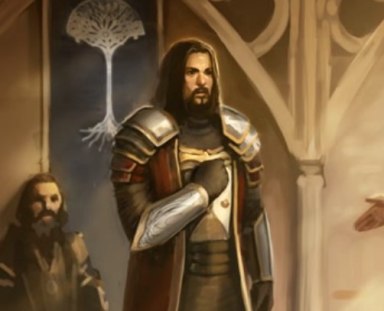
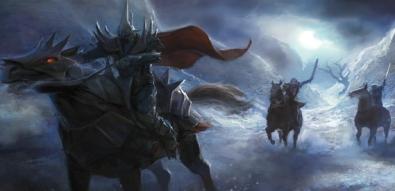
Earnur was the son of Earnil II. He like his father was a great warrior and became a great leader of armies before he became King.  His greatest victory was against Angmar in the Battle of Fornost, in which he defeated the Witch-king, whom he intended to slay had his steed not panicked in terror of the Witch-king’s darkness.  Earnur became King in TA 2043, and was challenged by the Witch-king of Angmar.  The King of the Ringwraiths, who then resided in Minas Morgul wanted this King of Gondor dead and gone.  Earnur, being quick to anger and wrath, would have accepted his challenge had the wise Steward Mardil Voronwe not held him back, and so the first challenge went unanswered.  Just seven years later a second challenge came, mocking Earnur, and the steward Mardil was not able to stop the King this time.  Ernur accepted the challenge, and after entering the gates of Minas Morgul with a small escort, Earnur was never heard from again.  The unwise King was thought to be dead, so his crown now rests upon his father’s tomb in the Hallows of Minas Tirith.
Prophecy_GlorfindelThe Battle of Fornost

A year prior to the battle, the armies of Angmar conquered Arthedain, the last realm of Arnor. Angmar’s armies had taken Fornost, the capital of the Dunedain, and Arvedui, the last King of Arnor, had drowned in the Ice-Bay of Forochel. A year later, a fleet of ships under King Earnur arrived in the Grey Havens and set off toward what was left of the once-great northern kingdom. With the armies of Gondor came men from Rhovanion, elves from Lindon, and the remainder of the Dunedain (among them Aranarth, the Prince of Arthedain).

The battle itself did not take place in the city of Fornost, but on the plains to the west of the city, near Lake Evendim. The armies of Angmar hurried west to meet the assault, and seeing this, the cavalry of Gondor rode north into the Hills of Evendim to wait in ambush. As the main part of the army of Gondor met the enemy in battle, the Gondor cavalry set out from the hills to strike the rear of the army of Angmar. This served as the turning point in the battle, and allowed the combined armies of the west to gain the advantage. Realizing that his forces were all but completely destroyed, the Witch-king of Angmar fled eastward. As he fled, an army led by Glorfindel came up out of the south and blocked his escape, destroying what was left of his crumbling army; the Witch-king himself was able to escape during the night and fled southward. Though the battle itself had been lost and Angmar utterly destroyed, Sauron was extremely pleased with the Witch-King’s work, for the destruction of the northern kingdoms of the Dunedain was a victory for the Dark Powers which far exceeded the loss of the Witch-King’s realm.

Glorfindel,_Elrond_and_King_Earnur_unite_against_the_Witch-King_of_AngmarA Broken Bloodline

The Line of Anarion was broken with the disappearance of Earnur, and the rule of Gondor passed to the Stewards beginning with Mardil Voronwe, the Steward who had tried to restrain Earnur from going to Minas Morgul to face the Witch-king. The Stewards were to rule “until the King returns” for it wasn’t sure at first whether Earnur had been killed dueling with the Witch-king or not. In addition, Earnur left without naming an heir, and while many nobles in Gondor could lay some sort of claim to the kingship, those claims were generally held in doubt, and no one wanted to risk another civil war like the one that had devastated and weakened Gondor.

The Stewards of Gondor were firstly the chief high councilors to the Kings of Gondor and then the rulers of Gondor, until the return of the rightful king (Aragorn Elessar).

First created by the powerful King Romendacil I, Steward was the traditional title of a chief counselor to the Kings of Gondor.  The Quenya name for the title is Arandur , “Servant of the King”.  The steward was was usually an elderly man not from the Royal House chosen for his wisdom and integrity, and was never permitted to go to war nor to go abroad.  During the time of the Steward Pelendur, from the famous House of Hurin, the title became hereditary, passing the station of counselor from father to son, much like the Kingship.

The House of Hurin was founded by one Hurin of Emyn Arnen, Steward to King Minardil, the twenty-fifth King of Gondor. They were of high Numenorean blood, but not descendants of Elendil in the ruling line.

After the death of King Earnur, who left no heir to the throne of Gondor, the Steward Mardil Voronwe became the first of the Ruling Stewards. Mardil was the first of the Stewards to administer Gondor, and his descendants did so for 25 generations.

The Stewards watched over the throne until it could be reclaimed by a true King of Gondor, an heir of Elendil. When asked by his son Boromir how long a time must pass before a Steward could become a King, if the King did not return, Denethor II replied, “Few years, maybe, in other places of less royalty … In Gondor ten thousand years would not suffice” (The Two Towers).

The Stewards never sat on the throne of the King; instead, they sat on a simple chair of black stone placed below it.

I hope you all are enjoying this series as it has been an absolute blast to write and put together!  We are nearing the end of the series but still have a lot more writing to do, so stay tuned to the site and think about following so you never miss one of my series.

You all stay awesome and I bid you a fine farewell!

Cheers,

Iogro Merrybelly


The Battle of the Gladden Fields

AnduinThe One Ring Lost

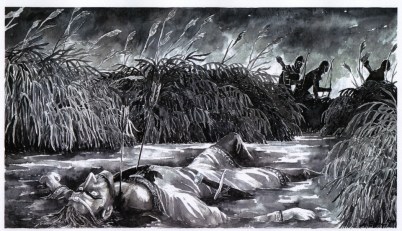
The Disaster of the Gladden Fields was a battle at the beginning of the Third Age, in which Isildur and a group of acompanying Dunedain were attached by a large group of Orcs as they were marching home after defeating Sauron. The king and his three eldest sons Elendur, Aratan, and Ciryon were all slain and the Ring of Power was lost in the River Anduin. Only three men survived this battle, Ohtar being one of them, an esquire of the kings which was able to save the shards of Narsil.

With the death of Isildur, it impacted both Gondor and Arnor as it left both kingdoms seperated and isolated.  Arnor wouldn’t be able to completely recover from this loss of it’s nobles and knights until the kingship of Aragorn in the Fourth Age. Most importantly, Isildur’s death prevented him from passing on the One Ring to the Keepers of the Three, which he had passed on to his brother Elendur to be his chief reason for visiting Elrond in Rivendell.

After the War of the Alliance, Isildur remained in Gondor for one year, taking back lost lands.  He sent a large part of Arnor’s armies back to Eriador through the Fords of Isen to Fornost.  After getting the affairs of the southern realm in order, he handed the South Kingdom over to Meneldil and marched to Rivendell. He chose to leave his wife and son at Rivendell, but also came for counsel from lord Elrond.

ae12The Battle Ground

The Dunedain traveled northwards from Lorien, marching along a path that led to Greenwood the Great where Thranduil ruled. They had to change routes due to the flooding of the Anduin, which led Isildur to take the road on the eastern banks of the river. Isildur’s party was flanked as the enemy used the steep cliffs overlooking the river.

The Dunedain sang cheerful songs but as the evening drew close they began to hear the orcs in the nearby forest. The first onslaught struck quickly so Isildur called for his esquire Ohtar to take the shards of Narsil back to Rivendell for safe keeping.  The second attack from the orcs brought down the Numenorians great defenses, and Elendur convinced Isildur to flee and cross the Anduin if he could and find safety back at Rivendell.

Isildur cloaked himself with the ring, and made a run for the valley parting ways with his armies and tried to cross the river. Unfortunately the rivers waters were flowing to hard and Isildur being exhausted got tangled in the reeds and in doing so the ring slipped from his finger. Nearby Orc’s caught sight of Isildur in the waters and out of fear quickly shot him and fled.

eiszmann42Wake of Destruction 

Only Ohtar, Elendur, Estelmo, and a handful of men survived the battle. Isildur’s body was never recovered, and was presumed captured and mutilated by Sauron’s forces  The orc army that ambushed the Dunedain were scattered among the lands by a relief force but they were to late.  Estelmo after being recovered spoke of how Isildur and Elendur related to each other about the One Ring. Isildur remarked: “I cannot use it. I dread the pain of touching it. And I have not yet found the strength to bend it to my will. It needs one greater than I know myself to be. My pride has fallen. It should go to the Keepers of the Three.”

Probably the biggest fall of the Gladden Fields was the union of Arnor and Gondor were broken by blood, and Isildur never managed to give the ring of power to the three.  Elrond, Galadriel, and Celeborn if given the chance probably would have destroyed the ring of power long before Sauron would have gathered his spirit and refortified Mordor.  But we all know how this story ends as Sauron does finally fall to the hands of many brave souls, and one very important little hobbit named Frodo.

The Forest of Fangorn

treebeardThis is one of the most majestic, secluded, and peacful places in Middle Earth and it’s also home to Fangorn which was the original name of Treebeard.  He was the eldest of his species the “Ents” who looked after vast areas of the surrounding land which was named Fangorn Forest. Additionally, Fangorn translated in Sindarin from “fanga” meaning “beard” and “orne” meaning “tree”.  Sindarin was the language of the elves who originally awoke the Ents and taught them language.   In other parts of Middle Earth, Fangorn was knows as the “Entwood” by the Rohirrim.
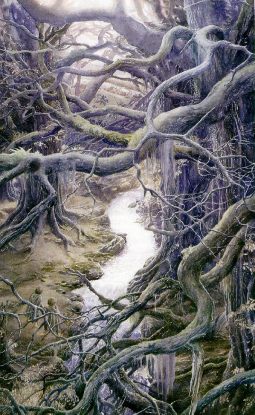
Treebeard also referred to the forest by many different Quenya names in the Lord of the Rings, some of which were Ambrona which meant uprising, or Tauremornalome which meant sunrise.   Some other names he used were Tauremorna which meant gloomy forest as the folk of Middle Earth had heard many strange stories about Fangorn, some of which spoke about trees who moved and even spoke.

The Forest of Fangorn was located at the south-eastern end of the Misty Mountains near the Gap of Rohan. The mountains formed the western border of Fangorn. At the end of the mountain range stood the tower of Isengard the home of Saruman.  Rohan surrounded this forest to both the south and east, and Lothlorien just to the north.  This was a large forest that stretched many miles, with many paths to be traveled.  Two rivers ran through the forest as well, the Limlight to the north formed the northern border of Rohan which then merged with the much larger Anduin.  To the south, the Entwash spread deep into the forest arriving from Methedras, a mountainous region located near the Misty Mountains. The valley of Derndingle was located just to the south-west which is where the Entwash passed into Wellinghall just past the home of Treebeard.

Fangorn was said to be humid, and the trees trunks grew large with dense foliage which allowed very little to penetrate the forest. Similarly, Fangorn was said to be a dangerous and evil place like Mirkwood where huge spiders roamed the forest and other evil creatures lay, but this unlike Mirkwood had not been corrupted in such a way.  This forest was home to many different creatures but Huorns also lived in the forest, similar to Ents but more discreet and lived very deep in the forest.

hobbitsmeettreebeardOne of the greatest and also oddly sized meetings in the forest was when Meriadoc Brandybuck and Peregrin Took entered the forest meeting Treebeard and alerted him of the danger Saruman posed to the Ents and their forest. Following an Entmoot, the rest of the Ents agreed to march against Isengard, taking Merry and Pippin with them, and sent Huorns to Helm’s Deep to deal with the Orcs there. Part of the Ents’ anger was caused by Saruman’s Orcs chopping down the trees at the south and west side of the forest. It was especially notable in that Fangorn Forest was embodied by Treebeard.
Other famed visitors to this great forest were Aragorn, Gimli and Legolas as they entered the forest to search for Merry and Pippin. They encountered an old Man dressed in white which at first they believed to be Saruman before realizing that it was Gandalf, whom they thought had been killed at Khazad-dum.

Fangorn forest was, just the easternmost remnant of the immense forest that spanned all of Eriador and Calenardhon in the First Age and early Second Age. Treebeard expressed a deep sadness at the loss of the forest to the Orcs and to the age of Men and their machines. The rest of the forest was destroyed by the Numenoreans and Sauron. This portion of the forest was the the oldest part of Treebeard’s realm, and the Ents’ last retreat.

scr.ee tags:

#MiddleEarthLore #ForestofFangorn

Tribute to Dol-Amroth

Hail and well met friends!

Since the release of Western Gondor on Lord of the Rings Online, I thought it fitting to give a tribute to Dol-Amroth since it’s one of the great cities we are now able to gaze upon in our journey within the game.

images (2)City of Dol-Amroth

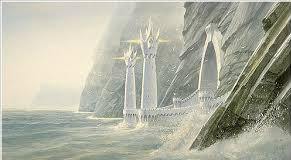
Let’s take a quick look at some history of this great city and where it formed.  We’ll start with Imrazor the Numenorean who moved to Edhellond According to tradition,  he married Mithrellas, a Silvan Elf of Lorien who bore a son which they named Galador.  After Imrazor’s death, his son Galador went on to found the city and later the princedom of Dol-Amroth.  Galador is counted the first lord of Dol-Amroth though the specific date of its foundation is nowhere recounted

373e5f204898613396a34130d2806d21The city of Dol-Amroth was built south of Edhellond at the inlet of Cobas Haven which was in the Bay of Belfalas. In the north of the city was built the Seaward Tower of Tirith Aear. The banner of the city was a silver swan, which were also seen on the battle banners carried by the knights during the Battle of Pelennor Fields.

The lands of Dol-Amroth were also known as Dor-en Ernil, which Galador’s father Imrazor lived and ruled.  It was also named the ‘Lands of the Prince’ which Galador inherited when he founded princedom over Dol-Amroth.

The first settlers of the area were Sindar from Beleriand and the people of Dol-Amroth were tall, grey-eyed, and dark-haired. They were famous for their abilities as the most skilled harp players in all of Gondor, who also played at the coronation of Aragorn. The inhabitants of Dol Amroth and in the lands nearby were some of the few people of Gondor who spoke Sindarin as a main language.

The Nazgul – Part Three

The Last time we left off we had just seen the Nazgul defeated at the Ford of Bruinen as they were pursuing Frodo to Rivendell.  Washed away and forced to flee we now regroup to see the fate that unfolds for the Nazgul and our final episode on them.

tumblr_lp8vvfyy4h1qg8i80o1_1280Fleeing to Mordor

Returning to Mordor in complete failure, the Nazgul were forced to abandon their hunt for the Ring.  The Nine received Fell Beasts as their new mounts which replaced the horses they had lost at the Ford of Bruinen.  Battle ready once again with their new mounts, the nine attacked the city of Osgiliath with an army of Orcs and swiftly held this location.


inspiration-of-medieval-language-and-literature-good-vs-evil-in-tolkiens-rotk-22the-witch-king-of-angmar-minas-tirith22-john-howe

The Battle of Pelennor Fields

After this, they made way for the assault on Minas Tirith.  Sauron once again unleashed his deadliest servant The Witch-king to lead his forces at the Battle of the Pelennor Fields.  During the battle, the Witch-king confronted Gandalf the White when attempting to enter the city.  Before the Witch-King could engage the great wizard, the forces of Rohan arrived. The Witch-king fled attacking Gandalf immediately to deal with the new threat against his masters forces.  The Witch-King turned his focus upon King Theoden on the battlefield.  As Theoden was crushed by his horse, the Witch King prepared to finish him off but Eowyn and Meriadoc Brandybuck rode out on the battlefield before the Witch King and Theoden’s niece confronted Saurons deadly servant.


Cory Godbeyhttp://corygodbey.com/ Death of the Witch-King

Engaging the Witch-King in battle, Eowyn killed the Fell beast. The Witch-King, however, was unaffected by this and attacked Eowyn with his mace.  After breaking her arm, the Witch-King readied the killing blow, but Meriadoc stabbed him in the leg from behind with his Barrow-blade.  Injured, and now off-guard the Witch-king screamed in pain.  Eowyn standing with no fear stabbed her sword into the Witch King’s crown and body killing the lord of the Nazgul and fulfilling the prophecy of Glorfindel.


images (1)The Fate of the Remaining

During Battle of the Morannon the remaining eight Nazgul, mounted on Fell beasts, attacked the Army of the West. The Nazgul were confronted by the Eagles, led by Gwaihir. During this time Frodo claimed the Ring near the fires of Mount Doom.  Sauron becoming immediately aware of Frodo, as well as his own folly. Enraged and frantic, Sauron ordered the Nazgul to capture the ring from Frodo.  However, the Nazgul failed; the Ring was cast into the fires of Mount Doom when Gollum bit Frodo’s finger and fell into the Cracks of Doom, with the ring.  Sauron was defeated by the loss of the Ring, and Mount Doom exploded with gigantic volcanic eruptions engulfing all eight of the remaining Nazgul destroying them, their form, and power dissipating forever.

Though this wraps up our series on the Nazgul and the lore behind them it sets us up for our next episode of the Shirelings Weekly Bugle.  Until next time; I am your host Iogro Merrybelly and I bid you a farewell.


A Look Into Bree

This week we’re taking a quick look into the village of Bree which is one of my favorite places in   Middle-Earth.  When I was a boy I used to day dream of living in Bree as I could just picture how fascinating of a place it was. Though we don’t get to see a lot about Bree we do have some historical facts that Tolkien wrote about this wonderful place.

The name Bree means “hill” according to Tolkien, referring to the fact that the village of Bree and the surrounding Bree-land were clustered around a large hill.

Bree sets East of The Shire and just South of Fornost if you’re looking at the map of Middle-Earth and was a settlement of men in Eriador which was established by the time of the third age. After the collapse of the Arthedain kingdom, Bree thrived but it did so without any government for some time.  Bree lies at the center of two major roadways, one being the Great East Road and the other the Greenway.  It was a place of trade for goods and a quick shelter to many travelers.

One interesting real life fact is JRR Tolkien base Bree off of the Buckinghamshire village of Brill which Tolkien visited quite often while teaching at Oxford.  It is also said that Tolkien lived in Brill for a short period of time as well.

Tolkien wrote of two different origins for the people of Bree. One was that Bree had been founded and populated by men of the Edain who did not reach Beleriand in the first age. The other origin was that the men who founded Bree came from the same line as the Dunlendings did.  Though these two histories of men are not completely contradictory as the Dunlendings were descended from Haladin who were counted the second house of the Edain.

Gandalf and Thorin Oakenshield met in Bree on pure happenstance which started the events we read about in The Hobbit and the quest of Erebor.  This event started the finding of the One Ring by Bilbo Baggins and by the time of the War of the Ring Bree was the westernmost settlement of men in Middle-Earth, and there was no other settlement of men within a hundred leagues of the Shire.

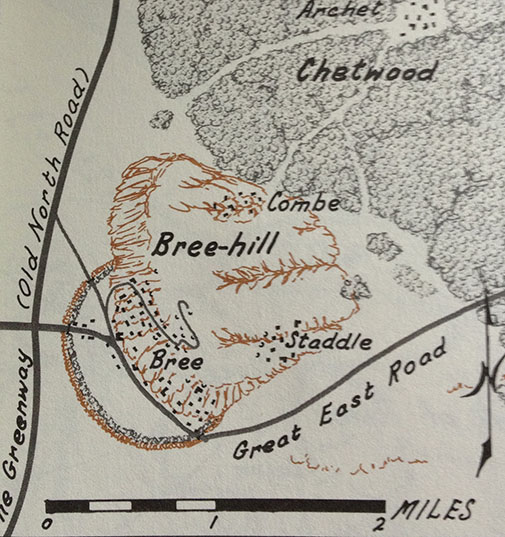
bree-land-map-archet-combe-staddleBree was the main village of Bree-Land, and the only place in Middle-Earth where men and hobbits were found together.  Bree-Land had four main villages that made up that portion of land.  You have…

  • Bree which was the largest settlement. Mainly populated by men but you also had hobbits who worked at the Prancing Pony Inn which had special hobbit-sized rooms. A lot of commercial trade happened within Bree at its peak and on occasion you would have some adventurous hobbits make their way from The Shire and visit Bree.
  • Staddle was mainly a hobbit population and made their living off of farming. This land produced such things as fruits, vegetables, and even pipe-weed. Staddle was on the south-eastern side of Bree-hill.
  • Combe was populated primarily by men, with some hobbits, and again this was another farming community. Combe was right at the borders of Chetwood if you were looking at the map. .
  • Archet was the furthest north. Located in the Chetwood, it was populated by men.