The Age of Ashes: Remembering the First Sundering

Before the Brothers Three, before the Spindelum of Time, there was the war that nearly broke the world. The old songs call it the First Sundering. The people remember it as the Age of Ashes.


The War of All

It began over a thousand years ago, when Malakaroth, the Dread King, rose from the shadows. His power was unlike anything the world had faced before — a hunger not for land or gold, but for the very soul of creation. His armies moved like a tide across Eldoria, burning, corrupting, consuming.

This was no simple clash of kingdoms. It was a war of the world itself. Every people, every race — elves in their silver towers, dwarves in their deep halls, men in their fledgling kingdoms, halflings in their quiet valleys — were drawn into the struggle. Even creatures now lost to memory are said to have taken part, their names surviving only in half-sung songs.

It was the one time in all of Eldoria’s history when unity became a necessity. The banners of Silvermoon, Greenwood, Ironclad, Stormwatch, and countless lesser realms flew side by side. Differences were set aside, though not without struggle — the proud dwarves distrusted the elves, men fought among themselves even as they fought the shadow, and many wondered if peace among allies was possible at all.

But the greater darkness left them no choice. The War of All had begun.


The Shadow’s Legions

Malakaroth’s strength was not only in his will but in the armies he summoned. Songs speak of the Blackened Hosts — men twisted by shadow, their eyes hollow, their voices no longer their own. There were beasts as well, some born of fire, others carved from stone, still others crawling up from pits of endless night.

Legends tell of the Revenants, generals of dread who could not be slain by steel, for death itself seemed to serve them. Others whisper of forests corrupted into armies of thorn and root, moving at Malakaroth’s command.

The war was not only fought on battlefields but in the very fabric of the world. Storms raged unnaturally. Seas rose higher than before. Mountains cracked, and entire valleys were swallowed by shadow.


The First Sundering

The war stretched across generations, its cost too great to measure. Some say entire kingdoms were erased from history — not conquered, but sundered, their names carried only in fragments of song.

The final battle came at the foot of the greatest mountain in Eldoria. There, the armies of light and shadow clashed for the last time. The ground shook. The skies burned. The rivers ran red.

Malakaroth was at last defeated — but not destroyed. For evil such as his does not die easily. He was bound in chains of flame and entombed deep within the heart of the mountain.

And so Gallandor, the First Kingdom, was founded above that tomb. It rose not merely as a seat of kings, but as a guardian, a living fortress built to watch forever over the prison of the Dread King.


The Age of Ashes

The victory did not come without ruin. Eldoria was left scarred, its beauty marred by the long shadow of war.

  • Forests, once lush, were burned into wastelands.
  • Dwarven halls cracked and caved beneath the earth.
  • Valleys became swamps, poisoned by shadow’s residue.
  • Ruins littered the land — silent reminders of what was lost.

The people called it the Age of Ashes, for even in victory, the world seemed broken, covered in the soot of its suffering.

Though thousands of years have passed since Malakaroth last walked the earth, the dread of his reign lingers. Whispers cling to the ruins. Old wounds ache in the land itself. And there are places in Eldoria where his shadow still festers, waiting.


The Scars That Remain

The First Sundering was not just a battle — it was a breaking.

  • The elves of Silvermoon still sing laments of those who never returned.
  • Greenwood bears trees twisted black, remnants of corruption.
  • The dwarves of Ironclad carry deep grudges, for they lost more halls than any people, and many never forgave their allies for failing to hold the lines.
  • Stormwatch’s cliffs are said to have risen higher during that age, carved by waves whipped by Malakaroth’s storms.

Even the smaller folk — halflings, nomads, wanderers — carry tales of ancestors driven from lands they never reclaimed. The Sundering touched all, and none escaped unchanged.

This is why Eldoria feels heavy with memory. Every ruin whispers of the Age of Ashes. Every kingdom carries scars, both visible and hidden.


A Living Legacy

For the Brothers Three, born in Gallandor, this history is no distant myth. It is their inheritance.

They live above the mountain that sealed the Dread King. They breathe the air of a kingdom founded not on peace but on vigilance. They are the sons of prophecy, their birth echoing with scars that tie them to that ancient darkness.

The Spindelum of Time itself may be bound to the Sundering. Some say it was forged in those days, others that it was uncovered in the aftermath. Whatever its origin, it has become a thread woven through Eldoria’s fate.


Why I Build Histories

As a writer, the Age of Ashes has been one of my favorite parts of shaping Eldoria. I’ve always been drawn to the way Tolkien built his worlds — how The Silmarillion gave weight to The Lord of the Rings, how ancient wars and forgotten heroes shaped every page of the stories that came after.

I wanted Eldoria to carry that same depth. Not just a surface story, but bones beneath the soil. The First Sundering may not be the tale readers follow page by page in The Brothers Three, but it shapes every corner of their world.

Writing history into fantasy is more than lore for me. It’s restoration. It’s a way of giving my story roots that go deeper than the characters themselves. It’s also been one of the most life-giving parts of my creative journey — an escape, yes, but also a place where my imagination finds purpose and breath.


Until Next Time…

The Age of Ashes has ended. The First Sundering is long past. But the scars it left still shape Eldoria — and perhaps the battles yet to come.

If the world was once broken, who is to say it cannot be broken again?

And a question, for you:
Do you love when fantasy dives into ancient wars and legends, or do you prefer to discover the story only in the present?

Years in the Making: A First Look at The Brothers Three Series and the Journey of Storytelling

Welcome back to A Hobbit’s Journey.

It’s been a little while since I last wrote here, but this season feels like the right time to begin again. For the past few months, I’ve felt the pull to return to this space — to share stories, reflections, and the worlds I’ve been quietly building in the background. Today begins a new chapter of writing, one I’m excited to walk with you.

If you’ve read my blog before, you know I love to explore Tolkien, myth, and the beauty of fantasy. That passion hasn’t changed. But alongside those reflections, I’ll also be sharing something very close to me: my own novel series, The Brothers Three.

Over the weeks ahead, I’ll be writing about the fantasy world I’ve been building for over eight years — the lore, the kingdoms, the songs, the villains, and the brothers at its heart. I’ll also share the process behind the words: how stories are mapped, how characters are shaped, and how world-building grows from sparks of inspiration into living, breathing realms.

This is the next step of A Hobbit’s Journey — not just reading and reflecting on fantasy, but creating it, together.


The Brothers Three Novel Series

It begins in Gallandor, the First Kingdom of Eldoria, built into the mightiest mountain in the land. For centuries, it has stood as the seat of the High King and Queen — a place of power, politics, and history. But beneath its grandeur lies a deeper truth. The mountain itself holds the sealed tomb of the Dread King, who was defeated in what the old songs call the First Sundering, a war so vast it drew every race and kingdom into its fire. The era itself is remembered as the Age of Ashes, when the world burned and nearly broke under his shadow. His body was entombed in the mountain’s depths, and Gallandor rose above it — both protector and reminder of the darkness that once sought to unmake the world.

It is here that three brothers were born together, in the same moment, under the same breath of fate. Triplets. A rarity even in our world, but in Eldoria, it is almost unheard of. Their birth sent whispers through the kingdom — whispers that destiny had not chosen one heir, but three.

Yet they were not born unmarked. Before their first cries echoed through the halls, Morgathra — the Dread King’s sister — had laid her curse upon them. Each bore a scar, etched before birth, a reminder that darkness had not forgotten.

And so their lives began not as princes in peace, but as sons of prophecy, tethered to a storm that has yet to break.


A World Called Eldoria

Their story stretches far beyond Gallandor’s mountain citadel. It unfolds across seven kingdoms, each with its own crown and song.

  • Silvermoon, hidden high in mist-shrouded mountains, where the High King’s palace glimmers faintly in the moonlight.
  • Ironclad, carved into the mountainside, its forges glowing red against the night sky.
  • Greenwood, a city grown into the colossal trees of the ancient forest, alive with torchlight and elven grace.
  • Stormwatch, clinging to jagged cliffs above a raging sea, its towers lit by lightning and battered by endless waves.
  • And others still, each carrying scars from the age of shadow, each holding secrets that will one day test the Brothers Three.

Eldoria is not merely a setting. It is a land heavy with memory. Every stone remembers the wars that came before. Every ruin whispers of glories and griefs long past. And in its silence, something stirs again.


The Spindelum of Time

At the heart of their first tale lies a relic — the Spindelum of Time.

Neither jewel nor crown, it is older than the kingdoms themselves. Some say it was forged by the Keepers. Others claim it fell from the stars. All agree on one thing: it does not serve lightly.

The Spindelum does not bend to men’s will. It tests them. To glimpse it is to see past, present, and future threaded together in fragile strands. To wield it is to risk shattering them all.

The Brothers did not seek it. But it has called to them all the same.


Songs Already Sung

And here is where the story blurs with myth. Across Eldoria, bards sing fragments of it already — not as prophecy, not as history, but as echoes.

They sing of The Forge Beneath the Veil, where fire was first kindled in darkness.
They mourn with The Whispering Wastes, where silence holds the voices of the lost.
They tell of oaths, of stars, of flames that would not kneel.

And if you’d like to hear those songs brought to life, you can. Over the last several months, I’ve been sharing them through a project called The Ambient Bard — a YouTube channel where the tales of Eldoria are sung out in bardic style, weaving lore and music together. It’s been a joy to take pieces of this world and give them voice, letting the songs of Eldoria echo outside the page.


Why I Write

Writing, for me, has always been more than words on a page. It’s an escape — a way of stepping outside the weight of the world for a while and breathing in another one. Some people find relief in music, others in long walks or painting; for me, it has always been stories.

When life has been heavy, the page has been a place to lay it down. When the world has felt too loud, the act of creating another has been quiet enough to hear myself again. Over the years, that practice of world-building, character-making, and plotting stories hasn’t just been about books — it’s been about restoration.

And that’s part of why I’m sharing it here. Not just to say “here’s my novel,” but to open the process, the joy, and the love of fantasy that’s carried me since I was a child. If you’ve ever felt that pull into a book that made you forget the clock, or if you’ve ever longed for a story that gave you space to breathe — you already know why I write.


Why This Story Matters

The Brothers Three isn’t just a book I’m writing. It’s the culmination of a lifetime of loving fantasy, of fifteen years of blogging, of eight years of world-building, character-making, and story-weaving.

It’s about brotherhood. About scars that become strength. About the fragile hope that even in a world overshadowed by darkness, light can still break through.

And maybe that’s why I want to share it here. Not because it’s finished — it isn’t. Not because it’s perfect — it won’t be. But because stories aren’t meant to be hidden. They grow brighter when they’re shared.


Looking Ahead

So what can you expect here in the weeks ahead?

  • Lore & World Building — more glimpses of Eldoria’s kingdoms, heroes, and villains.
  • Writing Reflections — behind-the-scenes looks at process, inspiration, and creativity.
  • Fantasy Explorations — my ongoing love of Tolkien and other works that shaped this journey.
  • The Brothers Three — teasers, tales, and moments as the saga continues to take shape.

This blog will be a blend of both my world and the craft of writing itself. A place where the songs, the lore, and the process meet.


Until Next Time…

This is only the beginning. In the weeks to come, I’ll be sharing more glimpses of Eldoria — its kingdoms, its heroes, its ruins, it’s shadows, and my writing process of how I look at creating a fantasy world and more.

For now, I’ll leave you with this:

The Brothers, Born as one, scarred as three, bound by the turning of time.

And a question, for you:
What draws you most to fantasy stories — the characters who carry the burden, the lore that breathes beneath the world, or the landscapes that make you long to wander?

Writing A World Of Fantasy

content-writing-typewriter-paperballs-ss-1920Doing something a little different for today’s post!  I’ve been putting a ton of time into plotting, world-building, and just getting that much needed time into writing on my novel series, so I wanted to share some fun tips I’ve learned along the way about writing in the fantasy genre.
Writing a fantasy novel is great fun – you can literally let your imagination run wild.  It’s a little different when writing a novel set in the real world as unlike books set in a reality where you can use real-life as examples, you’ll have to invent everything in your new fantasy world.  Do you enjoy writing, are you working on a fantasy novel, or have you had the notion to start one?  I hope the next few minutes while reading this helps you no matter what stage you might be in for writing a novel.

One of the best things you could do to kickstart things is to read as many classics as you can find!  No matter the type of book you begin writing this will give you a good idea about what works and what doesn’t.  Remember though that reading other people’s works is something to help with idea spawning and relax your mind.  You must take note not to simply copy the ideas you’ve read from any of the good old classics or other pieces of work you find.  If you find yourself dealing with elves, halflings, and orcs whilst being a reluctant hero on a quest to destroy a powerful item, it’s probably best to scrap it and start again. It is true that all stories are a combination of those the reader has encountered over the years. But, you should always try to find an original angle and it certainly should not be obvious what the source material was. Reading the classics will also allow you to discover how well-crafted characters interact with each other as the story progresses.

Tip 1: Use established myths and legends as the basis for your fantasy world. Think about what your fantasy world might be like.  Do your studying and find out what your world and culture are mostly like….Is it Celtic, Roman, a medieval world or a blend of multiple cultures with your own twist on it? Once you’ve chosen, go and read about the myths and legends that relate to those cultures. The mythological creatures and characters and their stories will give you a great basis for your new world.

Tip 2: Get to know your imaginary world – you need to be able to describe it in detail if you are going to convince your readers, for the duration of the book at least, that it exists. Be thorough and detail everything you can possibly imagine about the world you are creating.

  • Physical – what does your fantasy world look like? Think about and make a note of:
    • the color of the sky
    • what other planets can be seen from the surface
    • whether the air is breathable
    • what the plants look like
    • what creatures live there
    • whether there are seas
    • what the landscape looks like
    • futuristic world or something older
  • Residents – decide who lives in your newly formed fantasy world. You should spend time thinking about how they look, what they eat, how they move, whether they need sleep, how they speak to one another etc…
  • Society – what kind of society exists? Do they need money to buy things? Is there a complex system of politics they follow? Do they have a police force, a king or president? Is there a religion?
  • Special powers/magic – Do the residents have any special powers or use magic? If so, what are they and why do they exist? Does everyone have the use of them or only certain people?

Tip 3: Make your characters believable. This is one of the most essential parts of the book if you want to hook and keep readers interested in the story. A great way to achieve this is to apply logic to every character in every fantasy world you create. This means creating a set of rules that apply to the world and the character. The rules can be based on either real life or they can be simply invented by you.  Remember if you are creating the rules of the world, don’t let a BOX hold you back from being creative.  Sometimes creating our own ways is just the push we need to make that next step in our creative writing.

Tip 4: Make sure you keep careful notes of all the details you invent for your new fantasy world. This will help you maintain continuity throughout the novel. There are many ways of doing this, some writers like to have a set of cards with the details on, others set up spreadsheets; so play around with different systems to find one that suits you the best.  I personally use a book mapping chart I created in excel that helps me track all major parts of the book I need.  I hope these few steps help you get started, or give an idea of what steps to take next in writing your new fantasy novel!

Remember, have fun!! That is the first and foremost thing I can say when writing… Have Fun and lots of it!

The Dragonlance Chronicles – A Nostalgic Review


Dragonlance-Logo.jpg

I’ve been feeling a little nostalgic lately, and for whatever reason, the Dragonlance novels have been standing out over the last few weeks.  So, what better way to scratch that itch then dig out your old book collection from when you were a kid and re-read said novels.  Yes, I still have books from when I was a kid tucked away in boxes in the attic…..mainly because we’ve run out of space in all our bookshelves in the house.

If you haven’t read the Dragonlance novels and want a great high fantasy novel to get lost in then I personally would recommend these.

Dragonlance Novels:

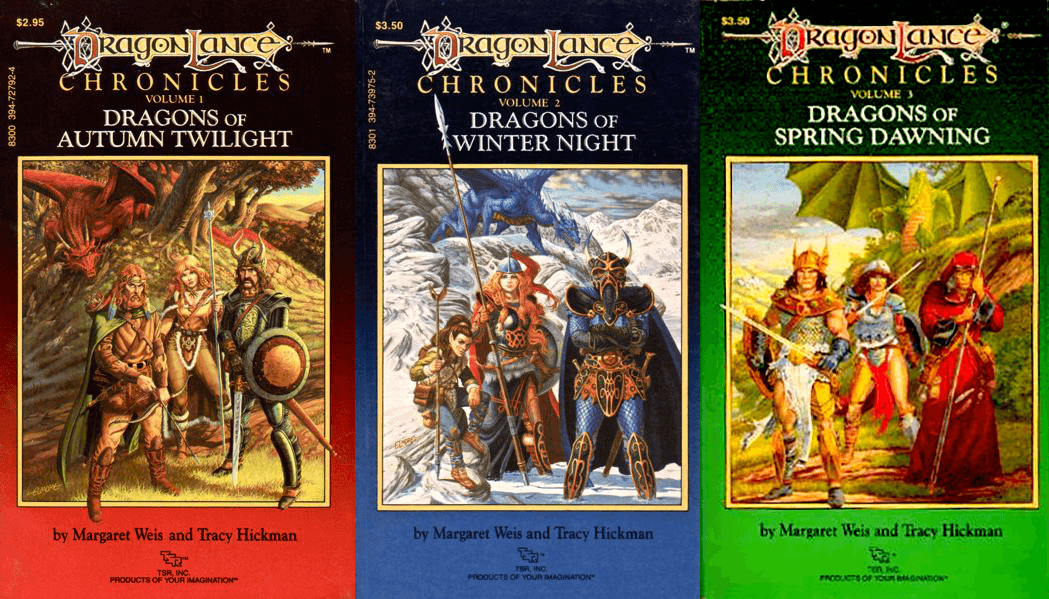
dragonlance-chronicles-books.png

History Behind The Books

The Dragonlance novels were based on a series of Dungeons & Dragons game modules. The books came about because the designers wanted novels to tell the story of the worlds they were creating.  After Tracy Hickman came to TSR it was announced that development was to happen on his series of dragons based role-playing adventures.  Hickman’s storyline was chosen for the Dragonlance books due to the twelve-part storyline.  Margaret Weis came into the picture as she was assigned to edit Hickmans “Project Overlord,” as it was initially called, a novel intended to be coordinated with a trilogy of Dungeon & Dragons modules.  The newly formed team plotted the novel and hired an author who didn’t work out.  By this time, Weis and Hickman were so into the project they felt they had to write it and the rest is history.

Breakdown of the Novels

9bb39109e3a6149a1f1e27e4fadc4bcfThe Dragonlance Chronicles were one of the first novel series I read that introduced my love for the world of fantasy.  The first novel series that I fell in love with of course was JRR Tolkien’s The Hobbit, and The Lord of the Rings.  The Dragonlance Chronicles holds a high place on my list though mainly because I was one of those role-playing geeks of the 80’s. 

Let’s take a look at the first book, Dragons of Autumn Twilight which has a strong character base but the first book does feel over the top at times.  What really stood out to me about the first book were the “Major” characters in the story, and there are a few that were very distinct.  Unfortunately, the story has some downsides and one major part is the characters seem lost, as does the navigation of the overall plot. But, as an introductory novel, it sets events in motion without giving anything away which is impressive to do no matter the genre.  The second and third novels develop completely different, which felt more organic and that the writers were given much more freedom with the plot.

Here’s what I like about the original Dragonlance Chronicles and what brought me back to read them once again:

  1. The novels continue to throw extremely creative scenarios and locations at you. Which keep the interest up while reading, as you gotta know what is coming up next.
  2. The authors did a fantastic job of balancing the character development, action, drama, and overall plot.
  3. The world of Krynn itself as the authors did an amazing job adding a level of mystery to the world which kept you wondering what’s next.
  4. The overall pace of the book is done quite well in story development, especially as you get into books 2 & 3.
  5. Ultimately the book is called Dragonlance…..so what better than the Dragon War and the evil queen that returns.

To me, these books are such a good mix of the Sword & Sorcery and the High Fantasy genres of the ’80s which I fell in love with at a young age so it’s hard not to like them.  How about you all, what are your thoughts on the Dragonlance Chronicles?  Have you read them?  Let me know in the comments below.

Creating the Inner Workings of a Fantasy Novel

BlaugustRebornLogo2018

I’m doing something a little different again for today’s Blaugust post!  Personally I have been writing a ton on my own novel series, and I wanted to share some fun tips I’ve learned along the way about writing in the fantasy genre.

Writing a fantasy novel is great fun – you can literally let your imagination run wild.  It’s a little different when writing a novel set in the real world as unlike books set in reality where you can use real life as examples, you’ll have to invent everything in your new fantasy world.  Do you enjoy writing, are you working on a fantasy novel, or have you had the notion to start one?  I hope the next few minutes while reading this helps you no matter what stage you might be in for writing a novel.

One of the best things you could do to kickstart things is read as many classics as you can find!  No matter the type of book you begin writing this will give you a good idea about what works and what doesn’t.  Remember though that reading other peoples works is something to help with idea spawning and relax your mind.  You must take note not to simply copy the ideas you’ve read from any of the good old classics or other pieces of work you find.  If you find yourself dealing with elves, half-lings and orcs whilst being a reluctant hero on a quest to destroy a powerful item, it’s probably best to scrap it and start again. It is true that all stories are a combination of those the reader has encountered over the years. But, you should always try to find an original angle and it certainly should not be obvious what the source material was. Reading the classics will also allow you to discover how well-crafted characters interact with each other as the story progresses.

Tip 1: Use established myths and legends as the basis for your fantasy world. Think about what your fantasy world might be like.  Do your studying and find out what your world and culture is most like….Is it Celtic, Roman, a medieval world or a blend of multiple cultures with your own twist on it? Once you’ve chosen, go and read about the myths and legends that relate to those cultures. The mythological creatures and characters and their stories will give you a great basis for your new world.

Tip 2: Get to know your imaginary world – you need to be able to describe it in detail if you are going to convince your readers, for the duration of the book at least, that it exists. Be thorough and detail everything you can possibly imagine about the world you are creating.

  • Physical – what does your fantasy world look like? Think about and make a note of:
    • the colour of the sky
    • what other planets can be seen from the surface
    • whether the air is breathable
    • what the plants look like
    • what creatures live there
    • whether there are seas
    • what the landscape looks like
    • futuristic world or something older
  • Residents – decide who lives in your newly formed fantasy world. You should spend time thinking about how they look, what they eat, how they move, whether they need sleep, how they speak to one another etc…
  • Society – what kind of society exists? Do they need money to buy things? Is there a complex system of politics they follow? Do they have a police force, a king or president? Is there a religion?
  • Special powers/magic – Do the residents have any special powers or use magic? If so, what are they and why do they exist? Does everyone have use of them or only certain people?

Tip 3: Make your characters believable. This is one of the most essential parts of the book if you want to hook and keep readers interested in the story. A great way to achieve this is to apply logic to every character in every fantasy world you create. This means creating a set of rules that apply to the world and the character. The rules can be based on either real life or they can be simply invented by you.  Remember if you are creating the rules of the world, don’t let a BOX hold you back from being creative.  Sometimes creating our own ways is just the push we need to make that next step in our creative writing.

Tip 4: Make sure you keep careful notes of all the details you invent for your new fantasy world. This will help you maintain continuity throughout the novel. There are many ways of doing this, some writers like to have a set of cards with the details on, others set up spreadsheets; so play around with different systems to find one that suits you the best.  I personally use a book mapping chart I created in excel that helps me track all major parts of the book I need.  I hope these few steps help you get started, or give an idea of what steps to take next in writing your new fantasy novel!

Remember, have fun!! That is the first and foremost thing I can say when writing… Have Fun and lots of it!

Writing Foundations of Fantasy Characters

When you think of fantasy novels, most people think, epic battles, magical worlds, filled with creatures and mysteries to solve. Those worlds have to have must be populated with engaging characters, and instances to grab the readers attention.  Strong characters are important to fantasy fiction for many reasons:

  • Fantasy often tells the story of events on a grand scale, and having characters the readers can connect to and care about makes that story tangible, and more enjoyable.
  • Fantasy often has an element of wish fulfillment about it, so readers want characters they can identify with and understand.
  • Engaging characters can help readers feel as though they get pulled into the story, and feel comfortable in an otherwise unfamiliar invented world.

The most popular fantasy fiction tells us that enduring characters influence how much readers love a work of fiction. Bilbo and Frodo Baggins, Harry Potter and his friends Ron and Hermione, and a whole host of other amazing and enduring characters throughout fantasy history are all amazing examples of iconic fantasy characters.

Several of the characters listed above are protagonists, but the surrounding cast to the protagonist must be engaging as well. No reader will feel suspense if the antagonist is unbelievable and lacks the luster to engage the readers. If the love interest in the story is one-dimensional, readers aren’t likely to be interested.  A mentor adds gravity to the protagonist’s quest, and sidekicks make the protagonist more likeable by bringing in the chance of humor and good laughs. This creates a broad contrast, and wholeness that a protagonist who is busy defeating evil throughout the book might otherwise not have the opportunity to show.

Characters are the heart of your fantasy novel, and without strong characters, the reader ultimately won’t care what happens between epic battles, how the hero of the story grew and challenged evil, or ultimately how the book ends.

One way to create memorable characters is to begin with set types and add depth to each of the specific characters.  No matter what approach you take to creating and developing characters it has to work for you.  This is definitively a formula based way to create characters, but fantasy character types are no different then how the framework of a plot outline works. If you think about some of the characters listed above, there are several types.

Hermoine Granger is the smart girl, Harry Potter is the orphan boy with secret magical powers, and Bilbo Baggins is the reluctant adventurer. All of these are stock characters from literature and the fantasy genre in particular. Yet if you are familiar with these particular versions of these characters from your own reading, you know that this stock description only scratches the surface of who these characters turn out to be: it doesn’t fully convey their strengths, weaknesses or story arcs.

Here is a list of five different fantasy character types you can develop and make into memorable characters for your readers! 

The Protagonist – aka “The Hero”


Up to this point, we have mostly discussed the protagonist, but there is a reason for this. This is the most important character in your story. If the protagonist doesn’t work, it won’t matter how well-developed the other characters are as no one will care or even stay engaged enough to finish the story.

Here are a few points to consider as you develop your protagonist:

  • Is your protagonist an ordinary person or do they have some extraordinary powers that help them fulfill their destiny?
  • Is your protagonist more of a traditional hero or is he/she an antihero? In other words, does your protagonist display typical qualities such as courage, loyalty and goodness, or does the protagonist have a dark side?
  • What are some of the defining characteristics of a protagonist? This will definitely help you put together an initial frame for developing this character.

The Antagonist – aka “The Bad Guy”

One error some writers make is creating an antagonist who is purely evil. Their reasoning may be that a more evil character is more likely to create suspense for the reader.

The problem with this approach is that the character may become so over-the-top evil that the reader disengages. A story is often more interesting when the antagonist has motives that are clear and understandable, even if the characters logic or actions behind their motives are wrong.

Another approach to making your antagonist more attractive and enjoyable to read is giving the character a connection with the protagonist.  If you have ever read any of the great fantasy novels of our time, then you get to see these connections come to life very clearly.  Look at Voldemort in Harry Potter or Darth Vader and Luke Skywalker in the Star Wars universe.  In The Lord of the Rings, Sauron is not relatably human, but Saruman was the mentor of the good wizard Gandalf, so when Saruman switches allegiance to Sauron, the betrayal increases a sense of threat and helps the reader understand the emotional roller coaster this has on it’s characters.

The Great Mentor 

This is one of the greatest categories of characters in a fantasy novel ever in my opinion! Like so many stories before this write up we saw such greats as, Frodo Baggins has Bilbo and Gandalf, and Luke Skywalker has Obi-Wan Kenobi.  Each of these great mentors are absolutely invaluable to the protagonist’s development. The main function of a mentor is to educate or train the protagonist, but the mentor can bring a very powerful and emotional component to the story as well.  One of the most interesting things over the course of a fantasy novel, is it’s almost inevitable that at some point the mentor and protagonist must part. Whether this means the death of the mentor or simply the mentor’s departure, this is usually a very emotional and dramatic turning point for the growth of the story.

Here are some points to consider when developing the mentor:

  • Does the mentor have any unusual abilities such as magical powers, or is their primary purpose to impart wisdom and teach?
  • What is the relationship between the protagonist and the mentor? Is it positive from the beginning, or is it a rough and bumpy ride?
  • How do the mentor and protagonist part? Is it sudden and tragic, or is it planned? How does the way the relationship ends affect the protagonist and overall cast of characters for the story?

The Sidekick

Protagonists can sometimes seem incredibly heroic, and sidekicks can help humanize them as well.  At times you will even see the sidekicks overshadow the protagonist.  This is not a fail on the part of the writer, but instead just a natural progression of the roles in the story.  In fantasy fiction, a protagonist often becomes so much larger than life that as the story progresses it becomes increasingly difficult for the reader to relate and engage. Meanwhile the sidekicks are often characters who are more ordinary and perhaps more likable or similar to the reader, which helps them enjoy and engage with this character. What is most important about the sidekick is that the writer remains in control and keeps things cohesive! It’s very easy to derail yourself when writing a character type like a sidekick, as you can pull the focus away from the main plot and protagonist so easily.

Sidekicks often offer wisdom, comic relief, or commentaries that match the reader’s perspective more closely than that of the protagonist. We’ve seen some very memorable and fond sidekicks but some of my favorites to date are still R2D2 and C3PO from Star Wars. Sidekicks are frequently invaluable, and often a protagonist cannot succeed without them.


The Famed Love Interest

Much like the sidekick, the love interest helps bring a level of humanity to the protagonist that is needed. The love interest also provides additional opportunities for conflict, suspense, and engagement with the readers. To create an effective love interest, writers should make this character multidimensional and not simply a perfect reflection of the protagonist’s — or the writer’s — wants, needs, and desires.

The love interest will usually be setup in such a way they challenge the protagonist by seeing or doing things in a different way. This character may also raise the bar for the protagonist which helps orchestrate their relationship.  This type of character opens up so many different paths you could take with the protagonist, such as a cause they can be committed to, or even a vulnerability the readers relate with.

One of the most important things to keep in mind while developing this character and the relationship, is that creating any relationship in a fantasy based novel should be no different from any other type of fiction. Writers in the fantasy genre will find it most effective and best suited to portray the growth of the relationship in real and concrete ways, as it makes it easier for the readers to engage and relate.

Protagonists, antagonists, sidekicks, mentors and love interests may seem like basic characters of fantasy, but they are the foundations of a well developed, and very complex set of characters that readers have fallen in love with for ages throughout the fantasy genre.  Have fun and enjoy the wild ride you get while creating the characters in your novel, as they will be the unique attraction points readers engage with!

A Fantasy Writers Process

tumblr_static_tumblr_static_4eo5pzujbwcg8gws0gcc8oc0s_focused_v3.jpgIt’s hard to start writing a niche genre like fantasy when you’ve got the passion for it, but no idea where to start! Maybe you have an idea, but you’re afraid to take the first step because you’re afraid of failing. While the writing process is frustrating and yes, your story may not work out, but if you do your research and work hard, you will find yourself creating an unbelievable story with a world you can mold to your liking.  It’s going to take a lot of patience, will-power to push through tough areas, and learning a few tips along the way from fellow writers.

This is my “Where Do I Start List” on the most important parts of the writing process that I use all the time.  None of these steps are chiseled in stone by any means but these are all tips / tricks I’ve learned over the years….and taken the good advice of better writers who helped me along my journey.

1. Write down EVERY SINGLE IDEA you have!  When writing a novel it doesn’t matter how silly an idea may sound, you thought of it for a reason so write it down.  These ideas can always stem into another and cause creativity and imagination to be boosted.  Plus this is a great way to keep track of the “Idea Process” which is how you personally pop out ideas.

When writing ideas down it could be as simple as (random word here) or it could be a bit more complex and you take it a step further.  Try something like this below and see if it helps with creating new ideas.

  • “Maybe (insert random name here) came across a clue (insert random stuff here) and discovered a great secret.”
  • “Should (name) be a knight or a king, or just some (random person in the story?)”
  • Keep track of how you use ideas and organize them.  See my post on mind mapping a novel to get some ideas of what to use and how to use this method.

2. Look at the setting of a story first before anything.  If you are a fantasy writer like me, then I’m sure you’ve spent a good bit of time doing this already.  Remember this is your story and you can make it however you like, but it’s always a good thought to look at other writers and see what imaginative thing they’ve come up with.  Does your world rely on magic, or maybe it’s inspired by a real place and you’ve put a twist on it.  Depending on what you choose, your characters must reflect the cultures and upbringing in this world. My novel is set in a fictional world but still close to home with traces of European cultures with kings, queens, monsters, tall tales, and hero’s alike.

3. Character development is an absolute must!!!! Make sure you take your time and plot out each character…give them some love as I’ve seen to many times where a story could have been great but the characters were very underdeveloped and it ruined the story. Pay close attention to those minor characters in the book because they can become key to a great story.  Take a look at a post I did on writing minor characters.

4. Character Names have to tie into the cultures you use in the story.  Think about that for a second as this can go a lot of different ways.  Do you have a made up language like Tolkien, or maybe you’ve pulled from Greek mythology, or just classic names from different cultures.  Most of my book I’ve created comes from a European background with a lot of made up in between.

5. Make a timeline because this helps keep everything consistent throughout the story, especially if you use days/weeks/months in your story. This will also allow you to go into accurate detail about places, seasons, weather, people etc.  My book i’m currently working on, Brothers Three, ranges over the course of a 10 year period for the main story.  This story begins with the birth of three brothers who were separated at birth to disguise who they really were, but picks up when the boys are 10.  The story begins on a spring morning, so I made sure to describe the temperature and what the “Spring” season was like which also affected the terrains and landscapes of course. Always make sure to keep in mind the time of year and how long time has passed in your story so that it’s consistent. A timeline also helps with events leading up to your main story. Every major event in the story, whether it actually occurs during the present or not, should be recorded on the timeline. If something major happened to a character in the past, it should be recorded. If something major happens before a main character is born, record their birth-date on the timeline.  I don’t want to give any spoilers away for my book so I didn’t want to share my timeline but one day in future posts I hope to share that process.

6. Make an outline of your entire plot. Some people argue against this process as there are authors who just write great work as they go along, but in my opinion making an outline worked great for me.  Your timeline you created can help a great deal with creating the outline as you should be keeping track of all major plot points and how they roll across chapters, major / minor characters, minor plots, climaxes, etc.

7. Editing, Editing, Editing!  Once you’ve typed out your manuscript, edit it yourself into multiple drafts….Why? Because you don’t want to lose the thing for one, and you are going to butcher this thing when editing it.  I would take a few chapters at a time, print them out, and use a colored pen (I prefer red or blue) but any color you choose will work to cross out, change words, or fix punctuation. It definitely helped me to have a thesaurus and grammar book for quick reference as well.
These are the main points I like to use when writing and getting things ready to edit. Everyone is different and each has their own methods they will develop and enjoy to use. These are mine and I hope they might work for you on the writing journey.  Good luck to all of you with your own writing adventures!

Writing Fantasy – Do’s & Dont’s

writing-a-bookFantasy is a fun genre of fiction that uses magic or other supernatural elements as a main plot element, theme, or setting. Many works within the genre take place in imaginary worlds where magic and magical creatures are common. Fantasy is generally set apart and crosses paths with science fiction and horror as they all three have sub-genres in the fiction world.

Fantasy is one of those genre’s made up of many creative things and frequently includes elements from the Middle Ages.  Most fantasy is adventure based, with a conflict between good and evil which is usually the common theme of plot.  When you here fantasy you probably think of things like wizards, elves, magic, etc…Fantasy is often based on myths, legends, and folklore, that could stem across multiple cultures.

If you’ve thrown around the idea of writing fantasy then here are a few things to do.  

  • Read a lot of fiction in the fantasy, science fiction, and horror genre’s. Soak up as much as you can about the way the books flow, plot layouts, structure, etc.
  • Do the real world research on any folklore, culture, and traditions those era’s had you want to pull into the book.
  • Ask questions, find writing mentors, learn new ways to bring an idea to the page.
  • If you are setting your story in medieval times or using elements from those times, research medieval life in the real world.
  • Plan your fantasy worlds before you start, figure out all the details you want the readers to know about.  This will help you during the writing process as it will become more natural and eliminate any doubt you might have on the topics.
  • Set limits for your world and hero / heroine of the world, as this creates obstacles within the story for readers to be evolved with and helps get to know the world.
  • Bring your fantasy to life with lots of detail.  Give the readers a chance to meet everyone in the book, and make them feel at home like they are actually in the world you are describing.

Here are a few things not to do when writing fantasy. 

  • Don’t disclose everything you know about the fantasy world you’ve made.  The planning you do up front is for you to make sure the story is told correctly, but that doesn’t mean that every detail you write needs to make it to the book.  All the prep you do up front will give the readers something real to look forward to and enjoy. Give the readers some play room with things that you know about the world but they don’t yet.  Let them come up with there own ideas and conclusions about a specific personality of a person, or maybe a place in the book.
  • Don’t break the rules of the world that you have planned.  This in a way will give the readers a false sense of reading and make them feel cheated like what your telling isn’t worth the time for them to read it anymore.
  • Don’t copy people, places, things from other fantasy authors.  Use your imagination to create this magical universe you want the readers to be a part of.
  • Don’t lose track of the story and where you are at with it. Map the book out, the ideas, and all the fun details you get throughout the days while prepping to write.  It’s fun to create worlds with magical tales to tell but don’t get so caught up with the tiny details that you forget to create the main plot of the story.
  • Don’t forget to save MULTIPLE copies of this story and the details, along with any planning materials you have along the way.  You don’t want to lose that work and not have a backup to revert to.

Mind Mapping a Novel

Writers-Block

Are you struggling to start your book?  I struggled with this idea for a long time before I dove into the deep end of the writing pool, and then when I dove in it was a bit overwhelming and at times felt I was drowning.

Many people don’t write books because they simply don’t know how to start.  They possess an idea for a book, but they don’t know what to do with it. They can’t imagine how they get from initial idea to finished manuscript which isn’t a small feat at all so don’t think I’m playing this down.

It wasn’t until I began using the “Brain Dump” method to get my ideas that were just floating around that space in my head, to the paper so I could have a visual.  Some call this mind mapping, but for me this is just an old fashioned Brain Dump.  Whatever you like to call it doesn’t really matter, just the methodology and way it’s used. Brain dumping will take you from a few grand book ideas, to a detailed book outline you can work from to make a manuscript.  This ultimately becomes the go to place for when you need a guide to take you from start to finish of this novel you’ve dived into.

It’s funny how our brains work as we have an analytical and creative side, so mapping those ideas out for a book when thinking about that can be tough.  Basically mind mapping allows you to bring the two sides of your brain together in one location so that all the thoughts and information are easily visual and accessible. Once you’ve learned how to wrangle those thoughts it’s time to take a look at the actual brain dump.  This is the point where the thought has to become a reality.  So….how do you make the brain dump happen?

Well multiple ways, but my favorites are using a large white board to map out my ideas and plot pieces of story together.  My journal is always a go to, though lately it’s littered with sticky notes from ideas I need to go back and form into the story section I need it in.  Another favorite is the sticky note and poster board which is always fun for me as you get to move the sticky notes around and write on the poster board as well.  Maybe this is a super writing nerd kinda thing, but this is very relaxing and enjoyable for me and that’s why i’m writing this post.  I’m hoping this sparks some ideas for you as well and lights a fire so you can get to moving on that great book idea you have.

Think of the brain like this and hopefully it will help you picture what needs to happen.

Brain Dump Process

  • Creative Right Brain is where the ideas flow from and all the magic happens.  The fun stuff clicks on this side of the brain.
  • Analytical Left Brain is where the organization of all that creative material you just dumped to the paper happens.  This is where the structure of the book comes from and where your – table of contents, and outline of the book will look like.

If you’ve lined everything out and keep a good record of the book and use this process then you can produce some very detailed information and great chapter outlines for your book.

Now let’s look back at the Sticky Notes and how they will help you map this book out. This is the easiest way to make a mind map of your book.

My Favorite Brain Dump Process:

  • Grab yourself a large poster board or poster boards, or even a large white board will work. Get yourself a big stack of sticky notes….multi colored is what I like to use as I color coordinate topics to specific colors.
  • Take a single sticky note in the middle of the poster board and write your topic on it, or a book title, just depending on what you are working on.
  • Write all the related topics you can think of on sticky notes and place them anywhere on the poster board.  Sounds like chaos I know, but don’t worry about where you place them , or  about organizing them, unless you are absolutely sure the topics relate to one another.
  • Fill the board with as many topics as you can possibly think of as this is the “Brain Dump” phase and when you think you’re done, look again as you will more than likely come up with more topics after taking a break, or a step back.
  • At this point I like to take a picture of the board for reference purposes in case I have to take a break or get pulled away for something.  They are called sticky notes, not permanently held in spot notes.
  • Ok now comes the organization of the topics.  The analytical side of the brain is ready to be worked right? Look for related topics. Pick up the notes and move them around. Take a close look at what you have grouped together as they just might become the chapters of your book. More than likely, this will be the groups with the most information lumped together.  Just remember this is your book and your board so move things around how you feel fits best, and don’t be afraid to break apart groups into multiple chapters if one is too large. Just make sure you use a different colored sticky note to mark that chapter and don’t forget to name the chapter.
  • Use each of the sticky notes you have grouped together under a chapter as a sub-topic that you want to write about in that chapter.  This is where the fun begins as writing guides and book maps are a must at this point.  Sub-plots of a story can make things confusing if you don’t.


Ok now get ready to write as it’s going to take a lot to get that story from your head to paper so what are you waiting for?  Sit down, start slow, think it out and enjoy the process of making that next best book anyone has ever read!

Writing & Building a Fantasy World

8da509b65cfd623939820230f39dc6d9As with most things in writing, there are a lot of ways to build a world well, and a lot more ways to do it poorly.  First, let me start with the fact that I am still working on my first novel series, and the world building early on became overwhelming.  This is no one’s fault except mine as I rushed into a very large project that at the time I wasn’t quite ready to tackle yet.  Many years of writing short fantasy / sci-fi stories, and personal blogging gave me the feeling I was ready to take on a novel of epic proportions.  Ultimately, I’ve loved every minute of this writing journey I’ve ventured into as it’s helped me grow as a writer, and building worlds was a huge step into the creative for me.  These few paragraphs are  just some of the tips and tricks I’ve learned a long the way to make world building easier, and more enjoyable.
When looking at the world you want to build think of it along these two lines: first, you need to establish what you know about the world.  Start looking at everything the world needs to have….Does the world have technology based on some time period we currently have or seen?  Does this world fit into a specific time period that we already know?  Maybe it’s set in the colonial age, or maybe some time period we’ve never even seen before. If you’re setting your world into a specific time period, you can answer a lot of questions for yourself as we have the history to study on it. The more different you make your world than any culture in earth’s history, the more challenging it is both for you as a writer and for your readers to imagine.

sb10067155f-001

Secondly, you’re going to have to think about how the world works which is where the writing gets fun!  This portion of the story creation is where you let the imagination run wild most of the times!  This is where you get to ask the big questions: Does this world have magic in it? What are the economic systems in this world? What kind of ruler or rulers will you have in this world? See, the fantastic thing about writing fantasy is that you can make up almost anything you want – as long as it makes sense and can be explained to some degree. If your world feels too weird, it will be hard for your readers to buy into what you’ve created. So in some ways, the weirder you make things, the more you have to make sure that readers see that your characters experience these weird things as normal everyday living. Think of the most normal objections readers would have to the weird things in your world, and don’t be afraid to confront them head on within the story.

So looking back at our first line of thinking, you really need to make a big decision of how this world actually works and functions.  Brain power is all this takes, along with gallons of coffee, and caffeine!  Really though, this just takes some time and deep thought, but coffee just goes well with that process!  It may take some serious study, as you look into how societies operated. Or it may just take time thinking. Whatever it is, you want to have the broad outlines of how people interact in your world figured out and settled. Secondly, you can look at layering other cultures into the story and process of how the world functions.   Does the kingdom next door have no nobility? Or not believe in magic, or believe in whatever you want really. This can get very mind-boggling though but if you are willing then go for it. Basically, there’s a lot of hard work here, and none of it will show up on the page. At least, none of it will show up as extra words that you write.

Third, do things out of the box and differently.  Don’t just copy some great authors ideas down and try to copy what they’ve created.  They became great writers and created those worlds because they did just that, thought differently and outside of the box. This will make your world more interesting. Doing things differently from what you’ve always seen is a good habit to trait and continue to cultivate that as a writer.

writing-fantasy-1920x1200Fourth, You’ve decided how your world works, you’ve decided your characters’ places within this world, and now you have to write, write, write. I tend to give very broad outlines of my world and the inner workings; then as the characters move through the world, I bring out those specifics.  My plot within the story moves very fast and at times the world building takes a back seat, but all in all the creation of the world takes place and ultimately becomes immersive.

Fifth, the greatest thing about world building is it’s your imagination and it’s not limited to a keyboard, or whatever walls you dwell in while writing.  Whatever you find fascinating and want to pursue for your book, go after it with vigor and don’t let anyone tell you otherwise.  Whatever you find fascinating, can make your book stand out from every other book that has ever been written – as long as you make it fascinating to the readers.  Most of the times this is an easy task as you know what you like, and what draws you to enjoyment while reading.  If you find something your passionate about it is extremely easy to communicate that as it’s just that a PASSION!  Just remember take care to communicate with the readers.  If you can do that within the flow of the plot and overall book, they will more than likely enjoy and love what you’ve written.

Don’t let building a world of fantasy be something to constrain your imagination, instead let it be the freedom you enjoy while writing what you love!

scr.ee tags:

#fantasyworlds