The Dragonlance Chronicles – A Nostalgic Review


Dragonlance-Logo.jpg

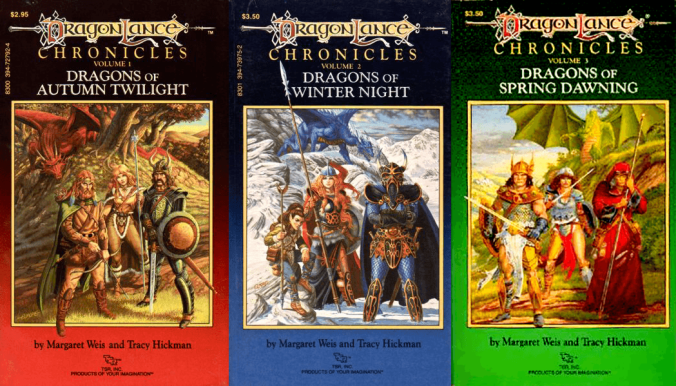
I’ve been feeling a little nostalgic lately, and for whatever reason, the Dragonlance novels have been standing out over the last few weeks.  So, what better way to scratch that itch then dig out your old book collection from when you were a kid and re-read said novels.  Yes, I still have books from when I was a kid tucked away in boxes in the attic…..mainly because we’ve run out of space in all our bookshelves in the house.

If you haven’t read the Dragonlance novels and want a great high fantasy novel to get lost in then I personally would recommend these.

Dragonlance Novels:
dragonlance-chronicles-books.png

History Behind The Books

The Dragonlance novels were based on a series of Dungeons & Dragons game modules. The books came about because the designers wanted novels to tell the story of the worlds they were creating.  After Tracy Hickman came to TSR it was announced that development was to happen on his series of dragons based role-playing adventures.  Hickman’s storyline was chosen for the Dragonlance books due to the twelve-part storyline.  Margaret Weis came into the picture as she was assigned to edit Hickmans “Project Overlord,” as it was initially called, a novel intended to be coordinated with a trilogy of Dungeon & Dragons modules.  The newly formed team plotted the novel and hired an author who didn’t work out.  By this time, Weis and Hickman were so into the project they felt they had to write it and the rest is history.

Breakdown of the Novels
9bb39109e3a6149a1f1e27e4fadc4bcfThe Dragonlance Chronicles were one of the first novel series I read that introduced my love for the world of fantasy.  The first novel series that I fell in love with of course was JRR Tolkien’s The Hobbit, and The Lord of the Rings.  The Dragonlance Chronicles holds a high place on my list though mainly because I was one of those role-playing geeks of the 80’s. 

Let’s take a look at the first book, Dragons of Autumn Twilight which has a strong character base but the first book does feel over the top at times.  What really stood out to me about the first book were the “Major” characters in the story, and there are a few that were very distinct.  Unfortunately, the story has some downsides and one major part is the characters seem lost, as does the navigation of the overall plot. But, as an introductory novel, it sets events in motion without giving anything away which is impressive to do no matter the genre.  The second and third novels develop completely different, which felt more organic and that the writers were given much more freedom with the plot.

Here’s what I like about the original Dragonlance Chronicles and what brought me back to read them once again:

  1. The novels continue to throw extremely creative scenarios and locations at you. Which keep the interest up while reading, as you gotta know what is coming up next.
  2. The authors did a fantastic job of balancing the character development, action, drama, and overall plot.
  3. The world of Krynn itself as the authors did an amazing job adding a level of mystery to the world which kept you wondering what’s next.
  4. The overall pace of the book is done quite well in story development, especially as you get into books 2 & 3.
  5. Ultimately the book is called Dragonlance…..so what better than the Dragon War and the evil queen that returns.

To me, these books are such a good mix of the Sword & Sorcery and the High Fantasy genres of the ’80s which I fell in love with at a young age so it’s hard not to like them.  How about you all, what are your thoughts on the Dragonlance Chronicles?  Have you read them?  Let me know in the comments below.

Creative Writing – What, How, Why of a Fantasy Novel

Writing a fantasy novel is great fun – you can literally let your imagination run wild.  It’s a little different when writing a novel set in the real world as unlike books set in reality where you can use real life as examples, you’ll have to invent everything in your new fantasy world.  Do you enjoy writing, are you working on a fantasy novel, or have you had the notion to start one?  I hope the next few minutes while reading this helps you no matter what stage you might be in for writing a novel.

One of the best things you could do to kickstart things is read as many classics as you can find!  No matter the type of book you begin writing this will give you a good idea about what works and what doesn’t.  Remember though that reading other peoples works is something to help with idea spawning and relax your mind.  You must take note not to simply copy the ideas you’ve read from any of the good old classics or other pieces of work you find.  If you find yourself dealing with elves, half-lings and orcs whilst being a reluctant hero on a quest to destroy a powerful item, it’s probably best to scrap it and start again. It is true that all stories are a combination of those the reader has encountered over the years. But, you should always try to find an original angle and it certainly should not be obvious what the source material was. Reading the classics will also allow you to discover how well-crafted characters interact with each other as the story progresses.

Tip 1. Use established myths and legends as the basis for your fantasy world. Think about what your fantasy world might be like.  Do your studying and find out what your world and culture is most like….Is it Celtic, Roman, a medieval world or a blend of multiple cultures with your own twist on it? Once you’ve chosen, go and read about the myths and legends that relate to those cultures. The mythological creatures and characters and their stories will give you a great basis for your new world.

Tip 2. Get to know your imaginary world – you need to be able to describe it in detail if you are going to convince your readers, for the duration of the book at least, that it exists. Be thorough and detail everything you can possibly imagine about the world you are creating.

  • Physical – what does your fantasy world look like? Think about and make a note of:
    • the colour of the sky
    • what other planets can be seen from the surface
    • whether the air is breathable
    • what the plants look like
    • what creatures live there
    • whether there are seas
    • what the landscape looks like
    • futuristic world or something older
  • Residents – decide who lives in your newly formed fantasy world. You should spend time thinking about how they look, what they eat, how they move, whether they need sleep, how they speak to one another etc…
  • Society – what kind of society exists? Do they need money to buy things? Is there a complex system of politics they follow? Do they have a police force, a king or president? Is there a religion?
  • Special powers/magic – Do the residents have any special powers or use magic? If so, what are they and why do they exist? Does everyone have use of them or only certain people?

Tip 3. Make your characters believable. This is one of the most essential parts of the book if you want to hook and keep readers interested in the story. A great way to achieve this is to apply logic to every character in every fantasy world you create. This means creating a set of rules that apply to the world and the character. The rules can be based on either real life or they can be simply invented by you.  Remember if you are creating the rules of the world, don’t let a BOX hold you back from being creative.  Sometimes creating our own ways is just the push we need to make that next step in our creative writing.

Tip 4. Make sure you keep careful notes of all the details you invent for your new fantasy world. This will help you maintain continuity throughout the novel. There are many ways of doing this, some writers like to have a set of cards with the details on, others set up spreadsheets; so play around with different systems to find one that suits you the best.  I personally use a book mapping chart I created in excel that helps me track all major parts of the book I need.  I hope these few steps help you get started, or give an idea of what steps to take next in writing your new fantasy novel!

Remember, have fun!! That is the first and foremost thing I can say when writing… Have Fun and lots of it!