 The One Ring Lost
The Disaster of the Gladden Fields was a battle at the beginning of the Third Age, in which Isildur and a group of acompanying Dunedain were attached by a large group of Orcs as they were marching home after defeating Sauron. The king and his three eldest sons Elendur, Aratan, and Ciryon were all slain and the Ring of Power was lost in the River Anduin. Only three men survived this battle, Ohtar being one of them, an esquire of the kings which was able to save the shards of Narsil.
With the death of Isildur, it impacted both Gondor and Arnor as it left both kingdoms seperated and isolated. Arnor wouldn’t be able to completely recover from this loss of it’s nobles and knights until the kingship of Aragorn in the Fourth Age. Most importantly, Isildur’s death prevented him from passing on the One Ring to the Keepers of the Three, which he had passed on to his brother Elendur to be his chief reason for visiting Elrond in Rivendell.
After the War of the Alliance, Isildur remained in Gondor for one year, taking back lost lands. He sent a large part of Arnor’s armies back to Eriador through the Fords of Isen to Fornost. After getting the affairs of the southern realm in order, he handed the South Kingdom over to Meneldil and marched to Rivendell. He chose to leave his wife and son at Rivendell, but also came for counsel from lord Elrond.
 The Battle Ground
The Dunedain traveled northwards from Lorien, marching along a path that led to Greenwood the Great where Thranduil ruled. They had to change routes due to the flooding of the Anduin, which led Isildur to take the road on the eastern banks of the river. Isildur’s party was flanked as the enemy used the steep cliffs overlooking the river.
The Dunedain sang cheerful songs but as the evening drew close they began to hear the orcs in the nearby forest. The first onslaught struck quickly so Isildur called for his esquire Ohtar to take the shards of Narsil back to Rivendell for safe keeping. The second attack from the orcs brought down the Numenorians great defenses, and Elendur convinced Isildur to flee and cross the Anduin if he could and find safety back at Rivendell.
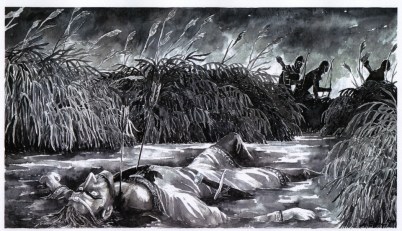
Isildur cloaked himself with the ring, and made a run for the valley parting ways with his armies and tried to cross the river. Unfortunately the rivers waters were flowing to hard and Isildur being exhausted got tangled in the reeds and in doing so the ring slipped from his finger. Nearby Orc’s caught sight of Isildur in the waters and out of fear quickly shot him and fled.
 Wake of Destruction
Only Ohtar, Elendur, Estelmo, and a handful of men survived the battle. Isildur’s body was never recovered, and was presumed captured and mutilated by Sauron’s forces The orc army that ambushed the Dunedain were scattered among the lands by a relief force but they were to late. Estelmo after being recovered spoke of how Isildur and Elendur related to each other about the One Ring. Isildur remarked: “I cannot use it. I dread the pain of touching it. And I have not yet found the strength to bend it to my will. It needs one greater than I know myself to be. My pride has fallen. It should go to the Keepers of the Three.”
Probably the biggest fall of the Gladden Fields was the union of Arnor and Gondor were broken by blood, and Isildur never managed to give the ring of power to the three. Elrond, Galadriel, and Celeborn if given the chance probably would have destroyed the ring of power long before Sauron would have gathered his spirit and refortified Mordor. But we all know how this story ends as Sauron does finally fall to the hands of many brave souls, and one very important little hobbit named Frodo.


 A Hobbits Journey