The Veylric Divide

Part II – When the Twilight Broke Itself
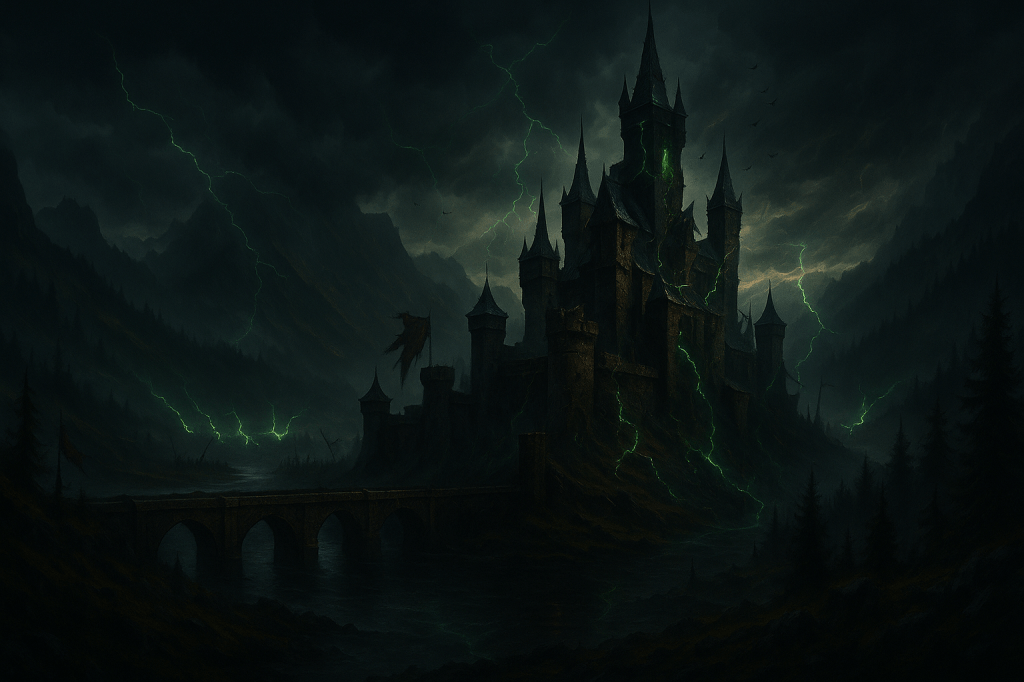
Great kingdoms rarely fall from the outside.
It is within—where whispers are sharper than swords—that ruin is born.


The Court of Shadows

At the height of its splendor, Noctharion was a realm of perfect balance.
Its citadels of obsidian rose like pillars between dawn and night, its banners of crimson and midnight mirrored both blood and storm.
The people of dusk held fast to their oath: to guard the borders between light and dark.

But within the heart of the Seventh Throne, a quieter battle began.

In the Great Hall of Eclipsera, torches burned blue within crystal sconces. Their glow fell across faces lined by suspicion rather than faith. Here sat the high lords and ladies of House Draemyr, once united by blood and purpose, now divided by philosophy.
What began as a debate of destiny became a fracture of the soul.

“We were meant to hold the line,” said one.
“We were meant to command it,” replied another.

The twilight that once shielded the realm had begun to turn upon itself.


Seeds of Pride

It was Lord Veyric Draemyr who first dared to voice what others only whispered.
He stood before the obsidian throne, its surface catching the torchlight like liquid night.

“Why should the dusk kneel before the dawn?” he asked.
“Do we not bear the weight while Gallandor basks in its own light?”

Many agreed in silence. Others, loyal to the old vows, shifted uneasily.
Among them was Prince Althar, his nephew, who saw in his uncle’s words not strength—but hunger.

That hunger spread faster than plague.


The Four Factions of the Divide

As the court split, so too did the kingdom’s spirit. Four banners were raised within the same walls:

1. The Iron Loyalists — those who clung to the oath of balance and defended Gallandor’s alliance, led by General Kaelor the Younger.
Their fortresses held the northern passes, still bearing the old sigil of the dusk-crown encircled by light.

2. The Shadowborn — Veyric’s followers, who claimed dusk was destiny, not duty.
They believed Noctharion should rule, not guard. Their emblem became the broken circle, a crown eclipsing the sun.

3. The Veiled Ones — scholars and seers who delved into forbidden magic.
They sought communion with powers beyond the Veil, believing knowledge itself could crown kings.
Among them, Lady Thalyss Draemyr whispered to mirrors and fire, learning tongues that had not been heard since the First Age.

4. The Betrayers — mercenaries and nobles who sold allegiance to whichever side promised them more.
It was they who opened the first gates in the walls and bartered secrets to unseen voices that spoke in dreams.

Each faction believed they alone carried the future of dusk.
Together, they forged the beginning of its end.


The Whisper of Ash

The dreams began soon after.
Lords woke with soot upon their palms. Priests heard hymns in reverse.
Children wept in sleep, saying a voice called from “beyond the mirror.”

That was the first sign of the Ash-Whisper—a disembodied promise echoing through obsidian halls.

“Why stand as the wall… when you might be the throne?”

It spoke differently to each heart.
To the proud, it promised dominion.
To the fearful, security.
To the grieving, resurrection.

And so began the quiet servitude of a people who believed they were free.


The Feast of Knives

On the eve of the Feast of Duskwatch, House Draemyr gathered to celebrate the old oaths of unity.
But unity was already ash.
Poison turned wine to black fire; daggers flashed in the candlelight.
By dawn, twenty-three nobles lay dead across the marble floors.
The banners of dusk were taken down and burned in the courtyards below.

That night, Lord Veyric Draemyr declared himself the True King of Twilight,
and the realm shuddered as the first civil war began.


The Siege of Veylric Hold

The Iron Loyalists gathered at Veylric Hold, the last fortress still sworn to Gallandor.
Its walls of basalt stood six hundred feet high, carved into the cliffs of the Dusk Sea.
But the Shadowborn came with fire.
Not the kind made by men—but by something older.

Veilfire.

The sky turned green. Shadows bled from the stone.
When the hold finally fell, the rivers ran black for seven days.
From that ruin, the Shadowborn built their new capital, Nareth Kûl, upon bones and cinders.
It would one day become the Black Spire.


The Legacy of Division

When the war at last ended, Noctharion no longer existed.
It was a realm of graves and ghosts.
The Draemyr name—once a banner of strength—became a curse.

From its ashes rose the prophecy that would one day echo through the Ash & Veil Chronicles:

“When the wall breaks itself, the ash will not need to knock.”


Behind the Writing

The Veylric Divide is the tragedy of pride made manifest.
Where Part I showed Noctharion’s majesty, this chapter reveals the poison in its veins.
I wanted the court politics to feel operatic—honor giving way to ego, loyalty to ideology, until even the stars seem to turn against them.

The Ash-Whisper introduces the Dread King’s earliest reach, a subtle infection rather than conquest.
From this moment on, every act of ambition across Eldoria traces its shadow back to this night of knives and green fire.


Until Next Time…

Next comes Part III — The Morghast Curse,
when the fractured soul of the Dread King returns through those who once believed they had destroyed him. The night has only begun to burn.
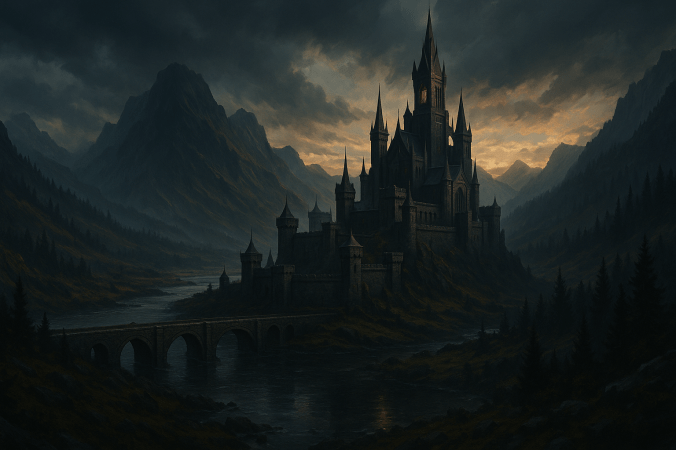
Noctharion, the Seventh Throne: Guardians of the Dusk

Part I — The Lost Kingdom of the Seventh House

Before Barakthûn was cursed, before the shadow consumed the land, there was Noctharion — the Seventh Throne.
It was not yet the Fallen Kingdom.
It was the Twilight Realm.

Where Gallandor gleamed with marble and sunlight, Noctharion stood in basalt and obsidian. Its skies were often storm-shrouded, its rivers deep and dark, its mountains black as iron. And yet, in this brooding beauty, there was majesty.

Noctharion was meant to be balance.
Where Gallandor raised banners of gold and white, Noctharion flew crimson and midnight.
Where Gallandor built temples to the Light, Noctharion raised citadels of endurance — fortresses meant to hold the line when others faltered.

They were not cruel, but they were proud.
Not shining, but steadfast.
Not joyous, but resolute.

It was dusk made kingdom.


The Twilight Realm

The Seventh Kingdom was carved from black stone cliffs, its fortresses rising like thorns against the horizon. Obsidian spires crowned its citadels, and basalt roads cut across the valleys like veins of shadow.

Its people believed themselves guardians of the dusk — the shield between the brilliance of Gallandor and the wild darkness beyond. They found beauty not in brightness, but in the strength to endure.

Among the Seven Thrones, they were the Iron Fist — the kingdom others trusted to hold the borders when the world trembled.


House Draemyr – The Twilight Bloodline

The rulers of Noctharion sat upon the Seventh Throne, proud and unyielding. The Draemyr line was famed for its fortress-lords, warrior-queens, and generals who shaped dusk into a weapon.

Ancestral Legacy

Valryon Draemyr – Founder of the line, called the Twilight Lord. Built the first obsidian citadels, declaring dusk as the shield between light and dark.

King Athelion DraemyrThe Stone Sentinel. Known for fortifying the borders of Eldoria with unbreakable bastions and commanding legions that never broke rank.

Queen Seranyth DraemyrThe Iron Rose. A warrior-queen who rode at the head of her armies and is said to have slain a giant alone at the Battle of Duskwatch.

Lord Malrec DraemyrThe Iron Voice. Famous for his uncompromising discipline and oratory; his decrees were said to echo across the mountains long after he was gone.

King Kaelor I DraemyrThe Shadowed Crown. Questioned why Noctharion should kneel beneath Gallandor’s light, planting the first seeds of ambition that would one day bloom into ruin.


The Later Line

Lord Veyric Draemyr – The most ambitious of his line. His reign marked the first whispers of division within the House, as branches of the family split between loyalty to Gallandor and hunger for power. His name would one day give rise to the Veylric Divide.

Lady Thalyss Draemyr – A courtly mastermind whose cunning words bent lords as surely as blades. Whispers claimed she courted shadows long before the kingdom itself fell to them.

Prince Althar Draemyr – The last heir before the fall into Morghast. A brilliant commander and tactician, but too proud to see the corruption seeping into his own bloodline.


Legacy of the Seventh Throne

The Draemyr dynasty embodied dusk — not light, not darkness, but the strength of the in-between. Yet within that strength grew a fatal flaw:
the belief that they should not guard the crown, but be the crown.

That flaw fractured their House, leaving it vulnerable to whispers of power and, eventually, to the corruption that would make Noctharion the seedbed of Barakthûn.


Themes of Noctharion

Majesty of Shadow – Beauty found in endurance, dusk, and storm.
Pride of Guardianship – The conviction that they alone were strong enough to defend Eldoria.
The First Cracks – Seeds of ambition, jealousy, and hunger for dominion that set them apart from Gallandor’s unity.


Behind the Writing

Noctharion was always meant to stand apart.
If Gallandor was the crown, Noctharion was the clenched fist.

Writing it as a kingdom of dusk and brooding beauty gave me the contrast I wanted against Gallandor’s marble light and Silvermoon’s starlit grace.

I wanted readers to feel the tragedy of it — that this kingdom wasn’t born wicked. It was noble, strong, even necessary. But nobility turned to ambition, and ambition turned to ruin.
To me, that makes the fall into Barakthûn all the more heartbreaking.


Until Next Time…

Noctharion is only the beginning of the Seventh Kingdom’s tale.

Next, we’ll explore The Veylric Divide — how ambition split House Draemyr, how whispers of power fractured their unity, and how the Twilight Realm began its slow descent into shadow.

If dusk can be corrupted… what hope then for the crown of day?

Ironclad: The Forgestone Kingdom

Every mountain in Eldoria has a voice, but only one roars with the sound of hammer and flame. Ironclad, the Forgestone Kingdom, is a realm where stone and fire meet, where bloodlines are tempered like steel, and where dwarves walk taller, prouder, and fiercer than any legend told in the halls of men.

Forged in the First Age, when Durak Forgestone united the mountain clans after the First Sundering, Ironclad has stood as the beating heart of dwarven resilience, the anvil upon which the fate of kingdoms is often struck.


The Realm of Ironclad

Ironclad lies in the Firepeak Mountains, its capital Stoneforge Keep carved into the roots of living rock. Great rune-lit halls stretch for miles, their walls veined with molten ore, their pillars engraved with the histories of clans long past.

The Great Anvil Hall, throne room, and forge combined, burn eternally with forge-fires, where kings sit not above their people but among their craft. When judgment is passed, it is done beneath hammer and flame.

The land above is harsh and winter-bound, forcing most of Ironclad’s people into the undercities. Caverns, bridges, and labyrinthine mines stretch beneath the mountains, where rivers of crystal and fire illuminate cities carved from shadow and stone.


House Brannok – The Forgestone Bloodline

Ironclad’s ruling house traces back to Durak Forgestone (Durak Brannok I), the founder-king who forged the Runeblade Ankar’dûm and bound the mountain clans into a single kingdom. His line became the Brannoks, known as the Forgestone Bloodline.

Ancestral Legacy

  • Durak Forgestone (Durak I) – Founder, first wielder of Ankar’dûm, united the clans.
  • King Brannok II “The Iron-Banner” – Rallied armies, established the Iron Banner of unity.
  • Princess Kaela Brannok – Founded the Emberguard, elite shieldmaidens who fight as queens’ protectors.
  • Queen Mara Brannok “The Flame-Tongue” – First queen to rule alone; her speeches stirred armies like wildfire.
  • Queen Veyra Brannok “The Steel Rose” – Legendary beauty and warrior, remembered in songs of both love and battle.

The Current Line

  • King Torvald Brannok – Broad-shouldered warrior-king, smith of renown, but heavy with the weight of tradition.
  • Queen Sigrid Brannok – Once commander of the Emberguard, famed for her beauty and battlefield ferocity.
  • Crown Prince Halrik Brannok – Strong heir, yet torn between duty and wanderlust.
  • Princess Kaelith Brannok – Striking, politically shrewd, whispered to be courted by Greenwood nobility.
  • Prince Dorn Brannok – Youngest, mischievous, and a genius of runecraft, underestimated by many.

The Brannoks embody Ironclad’s creed: to be both hammer and flame, builders and destroyers, bound to legacy and prophecy alike.


The Dwarves of Ironclad – Distinct and Reimagined

Ironclad dwarves are not the squat miners of old tales. They are taller, closer to human stature, but broader and denser in build, their frames carved by the forge.

  • Physique – Men stand between 5’2” and 5’10”, heavily muscled, with chiseled features. Women are striking, powerful, and renowned for their beauty as much as their strength.
  • Beards & Hair – Men keep shorter, braided beards; some are clean-shaven. Women wear elaborate braids to signify rank, lineage, or warrior vows.
  • Skin & Eyes – Tones of bronze, copper, obsidian, or pale silver-gray. Eyes glimmer like jewels or molten gold.
  • Culture – Family is sacred. Every child’s birth is recorded in stone tablets marked with destiny. Love is fierce, enduring, and sung in feasts that last weeks.

Warriors & Forge

Ironclad dwarves are unmatched in smithcraft and war:

  • Weapons – Rune-carved hammers, axes, and greatswords. Women favor twin axes or spear-shield formations.
  • Tactics – Shock infantry backed by rune-powered war machines. Their siege engines once brought down Malakaroth’s fortress walls.
  • Emberguard – Elite shieldmaidens, commanded by queens, as deadly as any male phalanx.

To fight as Ironclad is to see war not as bloodshed, but as sacred duty.


Role in History & Prophecy

Ironclad has long stood as a bulwark in the wars of Eldoria:

  • The First War – Their siegecraft helped end Malakaroth’s reign, bringing down the Dread King’s fortresses.
  • Alliances – Bound to Gallandor by marriage, their trade and smithing enriched the High Kingdom’s armies.
  • Prophecy – A verse hidden in the rune-archives declares:

“From fire and stone shall rise beauty and blood,
When the shadow returns, Ironclad shall stand —
Neither man nor elf, but forged in both.”

This prophecy speaks not only of their mixed stature and heritage, but of a destiny that ties Ironclad directly to the final war.


Strengths & Weaknesses

Strengths:

  • Supreme smithing and rune-magic craft.
  • Fearless warriors and shock infantry.
  • Emberguard’s unmatched shieldmaiden ranks.
  • Strong alliances with Gallandor and Greenwood.

Weaknesses:

  • Pride and ambition often cause clan feuds.
  • Vulnerable to betrayal from within.
  • Haunted by the prophecy — some fear it will undo them.

Behind the Writing

Ironclad began for me as a way to reimagine dwarves beyond their stereotypes. I wanted a people who weren’t bound to being “short, drunken miners,” but a race of warriors and smiths who carried themselves with the nobility of men and the fire of their mountain forges.

Designing Ironclad became a blend of myth and reinvention: taller dwarves, fierce shieldmaidens, a society where passion, tradition, and artistry burn as brightly as war. Their culture became not just one of survival, but of legacy — every name carved into stone, every weapon a story, every queen and king part of an unbroken chain.


Until Next Time…

Ironclad is the hammer of Eldoria, the forge where prophecy itself is tempered. But not all kingdoms remain whole.

Next, we descend into Barakthûn, the Fallen Kingdom, now a shadowed realm where crowns burn with green fire and the lands have been twisted by Malakaroth’s curses.

If Ironclad is the anvil of hope, Barakthûn is the echo of ruin.

What happens when fire that was meant to forge is turned to ash?

Durhaven: The Stone Bastion of Men

Every realm of Eldoria has its strength. Gallandor holds the crown, Stormhold rules the seas, and Silvermoon gazes at the stars. But Durhaven? Durhaven is the fortress of humanity itself — the kingdom that stands like a shield between the heartlands of Arathia and the encroaching dark.

Known as the Stone Bastion, Durhaven was born from resilience. Its people carved citadels into stone hills and valleys, its kings hammered law into discipline, and its armies have stood like iron walls against the storms of history.


The Capital of Durhold

At the heart of Durhaven lies Durhold, a mighty fortress-city of gray stone. Rising above the River Dur, its towers and battlements seem less built than grown from the very bones of the earth.

Durhold is not only a citadel but a thriving hub:

  • The Great Hall – seat of House Durain and the political heart of the kingdom.
  • The Market Quarter – bustling with farmers, smiths, and merchants who keep Durhaven alive through trade.
  • The Catacombs of Durhaven – vast, ancient tunnels beneath the city, once used to shelter the people during sieges. They now serve as ancestral tombs, reliquaries of relics, and chambers where whispers linger long after words are spoken.
  • The Chamber of Echoes – hidden deep in the catacombs, a sanctum where kings and queens meet in secret and oaths are bound by stone and silence.

Durhold is a city of strength and secrecy — open to the sun above, yet rooted in shadowed halls below.


House Durain – Guardians of Men

House Durain has ruled Durhaven since its founding, their line bound to stone as firmly as their fortresses.

  • King Alden Durain – A stern and pragmatic ruler, famed for his military genius and his mastery of fortifications. He is protector and strategist, forever wary of shadow and betrayal.
  • Queen Mara Durain – A woman of keen intellect and sharper diplomacy. Where Alden rules the battlefield, she rules the council, ensuring Durhaven’s stability through trade and reform.
  • Prince Darian Durain – Charismatic, courageous, and beloved by his people. But his love for Princess Elara of Silvermoon defied every boundary of blood and custom. Their forbidden union birthed Iogro and Searanore — half-human, half-elven twins, whose very existence ties Durhaven to prophecy itself.

House Durain embodies discipline and sacrifice. They see themselves as the shield of mankind, tasked with enduring what other kingdoms cannot.


Culture of Durhaven

The people of Durhaven are hardy and proud. They are farmers in fertile valleys, soldiers in stone keeps, and masons who build walls that endure for centuries.

  • Military Tradition – Durhaven commands one of the strongest human armies, with disciplined legions, armored cavalry, and master tacticians. Their engineers craft the finest siege engines in Eldoria.
  • Agriculture – The River Dur feeds sprawling farmlands, making Durhaven one of the breadbaskets of Arathia. Their food sustains allies and armies alike.
  • Architecture – Sturdy, austere, and enduring. Castles and villages alike are built with an eye toward survival, not ornament.
  • Values – Honor, loyalty, resilience, and discipline. They prize order above passion, duty above whim.

Yet this strength is also their weakness. Their suspicion of outsiders — especially of Elves and magic — has often set them at odds with Silvermoon and Greenwood.


Role in Prophecy

Durhaven’s place in the saga is as unshakable as its stone. It is the military bulwark of humanity, the kingdom that refuses to fall no matter the storm.

But through Prince Darian’s love for Elara of Silvermoon, Durhaven became bound to a destiny far larger than stone and steel. Their children, Iogro and Searanore, embody the unity of human and elf, north and south, discipline and dream.

The Chamber of Echoes and the catacombs beneath Durhold hold secrets yet to be revealed — relics, oaths, and truths that may decide whether prophecy is fulfilled or broken.


Durhaven’s Place in Eldoria

If Gallandor is the crown, and Stormhold the shield, Durhaven is the wall.

It is the stone that stands against shadow. The hammer that builds, the fortress that holds, and the oath that does not break.

But walls can crack. And when prophecy knocks at its gates — in the form of Iogro, Searanore, and the Brothers Three — Durhaven must decide whether to cling to its traditions or embrace the unity that may yet save the world.


Behind the Writing

Durhaven has always been my way of exploring the discipline and weight of humanity in fantasy storytelling. Where Gallandor is steeped in prophecy and Silvermoon in arcane wisdom, Durhaven is about endurance — the grit of men and women who hold the line, who may not always understand magic but who understand sacrifice.

When I first began shaping Durhaven, I wanted it to feel like a kingdom that could have existed in our own history — a place of legions, stone, and honor — but layered with fantasy depth. Its catacombs, its secret chambers, and its forbidden love story with Silvermoon gave it a personal connection to the saga that surprised even me as I wrote it.

Durhaven, for me, is not just about armies or walls. It’s about what humanity clings to when shadow presses in. It’s about oaths, family, and what happens when even stone must bend.


Until Next Time…

Durhaven is but one stone in the great wall of Eldoria’s kingdoms. Next, we will journey into Ironclad, the Stone Kingdom of the dwarves, where molten forges burn and runes are hammered into steel. After that, we will descend into the shadowed ruins of Barakthûn.

But here in Durhaven, the wall still holds. The legions still march. The oaths still bind.

If Durhaven falls, what wall will stand in its place?

Greenwood: The Sylvan Dominion

If Gallandor is the mountain and Silvermoon is the sky, then Greenwood is the earth itself. The third of Eldoria’s great kingdoms, Greenwood is not a land built of stone or crowned with towers. It is a realm grown — a living dominion of colossal trees, river-spirits, and druids bound to the heartbeat of the world.

To enter Greenwood is to pass beneath boughs that have stood since the Age of Ashes, where roots coil like serpents, where wolves of ember flame watch from the shadows, and where the very forest may rise in judgment. It is not merely a kingdom — it is a covenant with the land.


The Verdant Wilds

The Greenwood stretches across the heart of the Verdant Wilds, an endless forest where sunlight filters through golden canopies and rivers carve silver veins across the earth. But beneath its beauty lies power.

  • The Whispering Woods – Sentient groves said to carry voices of the dead. Travelers often hear names spoken on the wind.
  • The Golden Forest – Heart of Greenwood, its trees shine as if aflame at sunset, but their glow never fades.
  • Cursed Glades – Battlefields of the First Sundering, where shadows seeped into the soil. No flower grows there, and those who linger too long hear whispers urging them to despair.

The Greenwood is not a passive land. It remembers. It judges. And it does not forgive.


Thal’Emoras: The Living City

Hidden deep within the Golden Forest lies Thal’Emoras, Greenwood’s capital — a city not built, but sung into being.

Its halls are woven into the trunks of colossal golden-wood trees, spiraling upward in layers of vine-bridges and terraces lit by sap-lanterns. Roots form stairways, branches bend into arches, and flame-druids tend torches that burn with green fire, symbols of life and balance.

Notable Landmarks

  • The Rootspire – A monolith entwined with roots, believed to be where the first druids bound their lives to the land. Lady Myrialis guards it with unyielding zeal.
  • The Glade of Ancients – A circle of trees so vast their branches weave together like a temple roof. Here, oaths are sworn before the spirits.
  • Temple of the Verdant Eye – A sanctuary grown from a single tree, its heartwood glowing with emerald flame. Within, seers glimpse visions in fire and leaf.
  • The Golden Canopy – The highest level of Thal’Emoras, where the Queen’s council meets beneath branches that shimmer like captured sunlight, even in the blackest night.

Thal’Emoras is not merely a city — it is the forest dreaming in stone and song.


House Thalorien – Wardens of the Forest

The rulers of Greenwood are not kings in the manner of Gallandor or Silvermoon. They are wardens, chosen by both blood and the will of the land itself.

  • Warden-Queen Aerwyn Thalorien – Regal, fierce, and bonded to the Verdant Eye, she carries the Green Sight, hearing whispers of both past and future in the rustling of leaves. Her word is law, not because of crowns, but because the forest itself bows to her.
  • Prince Faelor Thalorien – Her only son, gifted with spirit-sight but brash and proud. He distrusts men, seeing them as destroyers of balance, and often rivals Iogro Merrybelly with open disdain.
  • Lady Myrialis – Aerwyn’s sister, Keeper of the Rootspire. A figure of dread and respect, more priestess than noble, who communes with spirits few dare approach.

House Thalorien traces its line back to Eldros the Verdant, the first druid to bind his soul to the Whispering Woods. They are less a dynasty than a covenant — the embodiment of Greenwood’s vow to protect balance at all costs.


The Culture of Greenwood

The Greenwood elves are distinct from their kin of Silvermoon:

  • Silvermoon → starlight, high magic, crystalline towers, scholars of fate.
  • Greenwood → roots, druids, torchlight, spirits, guardianship of balance.

Greenwood Traditions

  • Tree-Song Magic – Elves sing to shape living wood, raising bridges, halls, and even weapons from the forest itself.
  • Spirit-Binding – Some druids form lifelong pacts with river or beast, drawing strength from their bond.
  • The Ember Flame – Green fire that symbolizes balance; it is never allowed to extinguish within Thal’Emoras.
  • Shadowblending – Warriors slip into the forest’s essence, becoming one with shadow and green — perfect scouts and ambushers.

Their lives are not about dominion, but harmony. To Greenwood elves, to cut without blessing or to take without offering is blasphemy.


Greenwood in the Age of Ashes

During the First Sundering, Greenwood stood as the last barrier against Malakaroth’s eastern advance.

When the Dread King’s armies marched, Aerwyn’s ancestors called the forest to war:

  • Oaks tore their roots from the earth, crushing siege engines.
  • Wolves cloaked in emerald flame hunted cultists through the night.
  • Rivers rose in living torrents, drowning entire battalions.

The land itself fought beside Greenwood. But such power came with scars. There are glades that still bleed shadow, and rivers that whisper with voices of drowned soldiers. Greenwood carries those wounds like a crown — a reminder that balance must always be guarded, or it will shatter.


Prophecy in Greenwood

The druids believe the scars of the Brothers Three are not random. They say the Whispering Woods spoke of them long before their birth — three wounds upon the land, born as sons, who would either restore balance or break it forever.

Some claim the markings on their flesh mirror carvings found in the Rootspire itself. Others whisper that one of the Brothers is destined to fall, his death the price of balance.

Whatever the truth, Greenwood watches them with both hope and fear.


Songs of Greenwood

“Beneath the golden boughs we sing,
Of fire’s gift and shadow’s sting.
The forest wakes, the spirits cry,
Balance holds, or all will die.”


Behind the Writing

Greenwood has always been, for me, the “soul” of Eldoria. Where Gallandor is weight and vigilance, and Silvermoon is mysticism and prophecy, Greenwood is life itself. It’s the reminder that the world is not just kingdoms and crowns, but roots and rivers and spirits older than men or elves.

I wanted Greenwood to feel as dangerous as it feels beautiful. A kingdom you would long to see, yet fear to offend. A place where nature does not serve you — it tests you.

It also reflects my love for being outdoors, for forests that feel alive. Greenwood isn’t just a fantasy forest — it’s what forests feel like when you’re standing in them, listening to the wind and realizing you are very small.


Until Next Time…

Greenwood is the third of the Seven Kingdoms, and one of the most primal. In the weeks to come, we’ll sail the storm-lashed cliffs of Stormwatch, delve into the fiery forges of Ironclad, and walk the frozen halls of Durhaven.

But for now, we leave Greenwood — a realm of druids and spirits, where the forest itself remembers the Age of Ashes, and where balance is both gift and burden.