Part II – When the Twilight Broke Itself
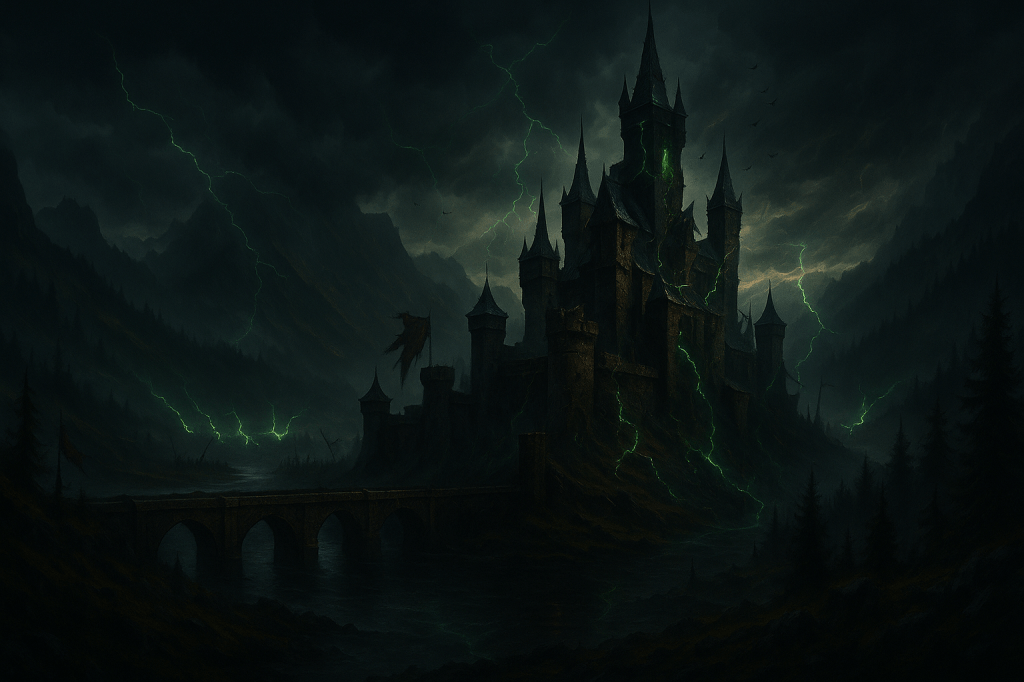
Great kingdoms rarely fall from the outside.
It is within—where whispers are sharper than swords—that ruin is born.
The Court of Shadows
At the height of its splendor, Noctharion was a realm of perfect balance.
Its citadels of obsidian rose like pillars between dawn and night, its banners of crimson and midnight mirrored both blood and storm.
The people of dusk held fast to their oath: to guard the borders between light and dark.
But within the heart of the Seventh Throne, a quieter battle began.
In the Great Hall of Eclipsera, torches burned blue within crystal sconces. Their glow fell across faces lined by suspicion rather than faith. Here sat the high lords and ladies of House Draemyr, once united by blood and purpose, now divided by philosophy.
What began as a debate of destiny became a fracture of the soul.
“We were meant to hold the line,” said one.
“We were meant to command it,” replied another.
The twilight that once shielded the realm had begun to turn upon itself.
Seeds of Pride
It was Lord Veyric Draemyr who first dared to voice what others only whispered.
He stood before the obsidian throne, its surface catching the torchlight like liquid night.
“Why should the dusk kneel before the dawn?” he asked.
“Do we not bear the weight while Gallandor basks in its own light?”
Many agreed in silence. Others, loyal to the old vows, shifted uneasily.
Among them was Prince Althar, his nephew, who saw in his uncle’s words not strength—but hunger.
That hunger spread faster than plague.
The Four Factions of the Divide
As the court split, so too did the kingdom’s spirit. Four banners were raised within the same walls:
1. The Iron Loyalists — those who clung to the oath of balance and defended Gallandor’s alliance, led by General Kaelor the Younger.
Their fortresses held the northern passes, still bearing the old sigil of the dusk-crown encircled by light.
2. The Shadowborn — Veyric’s followers, who claimed dusk was destiny, not duty.
They believed Noctharion should rule, not guard. Their emblem became the broken circle, a crown eclipsing the sun.
3. The Veiled Ones — scholars and seers who delved into forbidden magic.
They sought communion with powers beyond the Veil, believing knowledge itself could crown kings.
Among them, Lady Thalyss Draemyr whispered to mirrors and fire, learning tongues that had not been heard since the First Age.
4. The Betrayers — mercenaries and nobles who sold allegiance to whichever side promised them more.
It was they who opened the first gates in the walls and bartered secrets to unseen voices that spoke in dreams.
Each faction believed they alone carried the future of dusk.
Together, they forged the beginning of its end.
The Whisper of Ash
The dreams began soon after.
Lords woke with soot upon their palms. Priests heard hymns in reverse.
Children wept in sleep, saying a voice called from “beyond the mirror.”
That was the first sign of the Ash-Whisper—a disembodied promise echoing through obsidian halls.
“Why stand as the wall… when you might be the throne?”
It spoke differently to each heart.
To the proud, it promised dominion.
To the fearful, security.
To the grieving, resurrection.
And so began the quiet servitude of a people who believed they were free.
The Feast of Knives
On the eve of the Feast of Duskwatch, House Draemyr gathered to celebrate the old oaths of unity.
But unity was already ash.
Poison turned wine to black fire; daggers flashed in the candlelight.
By dawn, twenty-three nobles lay dead across the marble floors.
The banners of dusk were taken down and burned in the courtyards below.
That night, Lord Veyric Draemyr declared himself the True King of Twilight,
and the realm shuddered as the first civil war began.
The Siege of Veylric Hold
The Iron Loyalists gathered at Veylric Hold, the last fortress still sworn to Gallandor.
Its walls of basalt stood six hundred feet high, carved into the cliffs of the Dusk Sea.
But the Shadowborn came with fire.
Not the kind made by men—but by something older.
Veilfire.
The sky turned green. Shadows bled from the stone.
When the hold finally fell, the rivers ran black for seven days.
From that ruin, the Shadowborn built their new capital, Nareth Kûl, upon bones and cinders.
It would one day become the Black Spire.
The Legacy of Division
When the war at last ended, Noctharion no longer existed.
It was a realm of graves and ghosts.
The Draemyr name—once a banner of strength—became a curse.
From its ashes rose the prophecy that would one day echo through the Ash & Veil Chronicles:
“When the wall breaks itself, the ash will not need to knock.”
Behind the Writing
The Veylric Divide is the tragedy of pride made manifest.
Where Part I showed Noctharion’s majesty, this chapter reveals the poison in its veins.
I wanted the court politics to feel operatic—honor giving way to ego, loyalty to ideology, until even the stars seem to turn against them.
The Ash-Whisper introduces the Dread King’s earliest reach, a subtle infection rather than conquest.
From this moment on, every act of ambition across Eldoria traces its shadow back to this night of knives and green fire.
Until Next Time…
Next comes Part III — The Morghast Curse,
when the fractured soul of the Dread King returns through those who once believed they had destroyed him. The night has only begun to burn.
 A Hobbits Journey