 While some have looked down on fantasy fiction as derivative, poorly written or childish, the fact is that our oldest literature is fantasy fiction. From The Epic of Gilgamesh or the Odyssey, or one of my absolute favorites Beowulf! All of these stories that have survived the disappearance of ancient civilizations are stories of gods and magic and quests and monsters. It’s undeniable that fantasy is one of the most popular and favorite of many across all ages.
J.R.R. Tolkien is generally considered to be the father of modern English-language fantasy fiction for adults. There were fantasy novels written prior to Tolkien’s The Hobbit and Lord of the Rings, such as Lud In The Mist by Hope Mirrlees and The Worm Ouroboros by E.R. Eddison, but it was the commercial success of Tolkien’s work that kicked the modern genre into high gear.
Like every genre, fantasy is capable of producing fiction that is well-written and thoughtful with original characters, settings and plots. Modern classics such as the Earthsea series by Ursula K. LeGuin or Jack Vance’s Lyonesse series stand as proof that fantasy series can have wide appeal among readers of all ages and reading preferences. One of the biggest hits of today’s generation is, George R. R. Martin’s Song of Ice and Fire series which is wildly popular with critics, readers and viewers of the TV series adaptation, Game of Thrones.
Despite the success of G.R.R. Martin, some still argue that the last thing the fantasy genre needs is more long series of novels. However, this view does not appear to be shared by either readers or writers.
Writing A Series That Contributes Something New: A Few To-Do & Not To-Do’s
Read A Lot of Fantasy
This advice is sort of a cliché in itself, but something that is quite necessary in my opinion. If you are thinking about writing a fantasy series, then you are probably already well-acquainted with the genre, but you may only read a certain type of novel or a handful of authors.
Becoming familiar with the genre’s clichés and pitfalls means reading a lot of fantasy novels. This includes the good, the bad and the awful, and as you are reading think about the plot and what works, or doesn’t work. Read what is popular and what is critically acclaimed as the broader the scope of your reading, the better you will know what kinds of fantasy worlds and subtopics are still to be told.
In addition to reading contemporary writers, you should also read older fantasy. In part, this is important for understanding the history of the field, but it’s also important because it often provides insight on where clichés come from. When Tolkien penned the Lord of the Rings trilogy there was nothing cliché about elves and long quests and magic rings and using Northern European myth as the basis for a long fantasy series, but that is no longer the case.
Knowing the history of the fantasy genre and the realm you’ve decided to dive into will help you understand how to write a fantasy series. It also shows that elements of the fantasy genre that critics sometimes ridicule are not inherently bad but simply have been done 30 or 40 years ago and have been worn thin through overuse.
Forget The Big Guys
Tolkien, C.S Lewis, L. Frank Baum, and a countless number of others are the best the genre has ever known. They have in sorts cast a very heavy shadow across the field. Too many would-be and actual novelists who hope to follow these giants and their footsteps have shoddily constructed languages and maps and worlds and created thinly veiled versions of his characters. I myself have even been inspired by these authors, but it’s important you move away from big authors like this as to not get sucked into any overused work. Burly dwarves and angelic elves can be interesting, but if you use stock characters such as these, try incorporating them in an innovative way in your fantasy books.
Fantasy Traditions
Some writers feel that using the traditions of a culture that is not your own is a kind of appropriation, but we could say that about any genre of book if we take an honest look at the author’s inspiration. Drawing inspiration from the history, art, literature, and folk lore is just good practice for great idea churning! This does require a level of sensitivity and a lack of condescension, if you want to steer clear of possible backlash, but it’s quite possible to do without offending a culture or misusing these ideas.
Looking at a lot of culture and legends that have been used over the fantasy genre, you can look no further then Europe. Some people say it’s been overused in the modern fantasy but George R.R. Martin turned this so called overused idea into a fantasy classic with his Fire and Ice series. He chose a period of history that is largely overlooked and he approaches his novels as if they were historical fiction. Martin brings something fresh and rejuvenated even though his inspiration seems to come from a part of the world that has been reworked to death by fantasy novelists before him.
Stop When It’s Time to Stop
One of the biggest complaints about fantasy novels / series is they don’t end. At times the story is lacking depth and stretches to broadly across many books. Don’t overstay the book series welcome among the readers as they can quickly be burnt if you don’t know when to stop. Leaving the audience gritting for more is the best way to end a book as it’s way better then complaints rolling in about you needing to throw the pen away ages ago. Keep track of when you write, how long the series are running and what kind of feedback you get and it will make things much easier on when to stop writing vs. continuing something that’s not working.
How Do I Get Readers Hooked Across Story Arcs?
If you are looking at having multiple books then planning is key!!!
I can’t stress enough on how important it is to have the overall story arc planned out and tracked. Each book should be plotted out and each individual story arc should be tracked as well. You simply cannot write a three, five or even eight book series that sustains the necessary narrative drive and focus to keep readers interested without some idea of where the story is going. Planning also helps you avoid introducing subplots and characters in earlier books that go nowhere. Errors like this can be frustrating enough to make your reader put your books down halfway through the series and never return.
Your books must be self-contained to some degree as well. You must balance the progress of the overall arc along with the smaller arcs. Readers will easily become frustrated and may lay the book down if you move away from the main arc for an extended period. This becomes a fine balance of holding the readers attention and being able to switch between multiple stories through a books overall story arc. Different readers will naturally have some characters and story lines that interest them more than others, but you need to keep all of your story lines engaging enough to keep the reader turning pages. One way to do this is by writing emotionally-engaging characters. Another is to ensure that the main arc of the story is furthered through subplots.
Finally, one of the most important points to keep in mind is that writing a fantasy series is in many ways no different from writing a novel. You ultimately have to approach your series as though it is one very long novel. This can be very tough and challenging because you need a fully realized world that engages characters to inhabit, a plot that is going to draw readers in, and the mix of conflict / tension that will keep the readers turning pages for more.
Fantasy remains one of the most popular series among readers of all ages. Avoiding the pitfalls of clichés and planing a strong story arc that drives the story to completion and produces something readers will grab a hold of. Keeping the main story arc central is key throughout the novel series but avoiding the addition of too many subplots is that fine balance between readers being hooked, and dropping the book like a hot potato. Stay focused and have fun while you write which will help you move the story along.

 It’s hard to start writing a niche genre like fantasy when you’ve got the passion for it, but no idea where to start! Maybe you have an idea, but you’re afraid to take the first step because you’re afraid of failing. While the writing process is frustrating and yes, your story may not work out, but if you do your research and work hard, you will find yourself creating an unbelievable story with a world you can mold to your liking. It’s going to take a lot of patience, will-power to push through tough areas, and learning a few tips along the way from fellow writers.
 Blogging is a great outlet for writers who want to grow and connect with an audience or just to have an outlet for something you enjoy…”Writing”! This provides us a way to go in depth over a social media post, aka micro-blogging outlet like Twitter. I’ve enjoyed blogging for years and it’s given me a place to hangout with others in my little corner of cyber-space. If you’ve spent anytime at all blogging or writing, you know it can be tough and at times bring some stress with it.
 A Crooked Mile slaps us right in the middle of some pretty amazing and memorable moments to date in this game. Around every corner Telltale succeeds at introducing new characters in almost every scene which keeps the interest up, and brings some more light and story to characters we’ve only just seen a small glimpse of over the past two episodes. This episode drops some tough choices on you and some crazy consequences to boot, so overall this episode really gives you the feeling of being these characters and owning the story itself!
 Without going into many spoilers here, this episode brings us one of the biggest scenes to date. Watching Bigby finally bare his superpowers against an army of angry dwarfs is just a taste it seems of what you get to look forward to in future episodes. This incredible moment in the game lasted about as long as a blink of an eye, so the wait for episode 4 is going to be a nail biter for sure.
 As great as this episode was to play through I had a little beef in a couple of the scenes as they decided to cut before I had a chance to fully explore the surroundings. Both of these scenes were packed full of things to explore and items to discover, so one moment I’m happily exploring, the next I was sliding right over into the start of the next scene which was disappointing.
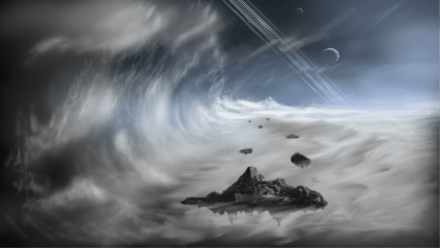 Long long ago, a rocky planet inhabited by the proto-Hive collided into a gas giant named Fundament and shattered. All of the rocky planet shards that were left scattered across the Fundament ocean, within one of of it’s many layers, and became “continents” in which the proto-Hive took refuge and lived out their existence. This vast world was filled with five hundred and eleven other intelligent species who also inhabited Fundament’s sea through seemingly similar circumstances. Surrounding Fundament and within it’s great orbit were fifty-two moons inhabited by a race called the Ammonites. The Ammonites were bony, six-armed cephalopods who evolved on an icy moon of Fundament. At some point, the Traveler arrived at the planet and became a patron of this race, who helped them build an advanced space travelling civilization with paracausal technology that spanned all of Fundament’s fifty-two moons. Deep beneath the Fundament ocean dwelled a massive creature called the Leviathan, a great disciple of the Traveler, and one who plays a larger part in this races existence, as it’s a gatekeeper for the darkness being imprisoned in the depths of Fundament.
 This world was filled with torment and a great fear of a catastrophic event called the “Syzygy” an artificially induced alignment of Fundament’s moons that would create a devastating global tidal wave, the “God-Wave” as the Ammonites called it. One kingdom of the Fundament Ocean was the Osmium Court, ruled by the Osmium King. When the King went mad out of fear of the “Syzygy”, Taox, the teacher of the King’s three daughters, invited the rival Helium Drinkers of the Helium Court to invade and install her on the Osmium Throne. The Helium Drinkers did so, but failed to kill the King’s three daughters: Aurash, Sathona, and Xi Ro. The sisters escaped on a ship, swearing an oath to avenge their father by overthrowing the Helium Drinkers and bringing revenge to their family by hunting down Taox.
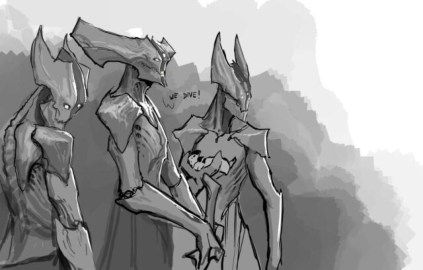 In just a few short years after the sisters transformed they took the Hive and conquered a large portion of Fundament’s surface population, reclaiming the Osmium Court and harrying Taox off-world. After building their first starships, the Hive followed Taox and encountered the Ammonite civilization that lived among the moons, as well as the Traveler. The Ammonites were far more advanced than anything on Fundament’s surface and were initially able to drive back the Hive’s attacks, especially as Auryx held the Hive back in the hope of achieving a peaceful resolution to the conflict. Savathun denounced her brothers weakness and killed her brother for his futile efforts of peace. The great Worms hidden in Fundaments depths then vested Auryx and his sisters with the power to defy death so long as they continued their conquest and fed their worms. Auryx returned to life and together he and his sisters defeated the Ammonites, killed the Leviathan, and forced the Traveler to flee.
 The second episode of Telltale’s The Wolf Among Us, titled Smoke and Mirrors, takes us to a whole new level of awesome! This masterpiece of a world that Telltale created is still bouncing with vibrant neon colors, but all the characters this go round are coming in shades of grey!
 Want some villians? Well, this episode has got plenty of them as they set the foundation for some really nasty ones who you will quickly love and hate all at the same time. SPOILER ALERT – One of the nasties in this game is named Georgie, a strip club owner and pimp with an absolute numbness to human dignity and need. No matter how you handle Bigby’s interaction with him, through understandable violence or forced restraint, the scene plays out great both ways. A few of the major decisions from Episode 1 also have some nice moments of payoff in Smoke and Mirrors. Particularly how you handled Belle lying to Beast and who you chose to chase out of the bar result in very different scenes that shape both the story and Bigby as a character.
 Overall The Wolf Among us series continues to bring moments of joy while playing, but at the same time tears away at the multitude of emotions while dealing with people. Sadness is something you see quite often in Bigby’s life as he is alone in this journey, or so he feels. You quickly learn that he has more allies then he realizes after meeting some of the other characters in this game. Telltale makes it more than worthwhile to go back and replay the episode as a complete maniac or a restrained reasonable person. This is really something I never wanted to do with any of the other adventure games Telltale has made, so good job for sucking me in even further Telltale.
 Fantasy is a fun genre of fiction that uses magic or other supernatural elements as a main plot element, theme, or setting. Many works within the genre take place in imaginary worlds where magic and magical creatures are common. Fantasy is generally set apart and crosses paths with science fiction and horror as they all three have sub-genres in the fiction world.
 The One Ring Lost
 The Battle Ground
 Wake of Destruction
 A Hobbits Journey