A Necromancer Above All Part Two

Sauron during the Second Age
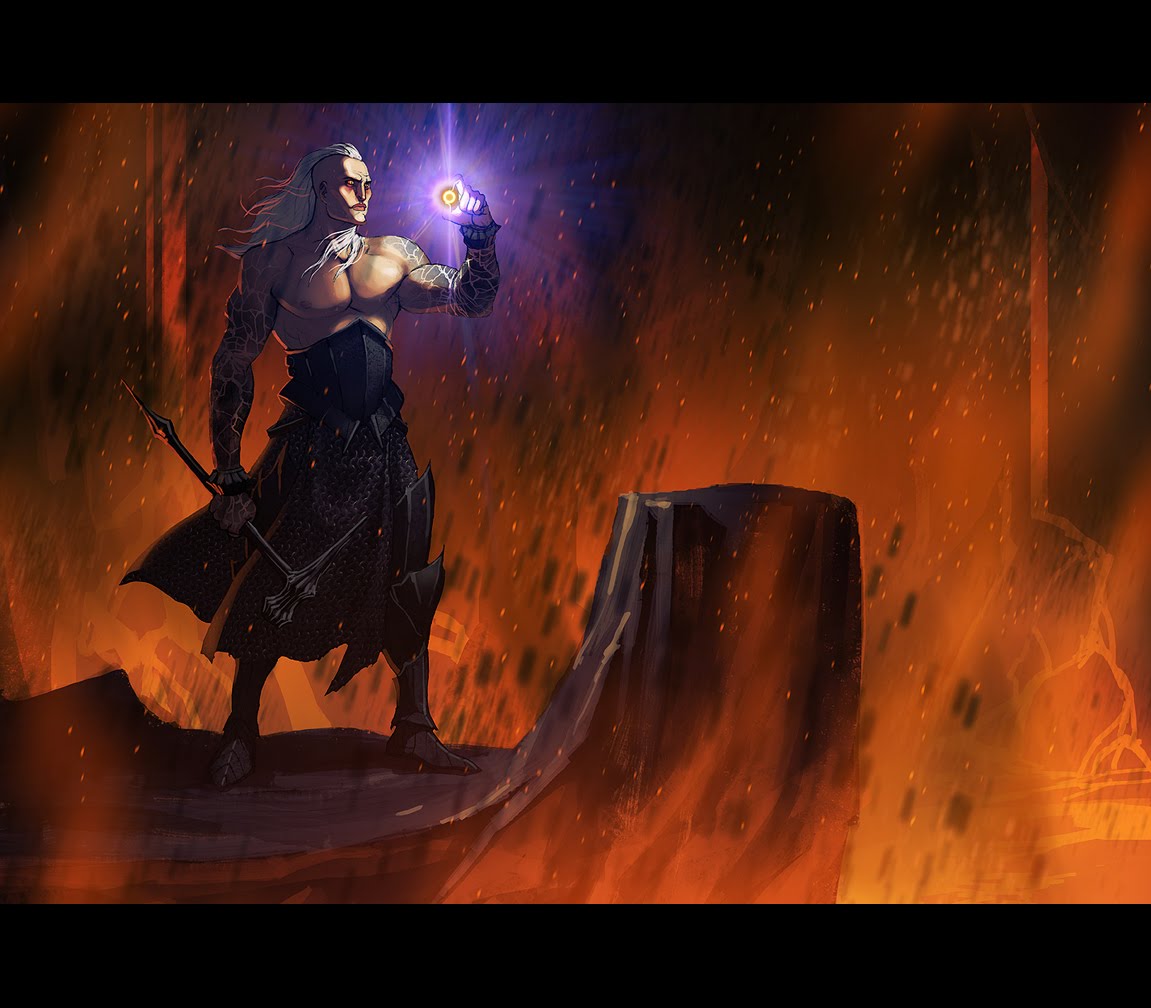
mattrhodes_sauronForging of the One Ring

“This is the Master-ring, the One Ring to rule them all. This is the One Ring that he lost many ages ago, to the great weakening of his power. He greatly desires it – but he must not get it.”

—Gandalf, The Lord of the Rings, “The Shadow of the Past”


sauron_by_spartank42-d502g9oSauron The Dark Lord’s hand of Power.

After lying hidden and dormant for 500 years, he began revealing himself once more, and by SA 1000 he gathered his power and established himself in the land of Mordor in eastern Middle-earth and began building the dreaded Dark Tower of Barad-dûr near Mount Doom. Sauron, like Morgoth, soon began raising massive armies of Orcs, Trolls, and possibly other creatures, as well as corrupting the hearts of Men with delusions of power and wealth, chiefly Easterlings and Southrons (the Haradrim).

Although Sauron knew that men were easier to sway, he sought to bring the Elves into his service, as they were far more powerful. By about SA 1500, Sauron put on a fair visage in the Second Age, and calling himself Annatar, the “Lord of Gifts”, he befriended the Elvish smiths of Eregion, and counseled them in arts and magic. Not all the Elves trusted him, particularly Lady Galadriel, Elrond, and Gil-galad, High King of the Ñoldor.


sauron__the_lord_of_the_rings_by_callthistragedy1-d5ru2gqSauron, wearing the One Ring.

To the elves who listened, Sauron gave knowledge and encouragement in forging the Rings of Power, though in secret Sauron forged his own, the One Ring, to rule the Elvish rings. Upon that ring Sauron left the inscription, Ash nazg durbatulûk, ash nazg gimbatul, ash nazg thrakatulûk, agh burzum-ishi krimpatul. In Westron the inscription translated into:One Ring to Rule Them All, One Ring to Find Them, One Ring to Bring Them All, and in the Darkness Bind Them.

However, as soon as Sauron put the Ring on his finger the Elves sensed his treachery, and removed their rings and hid them. Enraged, Sauron came against them in open war and demanded that all the Rings of Power be given to him. The Elves managed to hide the three greatest of the Rings from him, but the other sixteen Rings of Power were either captured by Sauron, destroyed, or lost. To the Dwarves he had given seven, but to Men he had given Nine, knowing that they would be the easiest to enslave. The Dwarf Lords who received the Rings proved to be very resistant to their power, and neither “faded” nor became enslaved to Sauron’s will. The Rings instead created in them an insatiable lust for gold, which ultimately caused a great deal of grief for the Dwarves.


horses_nazgul_artwork_jrr_tolkien_ring_wraiths_m58164The Corrupted Nine

As Sauron predicted however, the nine Men were all corrupted by their Rings and became the Nazgûl, Sauron’s deadliest servants. Had the Elves not recognized Sauron’s treachery and forsaken the power of their rings, the results would have been catastrophic for the Free Peoples of Middle-Earth. It seems that most if not all of the native Men of Middle-Earth succumbed to the power of the Ring once the Nazgûl were created; the Númenóreans were spared because of their distance. The Elves, had they been captured in this fashion, would have become the slaves of Sauron, and thus Celebrimbor’s resistance was of immense importance in the history of Middle-earth.

In this era, during which he marshalled and commanded great armies, Sauron became known as the Dark Lord of Mordor and his fortress of Barad-dûr was completed. He was very powerful even without control of the Elves, and he conquered nearly all of Middle-earth during the War of the Elves and Sauron. However, the armies of Númenór’s King Tar-Minastir were finally able to defeat him at a last battle near Gwathló or the Greyflood in SA 1700. Defeated but not vanquished, Sauron retreated back to Mordor and began recouping his strength over the many centuries.


NumenoreansThe Númenóreans

These Men lived on the island of Númenor in the sea between Middle-earth and Valinor. The Númenóreans, who were then proud, came to Middle-earth with astounding force of arms. King Ar-Pharazôn marched his troops all the way to Mordor without a single battle, and demanded that Sauron abase himself before the King. Sauron could see clearly that even the most powerful of his servants could not stand against the Númenóreans, and so came from Barad-dûr without any offer of battle. He assumed a fair form and flattered Ar-Pharazôn, but the King demanded that Sauron come back to Númenor as a hostage. Sauron feigned unhappiness at this development but secretly was delighted, for this presented him with an opportunity to destroy the Númenóreans from within. After only a few short years in Númenor he grew from captive to the King’s most trusted adviser, and nearly all the King’s court fawned upon him. Drawing on their fear of death, he converted many Númenóreans to the worship of Morgoth, lying that Morgoth had the power to save them from mortality. As his power and influence reached its peak, he raised a great Temple in which he performed human sacrifices to Morgoth. Finally, he convinced Ar-Pharazôn to rebel against the Valar and attack Valinor itself and claim it for himself.

But here, Sauron’s cunning overreached itself, for Eru then directly intervened – Númenor was drowned under the sea, and the great navy of Númenor was destroyed and the army that reached Aman was buried under mountains of falling rock and imprisoned in the Caves of the Forgotten. The world was bent, so that thereafter, only Elven-Ships could sail into the Utter West. Sauron’s body was destroyed, but his spirit was not diminished, and he fled back to Mordor bearing the Ring, where he slowly rebuilt a new body and his strength during the time known as the Dark Years. From this point on, he lost the ability to assume a fair shape, and ruled now through terror and force. A few faithful Númenóreans led by Elendil were saved from the flood, and they founded Gondor and Arnor in Middle-earth.
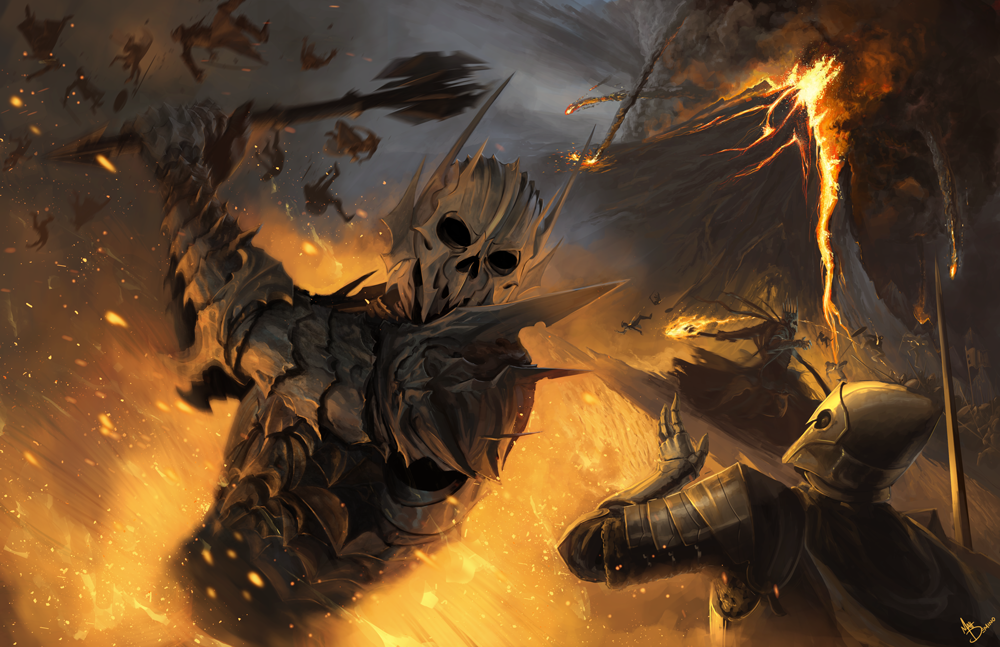
 

sauron__war_of_the_last_alliance_by_mattdemino-d5i799eSauron’s destruction in battle by Isildur

After losing his body in the destruction of Númenor and a brief period of renewed war, Elendil and his people allied with the Elven-king, Gil-Galad to create the Last Alliance, and together fought Sauron. They finally defeated his armies at the Battle of Dagorlad, and laid siege to Barad-dûr for seven years. Finally, Sauron himself came forth and dueled both Elendil and Gil-galad, slaying them both singlehandedly. Then Isildur, son of Elendil, took up his father’s broken sword, Narsil and cut the One Ring from Sauron’s finger. Sauron’s physical body was destroyed. With nearly all of his power stored in the ring, the dark lord was vanquished when it was cut from his finger. Without their leader’s dark will driving them on, Sauron’s armies were routed and fled, and thus, his campaign to defeat the free peoples was seemingly ended, and his greatest weapon taken from him.

But while Isildur had taken the ring, he could not bring himself to destroy it in the fires of Mount Doom where it was forged, instead he became corrupted by the One Ring and kept it for himself. He was eventually betrayed by it a few years later, and slain by orcs at Gladden Fields. The Ring fell into the river Anduin, and was lost for centuries before being found by Smeagol’s friend Deagol.

Until next week I’m Iogro Merrybelly signing off for the night.

Epic Quest Line Compendium

This Compendium is a high level overview of all the epic quests available to date.  I will be adding overtime detailed walk-through’s and video logs of each quest.  So check back for future updates.

Introduction

As you journey through Middle-Earth, your character shall have the opportunity to become a hero of Middle-Earth as you aid both the Fellowship and the Free Peoples with what is called the”Epic” quest line. This story is interwoven with J.R.R. Tolkien’s epic fantasy, both working alongside it – in a story created specifically for The Lord of the Rings Online – and crossing-over into it at important or interesting moments. After completing the first eight books of Volume 1, you will be granted the title A Light from the Shadow. Completing all Volume 1 books up to and including Book 15 will grant you the title Bearer of Hope. By finishing the first six books of Volume 2, the title Avenger of Khazad-dûm shall be awarded to you. Completing all of Volume 2 (up to and including Book 9) shall reward you with the title Stalwart against the Shadow.
Epic Introduction
Learn whether you have what it takes to become a hero of your race.

Volume I – The Shadows of Angmar
Prologue
Assist your homeland as dark forces threaten.
Book I – Stirrings in the Darkness
Help the Rangers protect Bree-land, as one of their own is turned against them.
Book II – The Red Maid
Assist Radagast the Brown in the Lone-lands.
Book III – The Council of the North
Aid Men, Elves and Dwarves in the North Downs so they can gather for a council.
Book IV – Chasing Shadows
Search for the missing Black Rider in the Trollshaws with the help of the sons of Elrond, then assist Legolas in finding the source of the uncovered evil.
Book V – The Last Refuge
Venture into the Misty Mountains and search for Skorgrím and the Black Rider with the assistance of Gloin and Gimli.
Book VI – The Fires in the North
Uncover the secrets of Angmar’s dreaded Watching Stones with the help of a Ranger in Aughaire.
Note: Completing this book will allow you to pass through Rammas Deluon [0.6S, 29.8W] without being instantly defeated.
Book VII – The Hidden Hope
Find the hidden Ranger refuge in northern Angmar and assist them in rescuing Golodir.
Note: Completing this book will get you the key to the gates of Carn Dûm.
Book VIII – The Scourge of the North
Rekindle Golodir’s hope and help him in an attempt to defeat Mordirith, the steward of Angmar in Carn Dûm.
Book IX – The Shores of Evendim
Uncover more about the mysterious Sara Oakheart while venturing to Barad Gúlaran.
Book X – The City of the Kings
Help the Dunedain in the battle for Annúminas against the Angmarim.
Book XI – Prisoner of the Free Peoples
Explore Tâl Bruinen in the Trollshaws while searching for Narchuil, the ring of Amarthiel.
Book XII – The Ashen Wastes
Rescue Laerdan and continue the search for Narchuil.
Book XIII – Doom of the Last-king
Attempt to locate the missing half of Narchuil in the frozen wastes of Forochel.
Book XIV – The Ring-forges of Eregion
Assist and then pursue Laerdan as he tries to rescue his daughter.
Book XV – Daughter of Strife
Help Narmeleth to prove her purification and to defeat Mordirith and Mordrambor once and for all.
Volume II – Mines of Moria
Prologue
Assist the Fellowship as they prepare to leave Rivendell in their quest to destroy the One Ring.
Book I – The Walls of Moria
Assist Bósi’s dwarvish expedition to clear the Hollin Gate and gain access to Moria.
Book II – Echoes in the Dark
Help the Iron Garrison expedition establish a first foothold within Moria.
Book III – The Lord of Moria
The dwarves are determined to retake their halls, perhaps too eagerly. They need your assistance.
Book IV – Fire and Water
The orcs strike back.
Book V – Drums in the Deep
Some force has allied itself with the orcs of Moria. Discover who/what it is.
Book VI – The Shadowy Abyss
You have made your way through Moria. The dwarves seek aid from Lothlórien and Galadriel.
Book VII – The Leaves of Lórien
Reunite with the Fellowship of the Ring and help forge an alliance between the Dwarves of Khâzad-dûm and the Elves of Lothlórien.
Book VIII – Scourge of Khazad-dûm
Return to Moria to thwart the evil influence of Dol Guldur.
Book IX – Fortress of the Nazgul
Join the Malledhrim as they prepare to assault Dol Guldur, the fortress of the Nazgul.
Epilogue – Of Elves and Dwarves
Volume III – Allies of the King
Prologue
Answer the call of Elrond Halfelven.
Book I – Oath of the Rangers
Travel throughout Eriador to gather the Grey Company.
Book II – Ride of the Grey Company
Assist the Rangers on the first leg of their journey south.
Book III – Echoes of the Dead
Discover more about the mysterious dwarf Nár.
Book IV – Rise of Isengard
Travel to Dunland, and uncover the influence of Saruman the Many-Coloured there. Aid the Grey Company in halting Saruman’s advances, ally or do battle with the tribal Dunlendings, and tread the valley of Nan Curunír; where the enemy fortress of Isengard looms.
Book V – The Prince of Rohan
The time has come to part ways with the Grey Company, who must soon begin the next leg of their journey. Your aid, however, is required at the Fords of the Isen: where Prince Théodred of the Mark is preparing to do battle against Saruman’s forces to secure the Gap of Rohan.
Book VI – Mists of Anduin
Seek the wisdom of the Lady Galadriel after experiencing troubling dreams, witness the return of Gandalf, now the White, and ride South past the Great River… towards Rohan.
Book VII – A Fellowship Endangered
The Fellowship of the Ring is in peril. At Galadriel’s behest, you must lead a fellowship of your own to discover their fate.
Book VIII – Into the Riddermark
You must pursue the Uruk-hai (and the Fellowship they endanger) across the plains of Rohan. To do that, you’re going to need a better horse…
Book IX – The Third Marshal
Ride with Éomer, the Third Marshal, to learn what became of the Uruk-hai, and what is to come for Rohan.
Book X – Snows of Wildermore
Investigate why contact has been lost with the region of Wildermore.

• Prior to Vol. III, Book 11 all epic quests are free to all players.
• Access to Books 11-13 requires the purchase of the Helm’s Deep expansion.

Book XI – The Golden Hall
Witness the return of Théoden King and help prepare his people for war against the White Hand.
Book XII – War in the Westemnet
Aid the people of West Rohan as the forces of Saruman ravage the land and treachery is found in unlikely places.
Book XIII – Helm’s Deep
Join the Rohirrim for their final stand at the fortress of the Hornburg, where the fate of Rohan will be decided.

The Shire

the-shireA Hobbits Home
In former times, Men were seldom seen there, though Dwarves often passed through the Shire as they travelled to the Blue Mountains from their lands in the East. More rarely still, Elves could sometimes be seen in the woods as they journeyed to Mithlond, the Grey Havens beyond the borders of the Shire, where they cross the Sea into the West.  Dark things seldom threatened the hills and meadows of the Shire. Largely this has been because hobbits are very good at keeping to their own business and not being noticed by others. But Little Folkwould be aghast and unbelieving if they only knew the lengths to which Gandalf the Grey and the Rangers of the North have gone to ensure the country’s peace. Now, though, even the Shire cannot escape the notice of the Shadow in the East.

The Lore
In the year 1601 of the Third Age, the Fallohide brothers Marcho and Blanco lead a group of Hobbits west from Bree and crossed the Bridge of Stonebows (later known as the Brandywine Bridge) and settled in the empty land they found. This became year 1 of the Shire-reckoning. King Argeleb II, the tenth King of Arthedain and a direct ancestor of Aragorn, granted the Hobbits this unused land and thus it became The Shire.

In III 2340 Hobbits expanded the Shire to include also Buckland and Brandy Hall was founded, though Buckland was never considered part of “the four farthings of the Shire”. Little is told about the history of the Shire, except for genealogical details about families, such as the Baggins, Brandybucks, Tooks, and many more. However…
In 22 September III 2890 Bilbo Baggins was born, and a few decades later his adventures would bring focus on the Shire. A fateful morning III 2941 an old bearded man with a blue pointed hat approached Bilbo and soon the Quest of Erebor begun, chiefly taking place in the far East. Eventually Bilbo brought back to Bag End treasures that greatly enriched hobbits all around the Shire, but one of the smaller items, a modest ring would also prove extremely hazardous, though not at once. In III 3001 Bilbo leaves the Shire and settles down in Rivendell, after giving the One Ring to Frodo.

the_hunt_for_gollum_2_by_tageloehner-d3bj86bIn III 3017 Gollum (the former owner of the One Ring) was released from Mordor, probably shortly after he had revealed “Baggins” and “Shire” for Sauron. The Shire was still innocently unaware that the Dark Lord soon would begin the War of the Ring and their farthings were at stake. In early April III 3018 Gandalf tells Frodo about the One Ring and its powers and hazards, urging him to leave the Shire promptly, though Frodo hesitated, he was slow and it took him more than five months to set out. In September 14 Frodo, Sam and Pippin set out from Bag End towards Crickhollow in Buckland (where Merry would join them on the quest).

The Shire was a fertile and well-tilled part of Arnor, but deserted during the waning days of the Kingdom when it was known as the splinter-realm of Arthedain; where the Shire was, it had been the hunting grounds of the King of Arnor. The Hobbits(who lived in Dunland and parts of depopulated Cardolan and Rhudaur) got official permission from King Argeleb II at Norbury (Fornost) to settle the lands. This was finally done in Third Age 1601 (Year 1 in Shire Reckoning) by Hobbits from Bree, led by the brothers Marcho and Blanco.

Frodo_of_the_Shire_by_NerahlaThe Shire was the homeland of the Hobbits. It was located in the northwest of Middle-earth, in the region of Eriador and within the Kingdom of Arnor, that is, while the kingdom existed. By the Third Age it was one of the few heavily-populated areas left in Eriador. Its name in Westron was Sûza”Shire” or Sûzat “The Shire”. Contrary to popular misconception, The Shire was not the birthplace of Frodo Baggins.  The Shire was settled by Hobbits in the year TA 1601 (Year 1 in Shire Reckoning). The Hobbits (who originally lived in the vale of Anduin) had migrated west over the Misty Mountains in the decades before, and before entering The Shire they had lived in Dunland and parts of the depopulated Arnorian splinter-realms Cardolan and Rhudaur. It has been speculated that the Hobbits had originally moved west to escape the evils of Mirkwood, and the trouble caused by the Easterlings.  The Shire was a part of Arthedain, and as such a part of Arnor. The Hobbits were granted official permission from King Argeleb II at Norbury (Fornost) to settle the Shire, which was not populated at the time, and seen as the King’s hunting grounds. The Hobbits considered themselves to be subjects of the King, and sent some support troops to the great battles Arnor fought against The Witch-king of Angmar. Tales claim that some Hobbit bowmen were involved at the Battle of Fornost, although no tales of it exsist in Men records. After the fall of Arnor, the Shire remained a small but independent entity.

Bilbo BagginsThe Shire During the Third Age
This peaceful situation changed after Bilbo Baggins’ acquisition of the One Ring in the year SR 1343 of the Shire Reckoning. Shortly after the first events that led to the War of the Ring (autumn of the year 1419 in Shire Reckoning), the Shire was first visited by the Nine Ringwraiths who went as far as Hobbiton, and then captured by Saruman. It was liberated with the help of Frodo, Sam, Merry and Pippin after the end of the Quest of the Ring. After Aragorn’s return as the King of Arnor and Gondor, the Shire became a protected enclave inside the Reunited Kingdom. He is known to have issued an order that forbade the entrance of full-sized Men into the Shire.

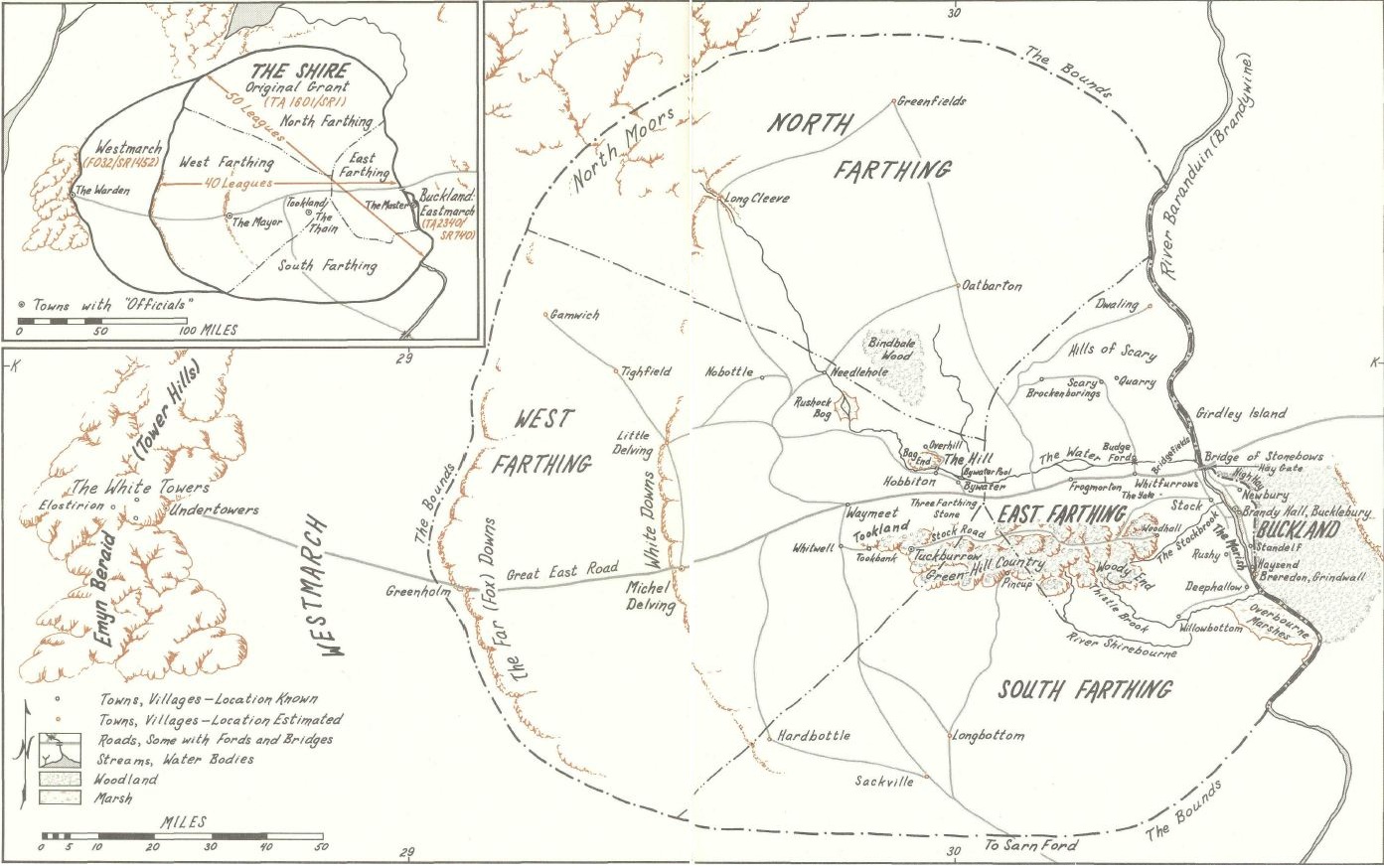
The Brandywine River (Baranduin) bound the Shire from the east. (Hobbits also lived in Buckland, which lay east of the river and west of the Hedge protecting the Shire from invasion from the Old Forest; however, Buckland was not formally recognised as part of The Shire until after the War of the Ring, when it was granted officially to The Shire by Aragorn II Elessar.) From the north and the west The Shire had no topographical borders, but rather was bounded by the ancient south and east roads, and by vague geographical features such as theTower Hills. The Shire was quite densely populated in parts with many villages and a few towns, but it still was open enough to allow for wide forested areas and marshes. The total amount of land calculated in square miles was 21,400 probably not including the Westmarch.

Map of The ShireThe Shire was originally divided in four Farthings (Northfarthing, Southfarthing, Eastfarthing, and Westfarthing), but Buckland and later the Westmarch were added to it. Within the Farthings there were some smaller, unofficial divisions such as family lands; nearly all the Tooks lived in or near Tuckborough, for instance. In many cases a Hobbit’s last name indicates where their family came from: Samwise Gamgee’s last name derived from Gamwich, where the family originated. Outside the Farthings, Buckland itself was named for the Oldbucks (later Brandybucks).  The Shire’s small size, relative lack of importance in terms of geographical position, natural resources, or even concerning hobbits themselves made it too modest an objective for conquest from the more dominant races of the East and South. More importantly, the Shire was guarded and protected by the Dúnedain Rangers, who patrolled the borders and kept out intruders, though Tolkien notes that many of the current hobbits of the Shire have grown so accustomed to this that they have forgotten their protectors altogether.
However the limited government of the Shire did hold its own voluntary police force known as Shirriffs that helped to keep the Shire safe, usually from trespassing beasts rather than from enemy forces. The only foreigners to enter the Shire were the Dwarves travelling on the Great Road that ran through the Shire to and from their mines in the Blue Mountains (Ered Luin), and the occasional elves on their way to the Grey Havens. Despite this, two battles were fought in the Shire, the Battle of Greenfields, and the Battle of Bywater. The Shire was also attacked by White Wolves in TA 2911 during the Fell Winter, prompting the use of the Horn-call of Buckland.

The Shire derived its laws from the authority of the King at Fornost. After Fornost fell and the last king died, the Hobbits appointed a Thain to continue the authority of the missing king. The title of Thain eventually passed to the head of the Took clan in Tuckborough. The Thain commanded an armed force during emergencies, but otherwise had only a symbolic role.  The Mayor of Michel Delving, elected once every seven years, became the most important official in the Shire. Most hobbits regarded Michel Delving as the principal town of the Shire, particularly with regard to its government. The Mayor was also the Postmaster and the First Shirriff for the whole Shire, so some called him the Mayor of the Shire.

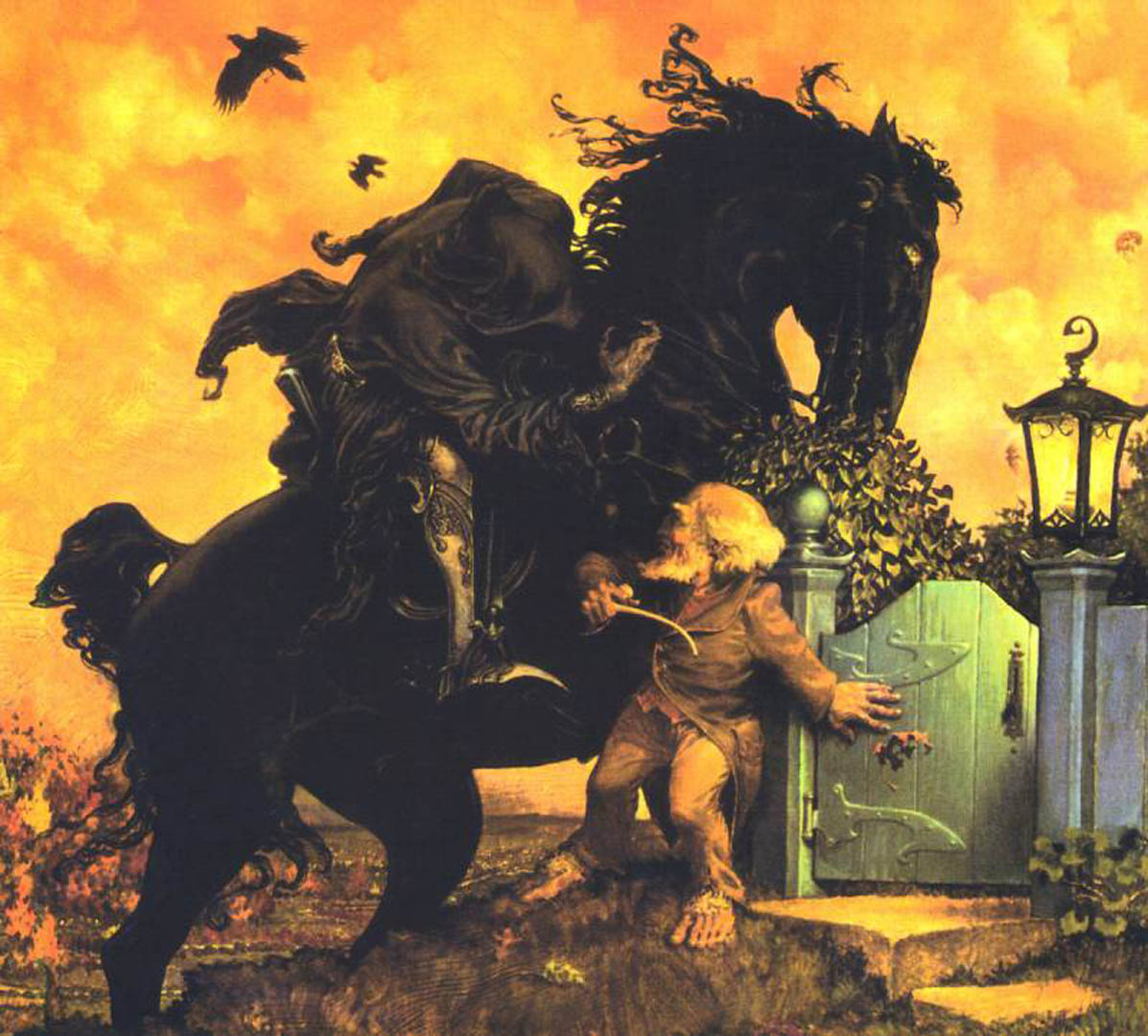
black-riders-in-the-shireThe Shire was a small but beautiful and fruitful land, beloved by its inhabitants. The Hobbits had an extensive agricultural system in the Shire, but did not proceed with industrialization. Various supplies could be found in the Shire, including cereals, fruit, wood and pipe-weed (a favourite treat of Hobbits). Its relatively peaceful existence during the perilous period preceding the defeat of Sauron can be attributed to the vigilance ofGandalf and Rangers of the North led by Aragorn who used daring tactics to keep evil at bay. However when these set out to a distant war, the Shire became essentially defenceless, which led to its capture. But the damage which Saruman caused by forced industrialization was undone by the Hobbits’ efforts. The Shire was restored with soil from Lórien, given to Sam by Galadriel. The year SR 1420 was called The Great Year of Plenty and was considered by the inhabitants of the Shire to be the most productive and prosperous year in their history.  The industrialization of the Shire was based on Tolkien’s witnessing of the extension of the Industrial Revolution to rural Warwickshire during his youth, and especially the deleterious consequences thereof. The rebellion of the hobbits and the restoration of the pre-industrial Shire may be interpreted as a prescription of voluntary simplicity as a remedy to the problems of modern society.

A Necromancer Above All

This weeks Bugle article takes a look into the background of Sauron.  This will be a four part series so keep your eyes pealed for the weeks to come.

Before the creation of Ea, Sauron was one of the countless Ainur spirits created by Eru Iluvatar, though at this time he was known as Mairon the Admirable, and partook in the Ainulindale, or Music of the Ainur. However, unlike many other spirits, Mairon did not align himself with Melkor upon the introduction of his discord themes, and thus, did not initially fall under his sway.  When the Music was completed, Mairon was one of the spirits who descended into Arda.

sauron_gorthaur the first ageSauron during the First Age

Upon his arrival in Arda, Mairon was one of the Maiar who aligned himself with Aulë the Smith, and learned much from him in the ways of forging and crafting, becoming a great craftsman, and mighty in the lore of Aule’s people. Although he was a Maia spirit, and not as mighty as the Valar, Mairon was one of the most powerful Maiar, being far stronger than others such as Olorin and Curunír (who was also a servant of Aule).
During this time, Mairon was as Eru had created him: good and uncorrupt. His greatest virtue was his love of order and perfection, disliking anything wasteful. However, this would also prove to be the source of his fall, for in the Dark Lord Morgoth, Mairon saw the will and power that would help him achieve his own goals and desires faster than if he had pursed them on his own. So great was his allegiance that even in later days, after Morgoth was defeated and locked outside the confines of the world, Sauron encouraged and coerced some Men to worship Morgoth as the one and true god. However, while Morgoth wanted to either control or destroy the very matter of Arda itself, Mairon’s desire was to dominate the minds and wills of its creatures.

After allying himself with Morgoth, Mairon maintained his appearance of being faithful to the Valar, but secretly fed Morgoth information about their dealings. It was only when Morgoth established his strongholds in Middle-Earth that Sauron left the Blessed Realms and openly declared his allegiance, and ever after remained a foe of the Valar and the Free Peoples of Middle Earth. TheSindar in Beleriand called him “Gorthaur” (“Dread Abomination”), and the Noldor, “Sauron” (“The Abhorred” or ‘The Abominable”–a mockery of his original name) At first, he was a spy for Morgoth, telling him of the Valar’s doings.

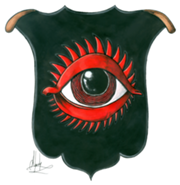
Saurons BannerSauron bears a coat of arms that is black charged with a red eye. An interesting dichotomy is set up between his deceptive nature and his symbol. While rarely appearing personally and deceiving all but the most wary, he represented himself as an all seeing eye that could pierce all disguises.

During the First Age, the Noldorin Elves left the Blessed Realm of Valinor in the Utter West (against the counsel of the Valar) in order to wage war on Morgoth, who had stolen the Silmarils of Fëanor, enchanted gems that glowed with light from the now-destroyed Trees of Valinor. In that war, Sauron was counted as the “greatest of [Morgoth’s] servants that have names” (Valaquenta). He was soon feared as a lord of terrible phantoms and dreadful beasts–a shape shifter, sorcerer, and a cunning servant of his dark master.

Draughlin First Warewolf

After his defeat by Lúthien, Sauron played little part in the events of the First Age (possibly hiding from Morgoth’s wrath), and after his master was defeated and taken to Valinor in chains, Sauron seemed to repent and pled to Eönwë and the victorious Host of the West for mercy. Although his plea was probably genuine, Sauron was unwilling to return to the Utter West for judgment, and so he fled and hid somewhere in Middle-earth.

Next week we will take a look into Sauron during the Second Age.  Until then, I’m Iogro Merrybelly signing off for the evening.